
During a distributed office security review, a Falcon Cloud Security Cloud Infrastructure Entitlement Management (CIEM) finding flags a non-production microservice role that holds read permissions for the cloud secrets manager across all environments. Why should the analyst prioritize tightening this permission?
Select an answer to reveal the explanation.
Short Explanation
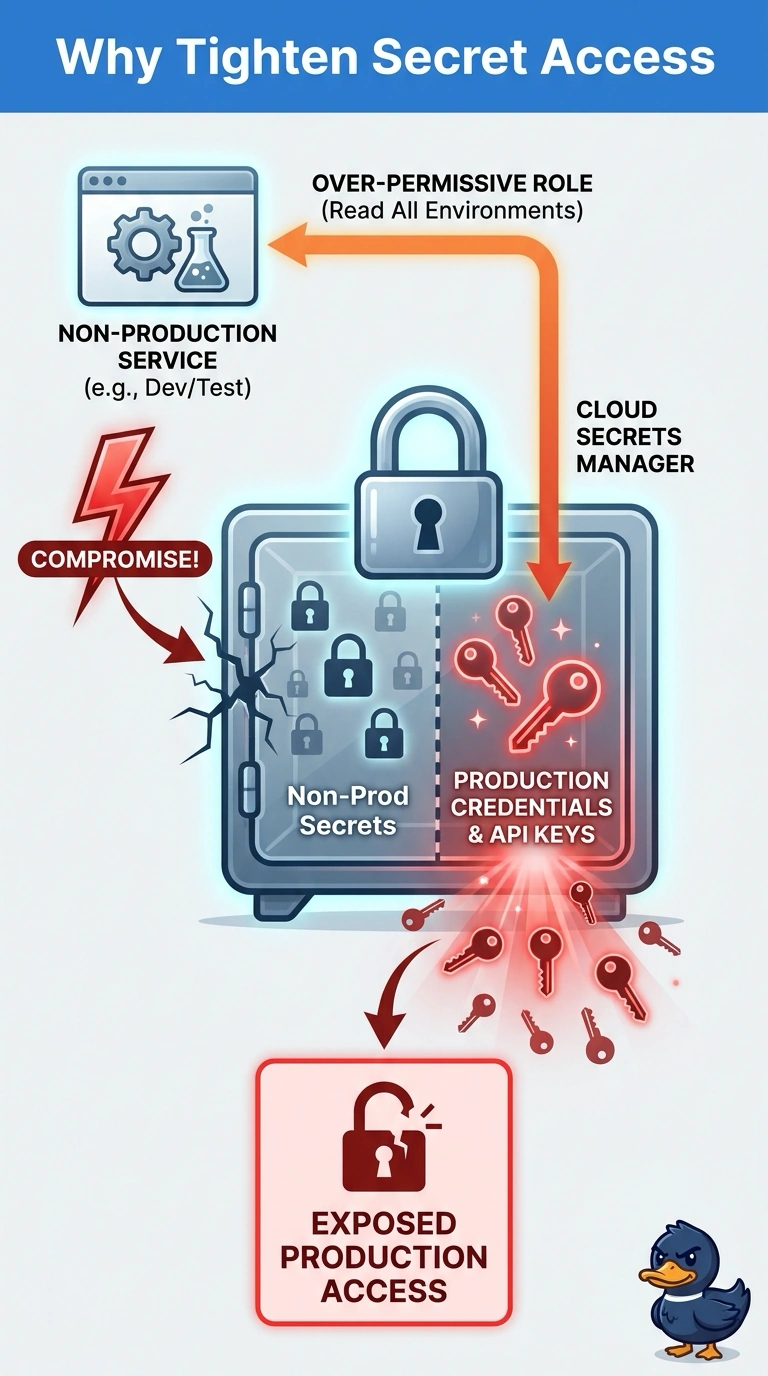
Giving a staging app the master key to every safe in the company turns a minor break-in into a full-scale breach. The trap is treating non-production identity findings as low priority just because the workload itself is not customer-facing. You should scope secrets-manager permissions strictly to each environment so a staging compromise cannot reach production credentials.
Full Explanation
Non-production environments often have looser operational controls, making their service roles attractive stepping stones for lateral movement. Because Compromise of the non-production service could expose production credentials and API keys, CIEM findings showing cross-environment secrets-manager access represent high-impact identity risk that must be narrowed to least privilege. Claiming Secrets manager read permissions automatically disable Falcon sensor runtime protection on VMs is incorrect because cloud IAM policies do not turn off host-level security sensors. Assuming Read permissions on a secrets manager prevent pre-runtime image assessment from scanning registries fails because registry image scanning uses its own configured pull credentials rather than application workload roles. Saying Holding secrets manager permissions forces Kubernetes admission controllers into alert-only mode is wrong because admission policy enforcement modes are configured in Falcon Cloud Security, not controlled by application IAM roles. Caveat: narrowing a shared service role may break legitimate cross-environment deployment scripts if they rely on that same identity, so separate non-production and production roles first. As an operational check, review cloud audit logs for secrets-manager read events by that role before scoping its policy to non-production resources only.
Prefer to study offline? Printable PDF study book + test engine ($7.50, unofficial). These questions stay free here.