
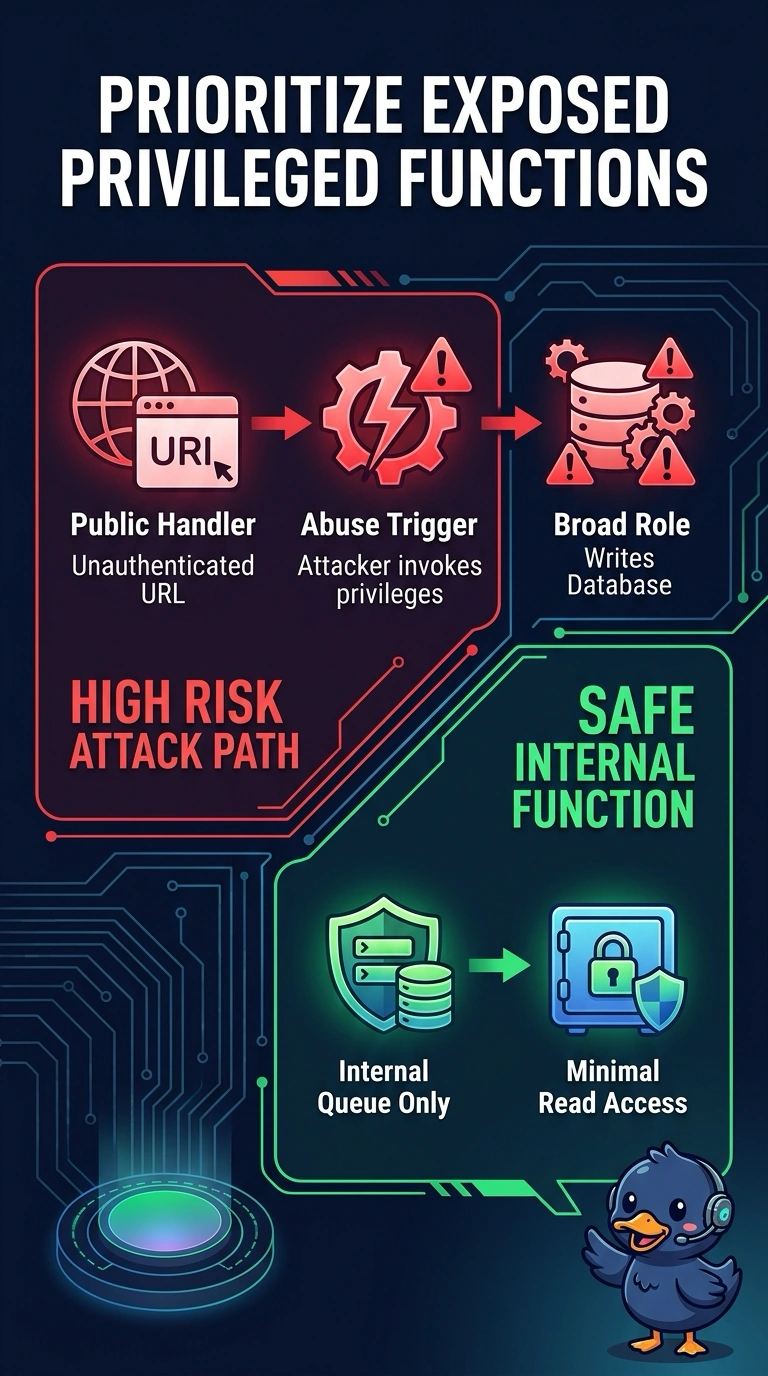
A retail cloud security analyst reviews two Falcon Cloud Security findings for serverless functions in the same cloud account: Function A is triggered only by an internal queue with minimal read permissions, while Function B has an unauthenticated public HTTP endpoint and an execution role with broad database write access. Why should the analyst prioritize Function B first?
Select an answer to reveal the explanation.
Short Explanation
An unlocked front door matters most when it leads straight into the vault, and you want to close that path before tidying the back room. The trap is treating every serverless finding as equal severity instead of prioritizing the combination of external reachability and excessive permissions.
Full Explanation
Risk prioritization in Falcon Cloud Security focuses on attack paths where network exposure amplifies excessive identity permissions, meaning Its public unauthenticated handler and broad execution role create a potential attack path if handler abuse or a vulnerability permits use of those backend privileges. A public invocation URL alone does not hand out execution-role credentials, but if an attacker abuses the handler logic or exploits a vulnerability, the function can then act with its broad database write privileges to tamper with or destroy data. The claim that Serverless functions with public HTTP endpoints cannot be evaluated by cloud posture or identity checks is false because agentless posture and entitlement analysis inspect both endpoint exposure and attached IAM roles. Likewise, the idea that Internal message queues automatically encrypt all payloads, eliminating any risk of lateral movement inside the account is wrong because transport encryption does not stop a compromised upstream producer from abusing a queued function. The idea that Cloud execution roles attached to queue-triggered functions are excluded from Cloud Infrastructure Entitlement Management is inaccurate because CIEM evaluates service roles regardless of trigger type. As a caveat, Function A should still be reviewed later to ensure its queue access policy remains restricted. For an operational check, correlate the exposed-asset finding on Function B with its effective CIEM permissions to confirm which database actions can be removed.
Prefer to study offline? Printable PDF study book + test engine ($7.50, unofficial). These questions stay free here.