
A software platform team is designing its Kubernetes security architecture and debates whether to embed the Falcon sensor inside every microservice container image or deploy it via a DaemonSet. Why is the node-level DaemonSet approach recommended?
Select an answer to reveal the explanation.
Short Explanation
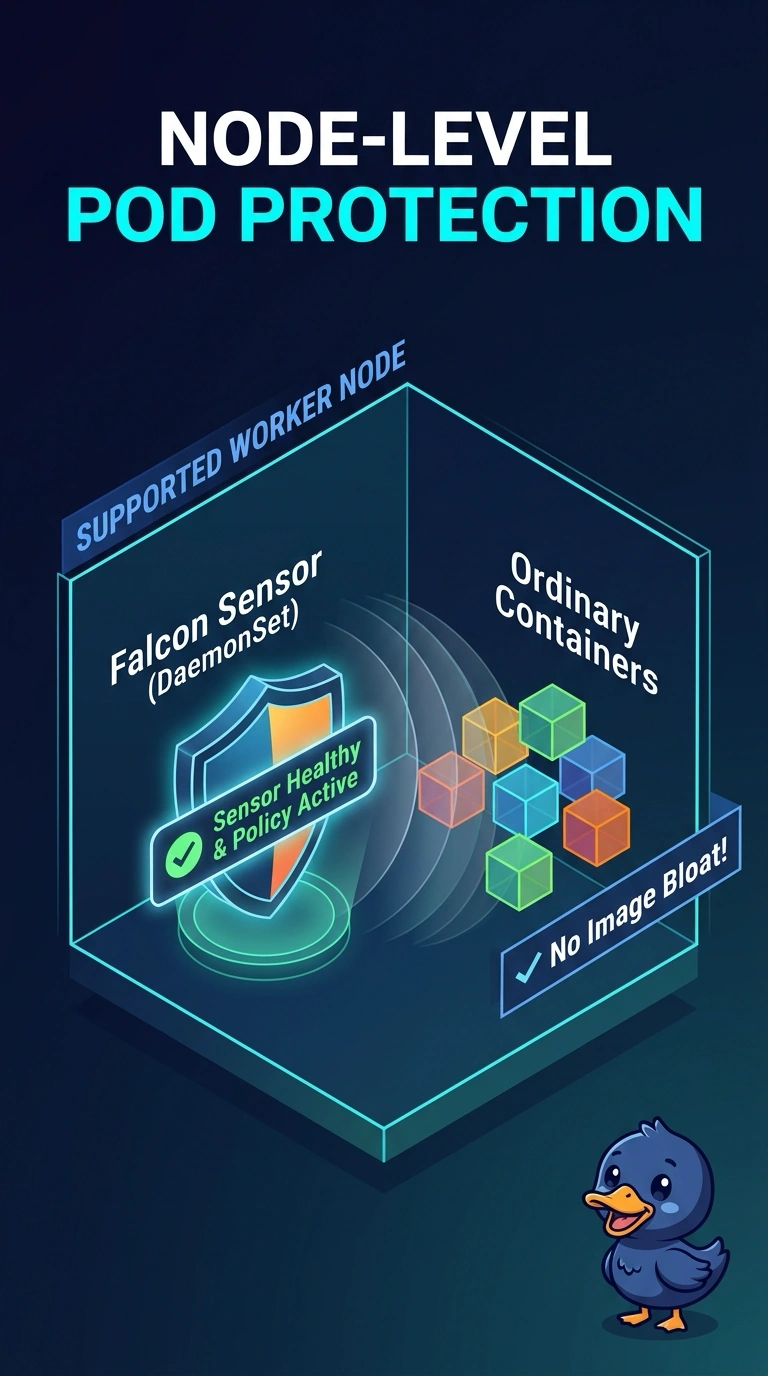
Think of a node-level DaemonSet like a building's shared security system rather than trying to make every tenant do their own background checks. The trap is assuming a runtime DaemonSet also patches application libraries or replaces pre-runtime scanning. You gain runtime protection for supported ordinary containers on eligible supported nodes, with the sensor healthy and appropriate policy active, while keeping your microservice images lean.
Full Explanation
In Kubernetes, containers on a worker node share the host kernel, allowing a single privileged sensor pod per node to observe process, file, and network activity, though this visibility is not a guarantee for every sandboxed/VM-isolated runtime, node OS or serverless workload. Choosing the design where A DaemonSet protects supported ordinary containers on eligible supported nodes, with the sensor healthy and appropriate policy active, without bloating application container images ensures automatic runtime coverage as pods scale while keeping security tooling decoupled from builds. Believing A DaemonSet automatically patches vulnerable open-source libraries inside running containers is incorrect because the sensor monitors and blocks malicious runtime behavior rather than modifying installed packages. Claiming A DaemonSet replaces the need for pre-runtime image assessment in the CI/CD pipeline fails because runtime sensors do not stop vulnerable images from being built and pushed to registries. Assuming A DaemonSet evaluates cloud storage bucket encryption settings across the entire account is wrong because cloud control-plane auditing is handled by agentless posture management, not node sensors. Caveat: managed serverless platforms without accessible nodes may require container-level deployment instead of a DaemonSet. As an operational check, verify one healthy sensor pod on eligible supported nodes, including newly added supported node pools.
Prefer to study offline? Printable PDF study book + test engine ($7.50, unofficial). These questions stay free here.