
A retail cloud architect is reviewing the cross-account IAM trust policy generated for registering an AWS account in Falcon Cloud Security. Why does the trust policy require a unique external ID condition?
Select an answer to reveal the explanation.
Short Explanation
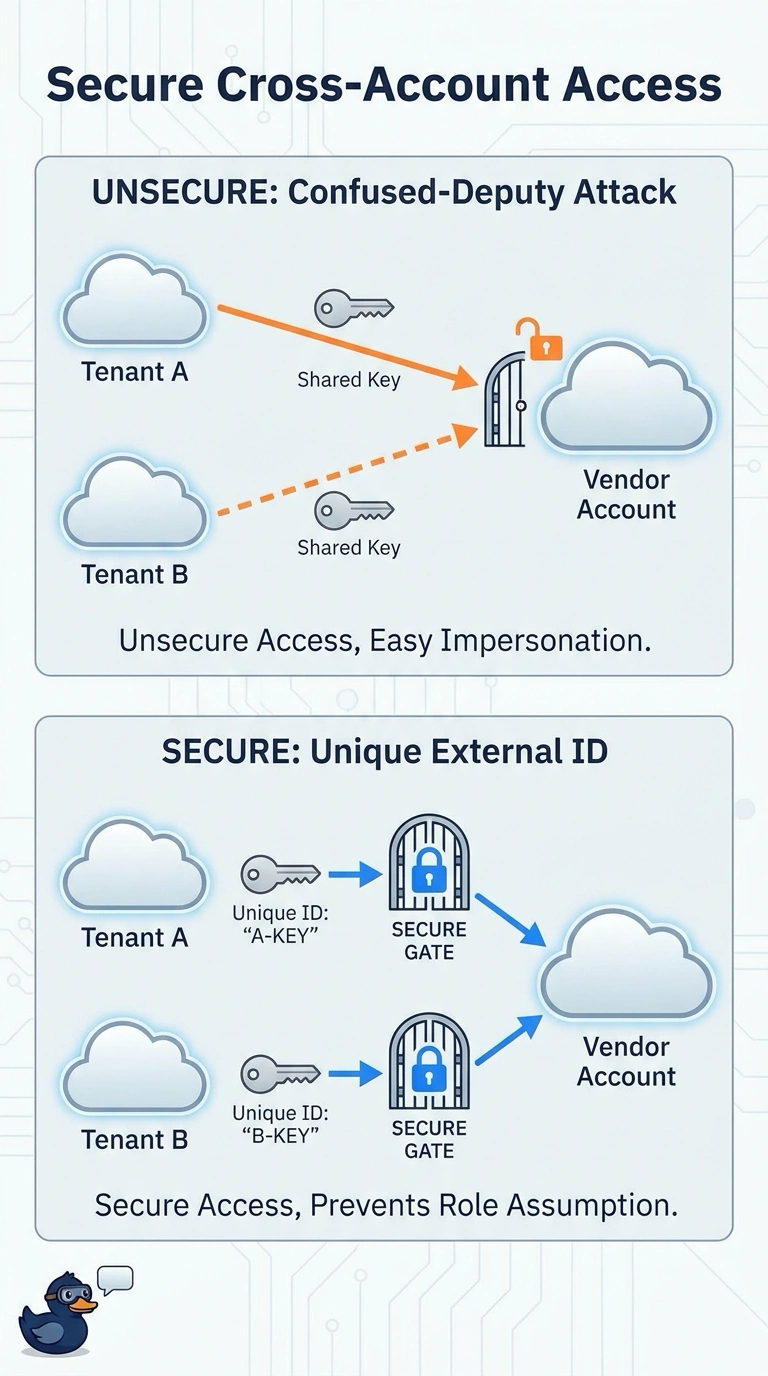
A service-generated customer/registration discriminator checked in the trust condition; it is not a password or secret. Without it, another tenant could trick the shared service into assuming your role when you onboard. The trap is mistaking this trust-policy safeguard for encryption, remediation permissions, or a policy bypass.
Full Explanation
Cross-account onboarding relies on a shared cloud security service principal assuming an IAM role in the customer account, so the trust policy uses a unique external ID for one clear purpose: "To prevent unauthorized cross-tenant role assumption in confused-deputy attacks." A service-generated customer/registration discriminator checked in the trust condition; it is not a password or secret. AWS evaluates the caller/trust/condition, while the provider must correctly associate the ID with the customer, which mitigates the third-party confused-deputy problem without implying the ID itself authenticates a human tenant. "To encrypt posture scan telemetry transmitted back to the Falcon platform" is incorrect because transport encryption relies on TLS rather than an IAM trust condition. "To grant the onboarding role write permissions for automated remediation" fails because trust policies govern who may assume a role, whereas attached permission policies define allowed actions. "To bypass organization-level service control policies during initial account discovery" is wrong because organization guardrails still restrict every role regardless of trust conditions. As a caveat, editing the external ID manually without updating the registration breaks posture scanning. As an operational check, confirm the trust policy's external ID matches the value in your Falcon registration record.
Prefer to study offline? Printable PDF study book + test engine ($7.50, unofficial). These questions stay free here.