
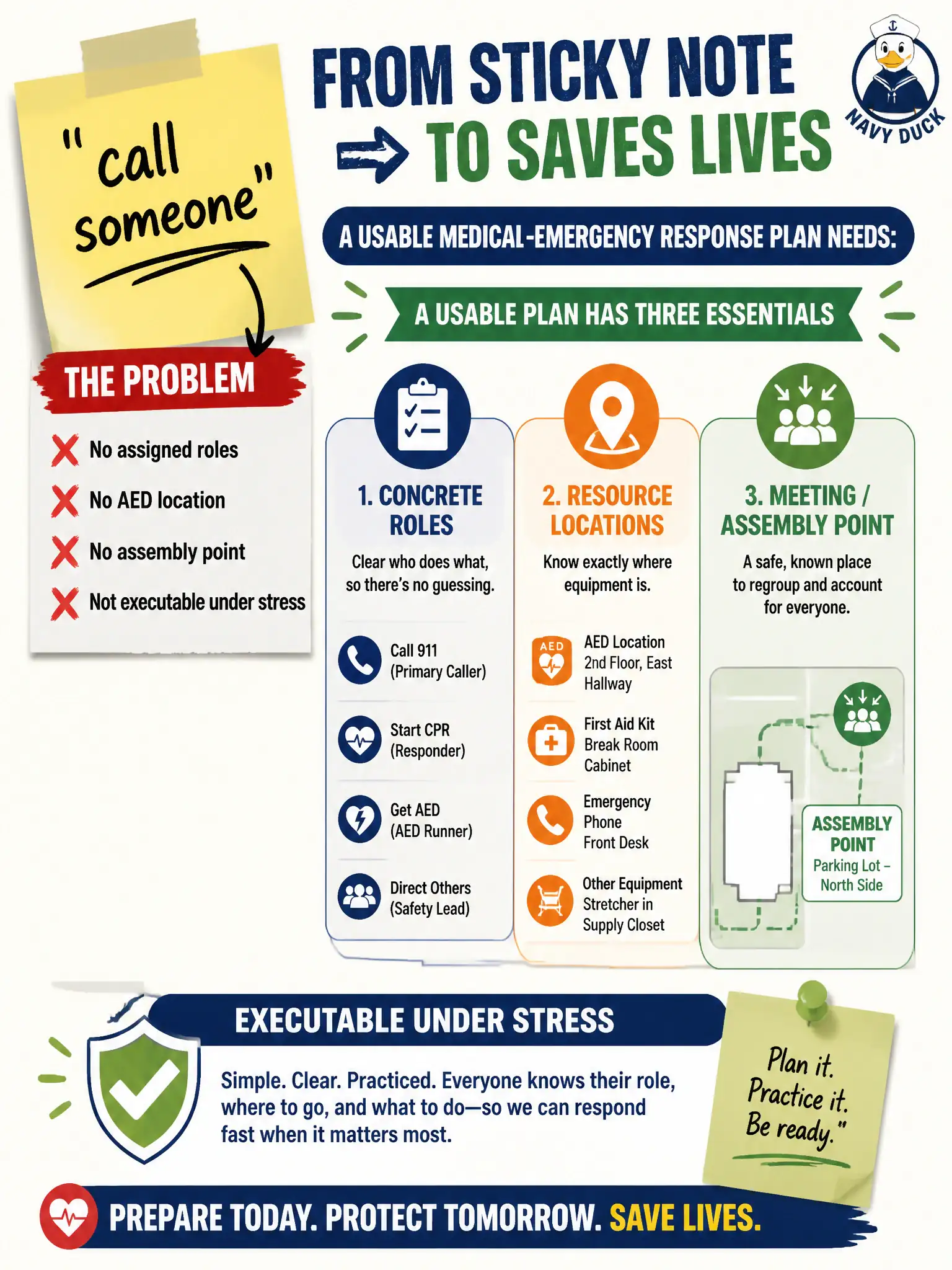
A professional-services firm’s medical-emergency “plan” is a sticky note that says “call someone,” with no assigned roles, AED location, or assembly point. What does a usable response plan need instead?
Select an answer to reveal the explanation.
Short Explanation
“Call someone” is not a plan—it is a shrug. When a colleague collapses, people need who dials, who grabs the AED, and where to meet responders. Write the roles and locations now, while everyone is calm enough to read them.
Full Explanation
Concrete roles, resource locations, and meeting or assembly points staff can execute under stress are what a usable medical-emergency response plan needs because sticky-note vagueness (“call someone”) collapses when seconds matter. Under stress people need named roles (who calls EMS, who retrieves the AED, who meets responders), known equipment locations, and a clear gathering point. Professional-services and civic office settings still require that executable clarity even when clinical risk feels lower than industrial sites.
A longer sticky note with only the building manager’s personal cell fails by concept because single-person dependency and personal phones are fragile—especially after hours—and still omit AED location, roles, and assembly guidance. Relying on 911 alone without on-site role clarity or equipment guidance fails because callers still need someone to locate the patient, fetch the AED, and guide EMS; 911 does not replace on-site organization. A legal disclaimer that medical emergencies are each employee’s private responsibility fails because employers retain workplace emergency-response duties and disclaimers do not create readiness.
Exam caveat: CRMC response planning judges plans by executability under stress. Minimalist slogans and liability language are not substitutes for roles, resources, and points of assembly.
Operational check: Replace the sticky note with a one-page medical response card posted in the civic office: role roster by shift, AED and first-aid locations, EMS meeting point; drill it quarterly and fix any missing key or empty kit found.