
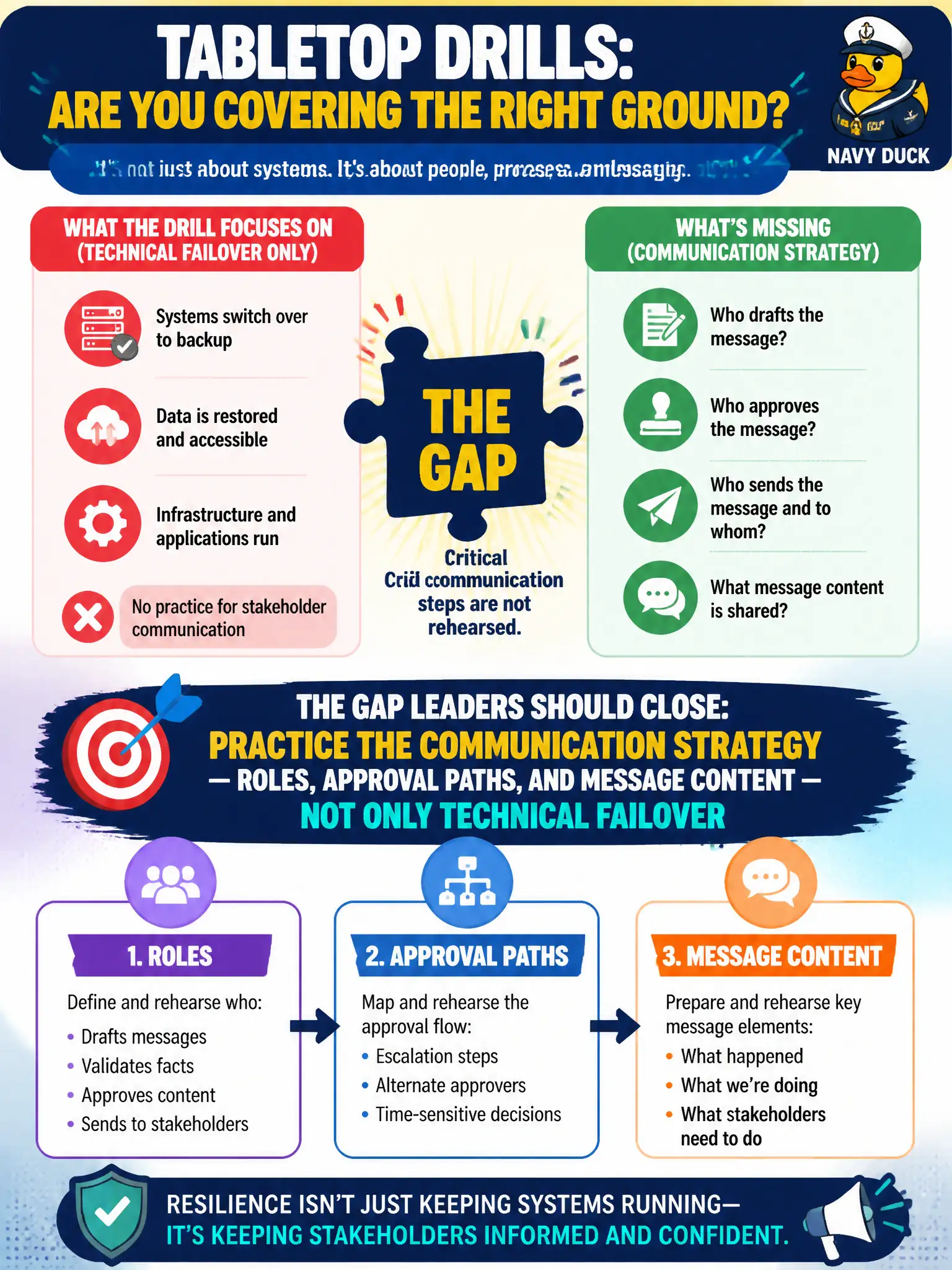
A continuity tabletop drills only technical failover of systems and never rehearses who drafts, approves, or sends stakeholder messages. What gap should leaders close?
Select an answer to reveal the explanation.
Short Explanation
Failover that works while the spokesperson freezes is only half a plan. Communication is a muscle—you have to rehearse who says what, when, and through which channel. Exercise the message path, not just the servers.
Full Explanation
Practicing the communication strategy—roles, approval paths, and message content—not only technical failover is correct because continuity success includes informing stakeholders under stress. Tabletop exercises that recover systems while leaving spokespersons, approvers, and message owners unrehearsed produce technical uptime with public confusion, conflicting guidance, and delayed civic notifications. Communication is an operational capability that degrades without drill.
Assuming written comms annexes work without exercise fails by concept because untested templates and RACI charts break under time pressure, unavailable approvers, and incomplete facts. Limiting tabletops to IT recovery and leaving messaging to ad-hoc improvisation fails because improvisation under crisis is a known source of contradictory multi-channel content. Outsourcing crisis messaging design to vendors who do not participate in drills fails because external designers who never rehearse with the EOC cannot validate local approval paths or audience lists.
Exam caveat: CRMC business continuity and communication strategy expect integrated exercise objectives. Technical recovery without practiced stakeholder messaging is an incomplete continuity capability on the exam.
Operational check: Add communication injects to the next county continuity tabletop: name who drafts, who approves, which channels fire, and what the first stakeholder message says; time the approval path and fix bottlenecks in the annex.