
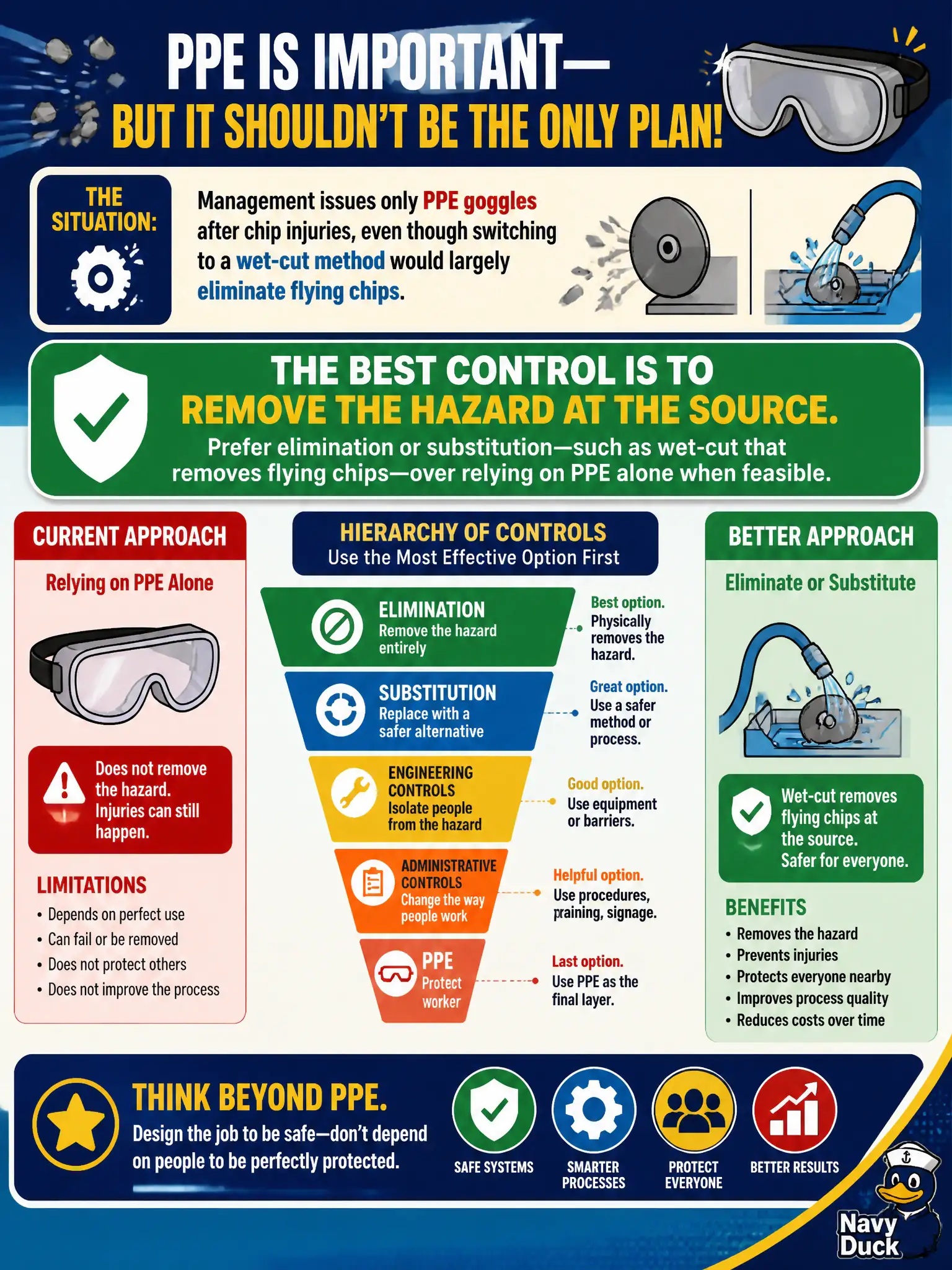
Management issues only PPE goggles after chip injuries, even though switching to a wet-cut method would largely eliminate flying chips. Which control preference is more appropriate?
Select an answer to reveal the explanation.
Short Explanation
Goggles are the last line, not the first idea. If wet-cut knocks down the chip cloud, that sits higher on the control ladder than hoping everyone wears eyewear perfectly. Fix the process when you can; PPE backs it up.
Full Explanation
When chip injuries occur, preferring elimination or substitution—such as a wet-cut method that largely removes flying chips—over relying on PPE goggles alone follows the hierarchy of controls when the safer process is feasible. Keeping dry cutting forever because PPE is always the strongest control available inverts the hierarchy; PPE is typically the last layer, not the strongest. Adding louder warning sirens without changing the cutting method substitutes another weak administrative cue for source control. Banning all cutting without evaluating whether a safer process exists may be unnecessary avoidance when substitution can preserve operations with lower residual risk. Feasibility, quality, and cost matter in treatment selection, but defaulting to PPE while refusing known higher controls is the conceptual error. Exam caveat: PPE remains necessary in many shops as a backstop; the exam targets PPE-first strategy when elimination or substitution is available. Operational check: pilot wet-cut or equivalent substitution, confirm chip exposure drops, retain eye protection as needed for residual risk, retrain operators, document the hierarchy rationale in the risk file, and retire the PPE-only corrective action narrative.