
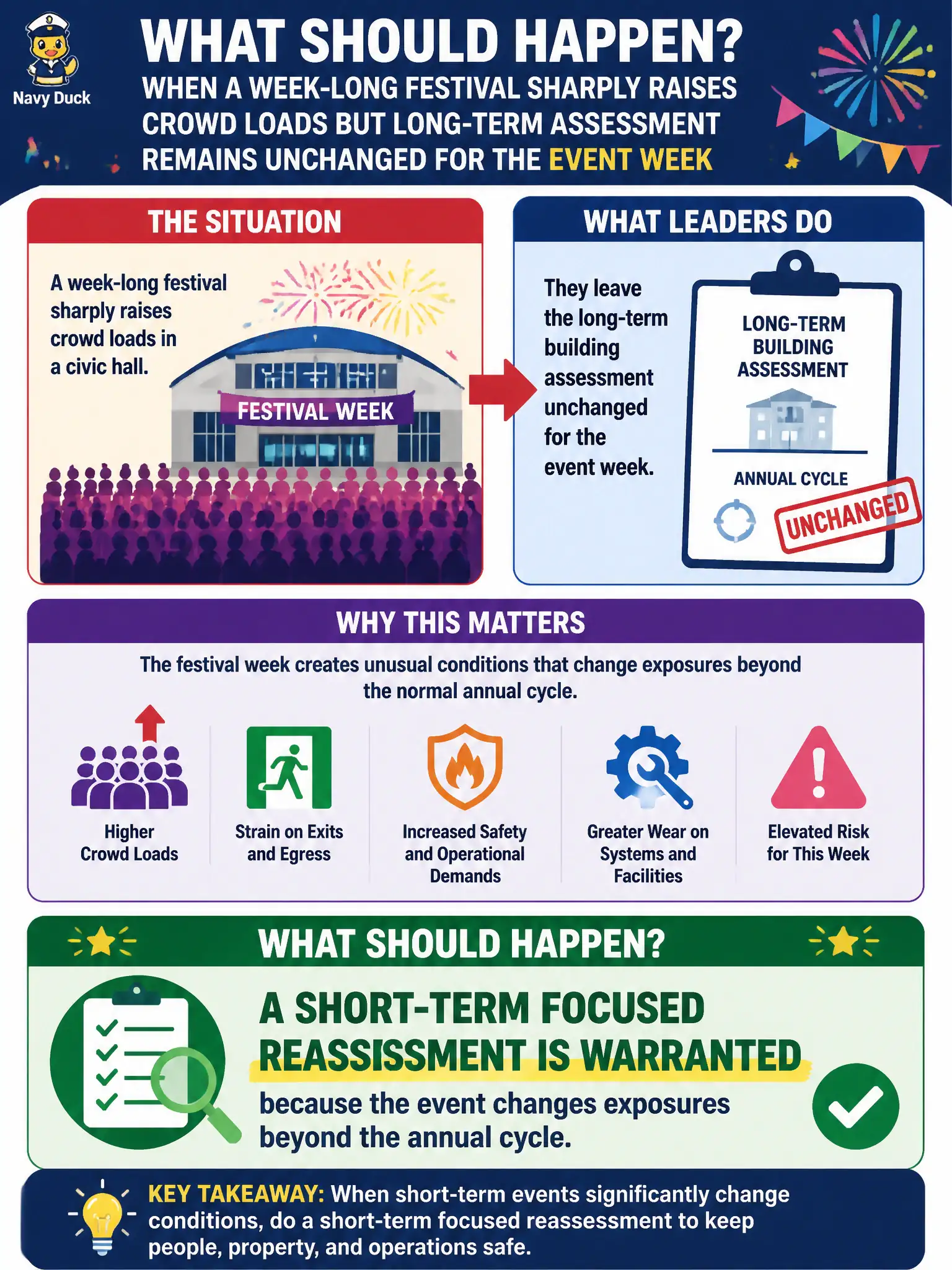
A week-long festival sharply raises crowd loads in a civic hall, but leaders leave the long-term building assessment unchanged for the event week. What should happen?
Select an answer to reveal the explanation.
Short Explanation
A festival week is a different building in the same walls—more people, more stress on exits and floors. Short-term spikes need a focused look, not last year's annual binder. The calendar event is the trigger.
Full Explanation
A week-long festival that sharply raises crowd loads in a civic hall warrants a short-term focused reassessment because the event changes exposures beyond the assumptions embedded in a long-term building assessment. Annual cycles alone will not capture temporary peak occupancy, vendor cooking loads, altered seating, or blocked secondary egress during the festival window. Certificates of occupancy on file do not replace event-specific identification of crowd, access, and fire-safety risks under actual use. Shifting all assessment duty to the festival vendor ignores the venue owner’s ongoing responsibilities for the building and public safety. Assuming an annual assessment automatically covers any temporary surge treats static analysis as dynamic truth. Long-horizon facility reviews should be combined with time-bounded event assessments when use patterns change materially. Exam caveat: short-term reassessment complements the annual cycle; it does not imply discarding long-term reviews. Operational check: run a pre-event walkthrough against peak occupancy, update temporary controls and staffing plans, document residual risks for the festival window, brief vendors on exit rules, and close out with a short after-action note in the hall’s risk file.