
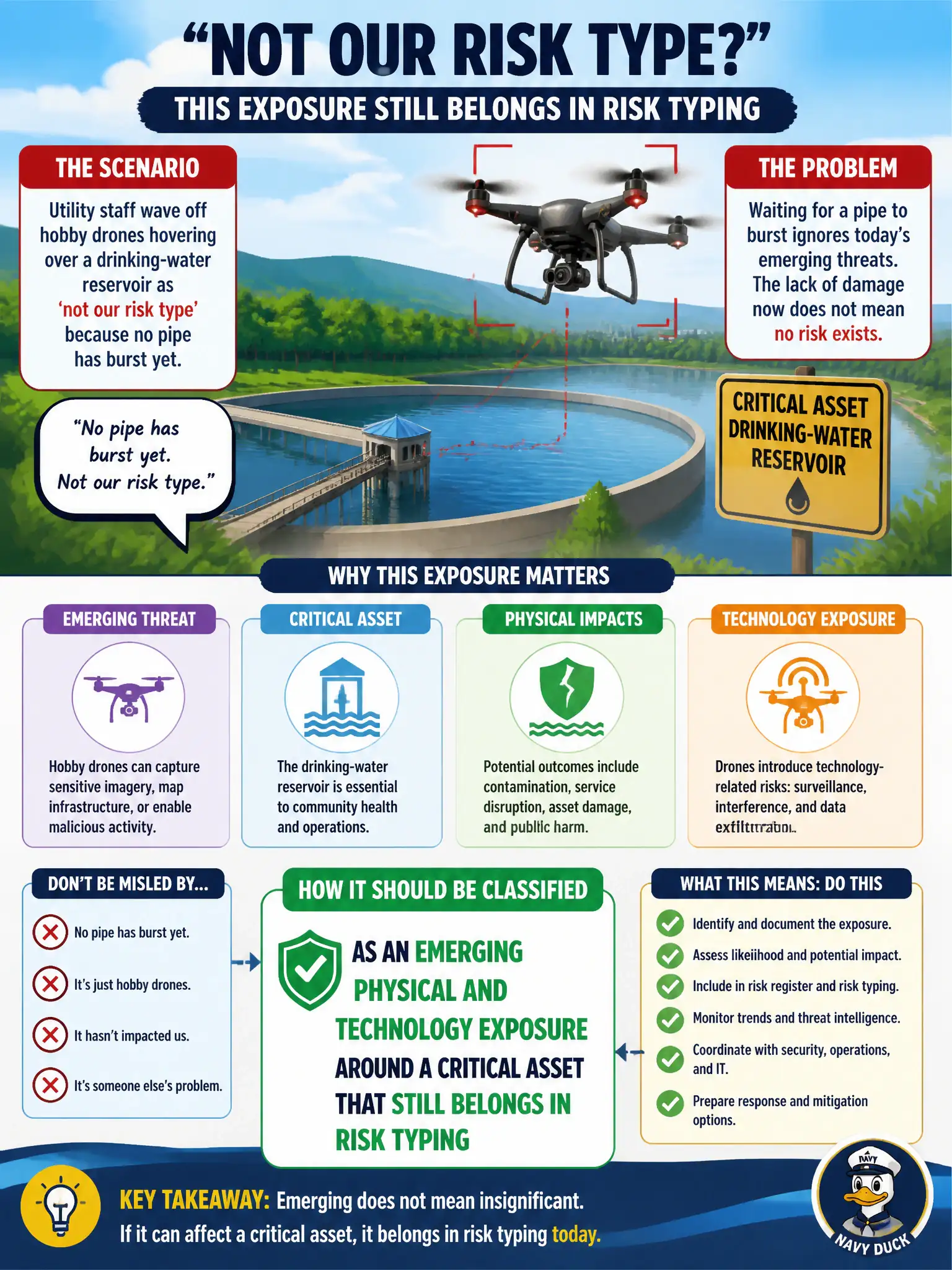
Utility staff wave off hobby drones hovering over a drinking-water reservoir as 'not our risk type' because no pipe has burst yet. How should the corporate risk manager classify this exposure?
Select an answer to reveal the explanation.
Short Explanation
Picture the reservoir as a bank vault with an open skylight—flying cameras overhead are still an exposure even if nothing is stolen yet. New physical and tech paths around critical assets count in risk typing. Waiting for a burst pipe misses the point.
Full Explanation
Corporate risk typing must include emerging physical and technology exposures around critical assets, not only losses that have already materialized. Hobby drones over a drinking-water reservoir create surveillance, interference, contamination, and access pathways that belong in the municipal risk register even if no pipe has burst. Treating the exposure as marketing-only collapses a critical-infrastructure issue into brand optics and delays operational controls. Framing it as an insurance-premium matter that skips operational registers confuses financing with identification—premiums respond to classified exposures; they do not replace typing. Casting it as an after-hours HR hobby-club issue misassigns ownership and ignores non-employee actors near civic assets. Exam caveat: absence of a historical loss does not mean absence of a risk type; emerging pathways still require classification under corporate risk frameworks such as those reflected in ISO 31000-style identification. Operational check: add the reservoir airspace exposure to the risk register with an owner, likelihood/consequence draft, interim controls (signage, reporting to operations/security, coordination with aviation/local authorities as appropriate), and a dated review when drone activity or asset criticality changes.