
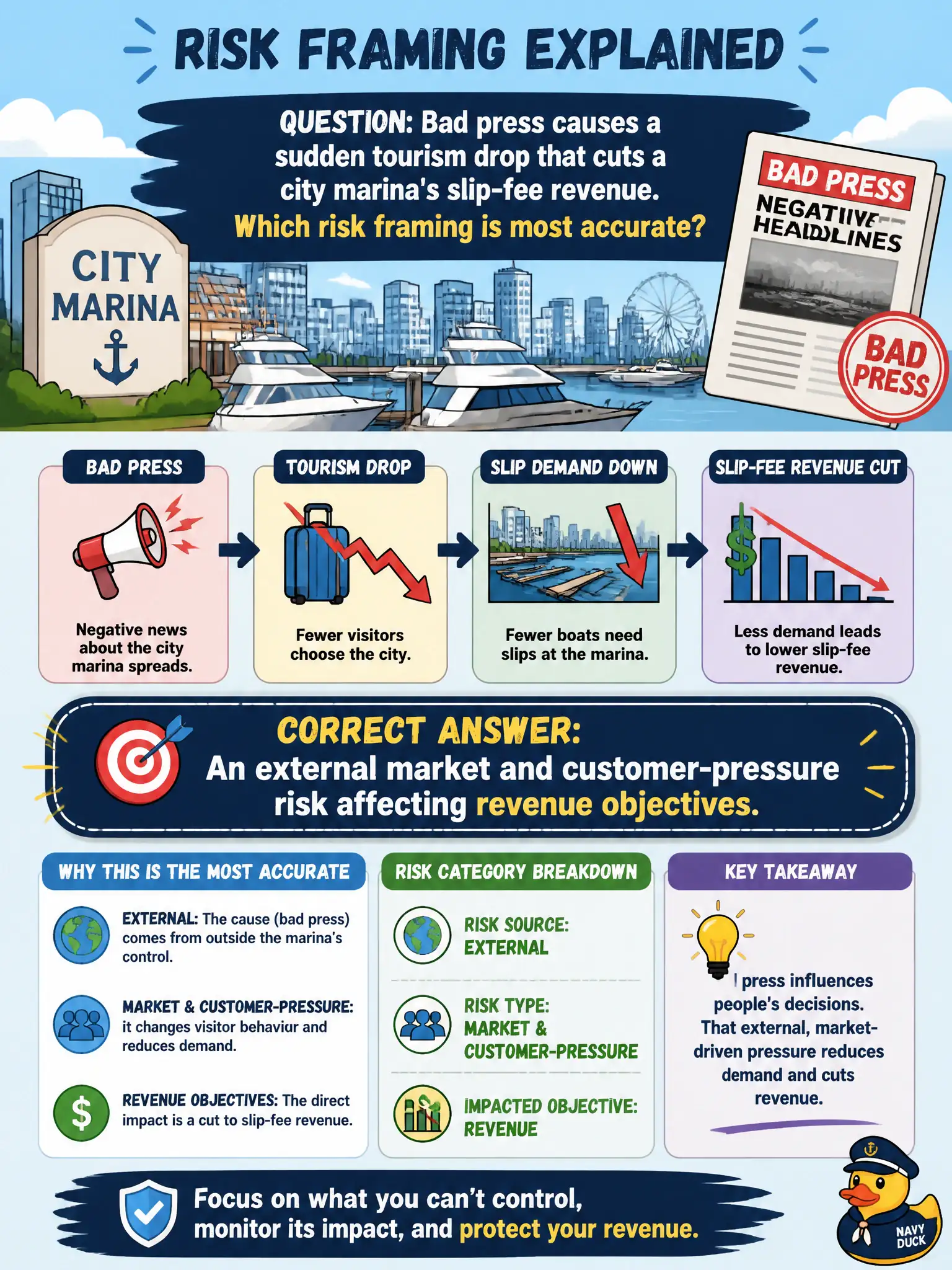
Bad press causes a sudden tourism drop that cuts a city marina's slip-fee revenue. Which risk framing is most accurate?
Select an answer to reveal the explanation.
Short Explanation
When visitors vanish after bad headlines, the marina feels it in empty slips and thin revenue. That is external market and customer pressure, not an indoor maintenance glitch.
Full Explanation
Bad press that suddenly drops tourism and cuts marina slip-fee revenue is best framed as an external market and customer-pressure risk affecting revenue objectives. It is not explained as an internal Wi-Fi outage alone, a physical roof leak as sole cause, or a personnel scheduling quirk with no external demand link. Exam caveat: external demand/reputation shocks that hit revenue are market/customer-pressure risks even for cities. Operational check: enter a market/revenue-pressure risk for the marina, link monitoring of booking cancellations and media sentiment, and prepare service-recovery and messaging treatments with the harbor master and communications. Distinguish any concurrent facility issues as separate register rows so causes are not conflated. In municipal practice, record the rationale in the risk procedure or committee minutes so future staff apply the same rule under budget pressure. Re-validate after the next seasonal peak or org-chart change to confirm the civic control still holds as designed for residents and staff. In municipal practice, record the rationale in the risk procedure or committee minutes so future staff apply the same rule under budget pressure. Re-validate after the next seasonal peak or org-chart change to confirm the civic control still holds as designed for residents and staff.