
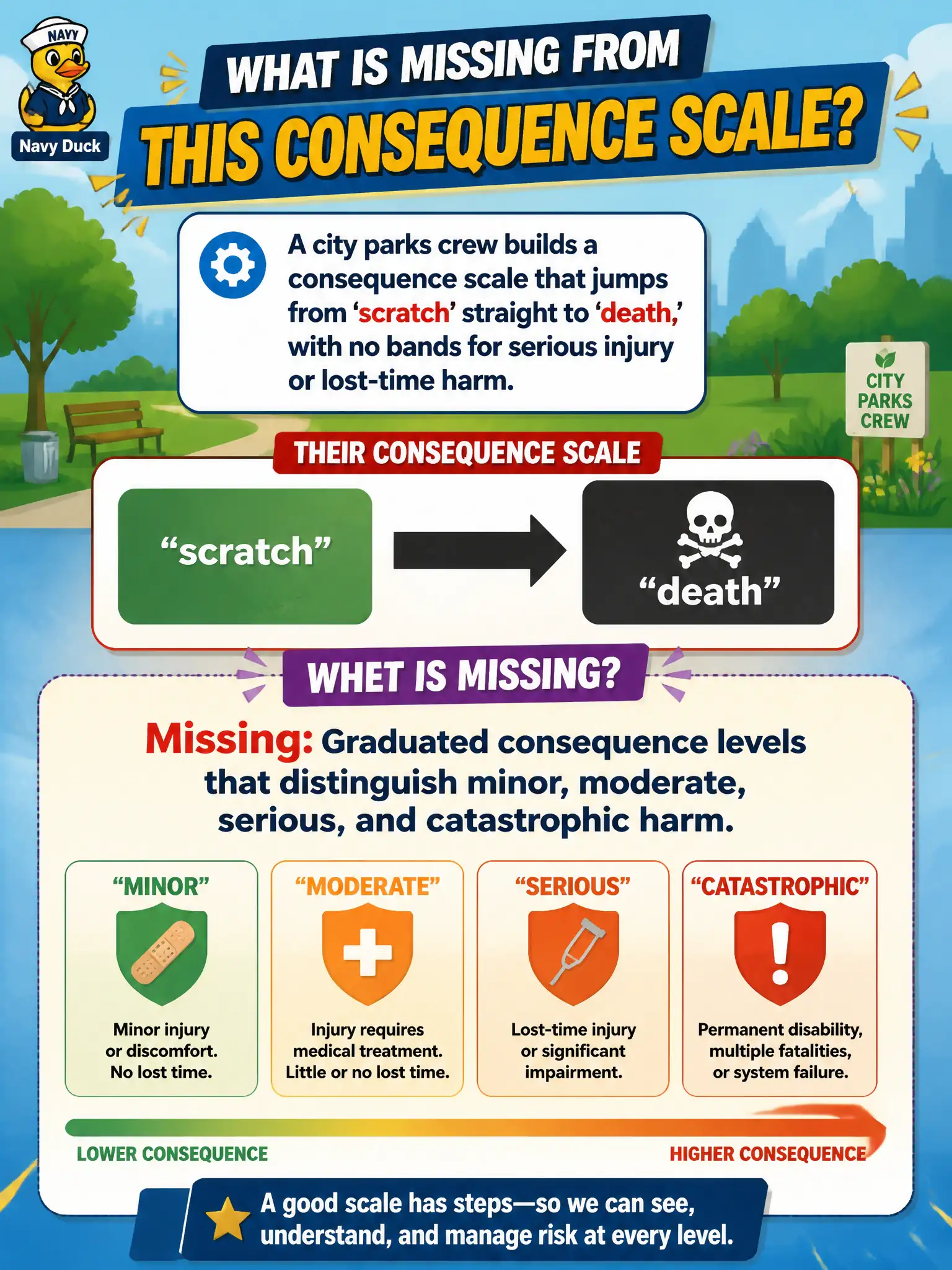
A city parks crew builds a consequence scale that jumps from 'scratch' straight to 'death,' with no bands for serious injury or lost-time harm. What is missing from this scale?
Select an answer to reveal the explanation.
Short Explanation
A scale that only knows 'scratch' and 'death' is like a speedometer with two marks. Real work sits in the middle bands—broken bones, lost time, serious injury. Graduated levels let teams rate harm honestly instead of forcing everything into extremes.
Full Explanation
Consequence scales need graduated levels that distinguish minor, moderate, serious, and catastrophic harm. A parks crew scale that jumps from "scratch" straight to "death" leaves no band for serious injury or lost-time harm, so mid-severity events are forced into extremes and prioritization warps. A single binary checkbox asking only whether any injury occurred collapses useful discrimination. Popularity votes among supervisors about which stories sound worst replace criteria with anecdote. Forcing consequence ratings to always match an annual budget line item confuses financial coding with harm magnitude. Exam caveat: multi-level people-harm bands are expected on evaluation items. Operational check: rebuild the parks consequence legend with at least four people-harm tiers and civic examples, rescore three recent incidents, and confirm mid-severity injuries no longer jump to catastrophic by default. Train seasonal leads on the new bands before peak recreation season. In municipal practice, record the rationale in the risk procedure or committee minutes so future staff apply the same rule under budget pressure. Re-validate after the next seasonal peak or org-chart change to confirm the civic control still holds as designed for residents and staff.