
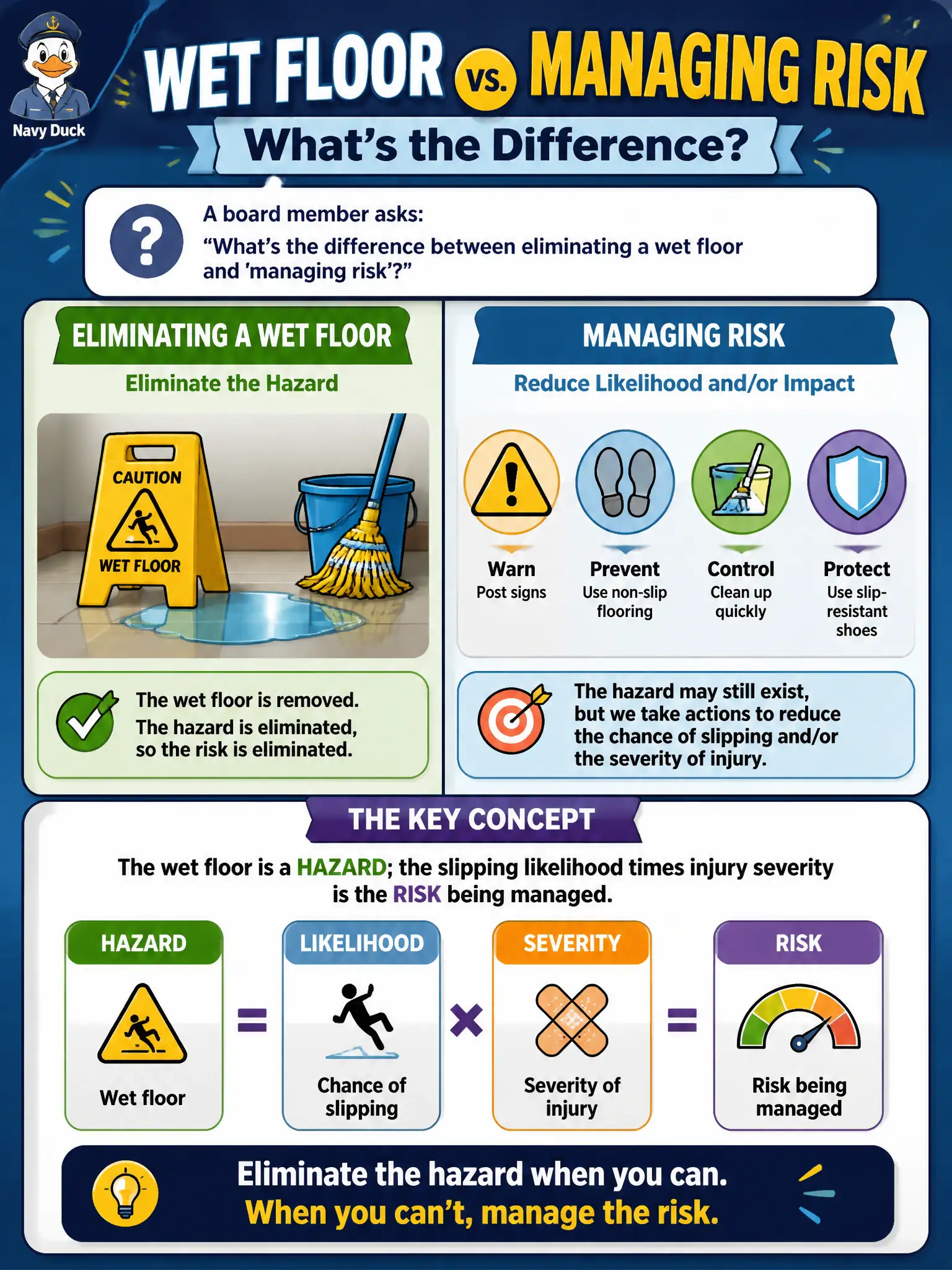
A board member asks for the difference between eliminating a wet floor and "managing risk." Which explanation is correct?
Select an answer to reveal the explanation.
Short Explanation
The puddle is the hazard — the thing that can cause harm. Risk is the combo of how likely someone slips and how badly they get hurt against what you care about. Mopping treats that risk by removing the hazard source.
Full Explanation
A wet floor is a hazard—the condition that can cause harm. Managing risk means addressing the likelihood of a slip combined with the severity of injury relative to safety and service objectives, often by eliminating or controlling that hazard (mopping, barriers, mats) and verifying residual exposure. Saying mopping is unrelated to risk because it is "only janitorial" invents a false wall between housekeeping and risk treatment. Claiming risk management begins only after someone slips denies preventive treatment. Calling the wet floor residual risk while reserving likelihood and severity for "financial hazards" mislabels the source and misuses residual-risk vocabulary. Exam caveat: hazard versus risk (likelihood×consequence) remains the core distinction; elimination of the hazard is a primary treatment of the risk it creates. Operational check: for the next wet-floor report in a civic lobby, record hazard description, pre-control likelihood and consequence, treatment performed, and post-control residual rating in the same log supervisors already use. Show facilities staff that drying the floor is risk treatment, not a separate universe of work. In civic practice, keep the same vocabulary in board minutes, toolbox talks, and the live register so department heads do not reintroduce casual synonyms after training. Re-check the concept during the next quarterly risk review against one real municipal example so the distinction stays operational rather than slogan-only.