
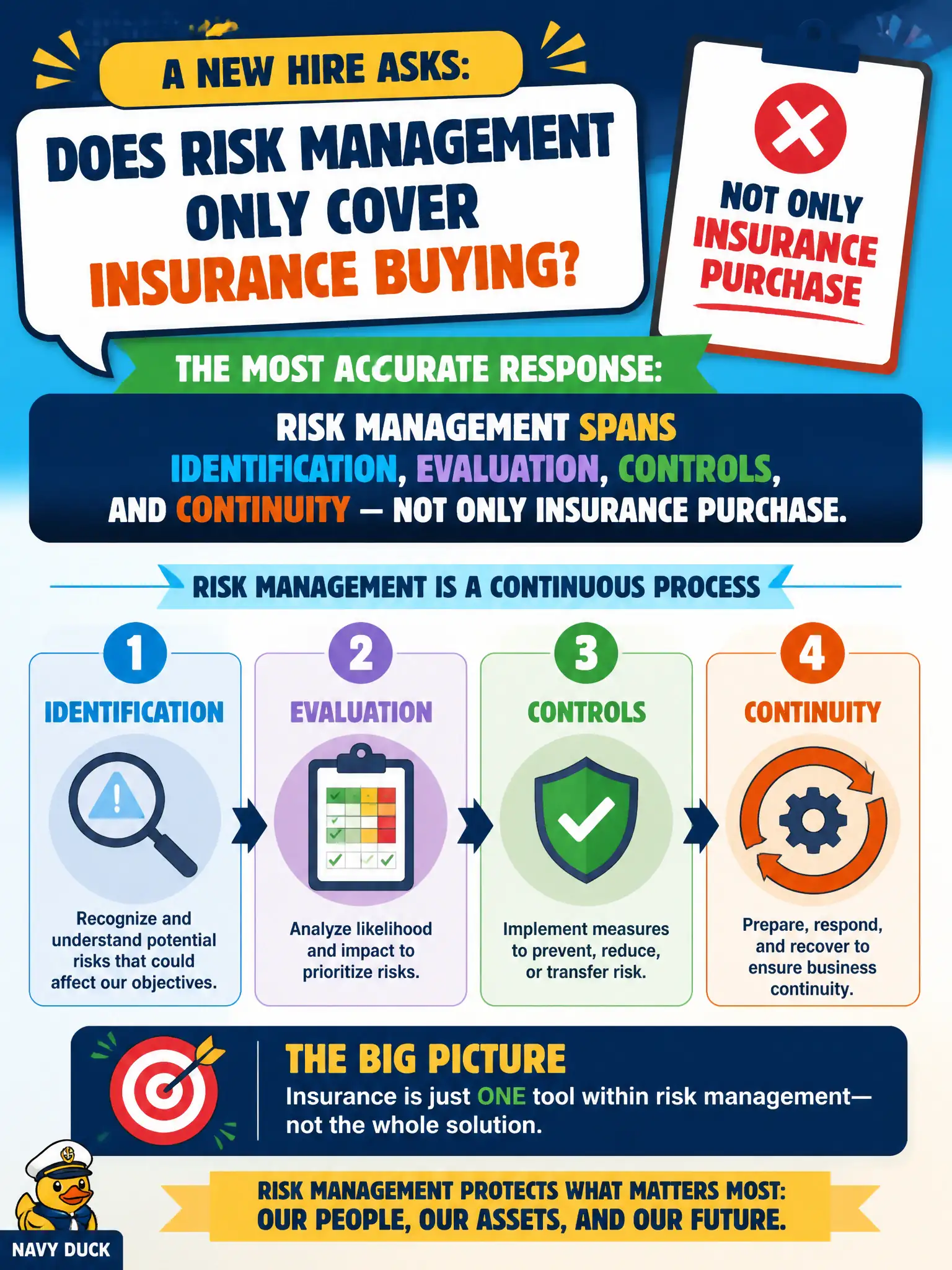
A new hire asks whether risk management only covers insurance buying. Which response is most accurate?
Select an answer to reveal the explanation.
Short Explanation
Buying insurance is like putting a spare tire in the trunk — useful, but not the whole trip plan. Real risk work still means spotting what can go wrong, judging how bad it could be, putting controls in place, and planning how to keep going. Insurance is one tool, not the whole toolbox.
Full Explanation
Corporate and civic risk management is a cycle of identification, evaluation, control selection, monitoring, and continuity planning. Purchasing insurance is one financing or transfer tool inside that cycle, not the definition of the function. Telling a new hire that the work ends once policies are bought leaves uninsured and uninsurable exposures—process failures, information loss, relationship damage—without owners. Reducing the discipline to premium shopping and broker selection ignores hazard inventories, likelihood-consequence analysis, and control design that cities use every week. Limiting the role to filing claims after covered losses is purely reactive and misses near-miss learning and preventive treatment. Exam caveat: items that contrast "insurance only" with a full identify-evaluate-treat-monitor view almost always prefer the broader lifecycle answer. Operational check: map one city program (fleet, recreation, utilities) from hazard list through evaluation, at least one non-insurance control, and a continuity note, then show the new hire where the insurance certificate sits as a single row—not the whole map—in the municipal risk file. Revisit after the next renewal so premium decisions stay linked to the live risk register rather than replacing it.