
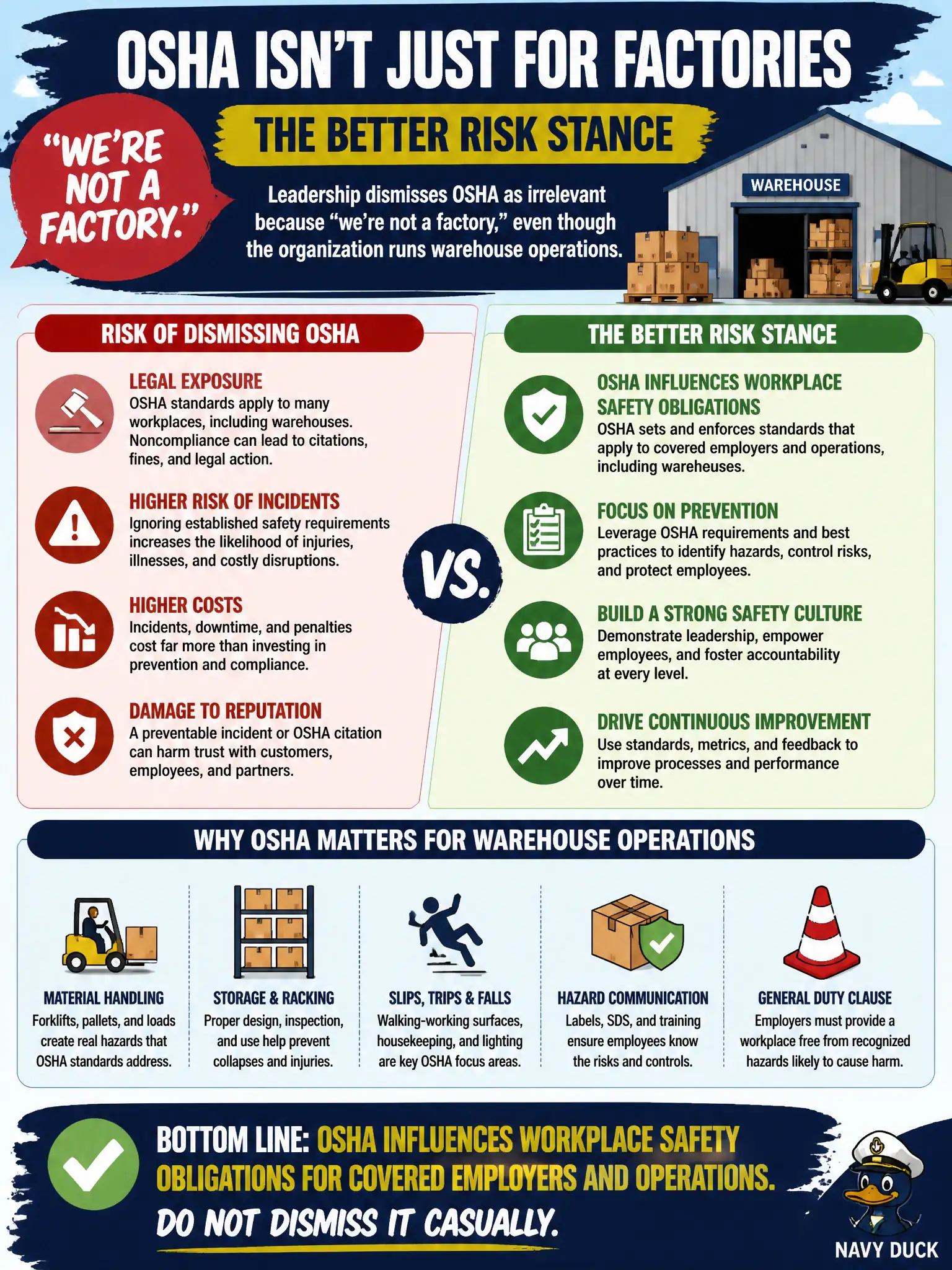
Leadership dismisses OSHA as irrelevant because “we’re not a factory,” even though the organization runs warehouse operations. What is the better risk stance?
Select an answer to reveal the explanation.
Short Explanation
“Not a factory” is not a magic force field. If you have warehouse people lifting, stacking, and driving equipment, OSHA-shaped safety duties still matter—wave them off and you are gambling with people and liability.
Full Explanation
OSHA sets and influences workplace safety requirements for covered employers and operations, including many warehouse and similar settings—not only traditional factories. Leadership that dismisses OSHA because “we’re not a factory” while running warehouse operations takes an unsafe and often incorrect stance. The better risk posture is to treat OSHA as relevant to covered workplace safety obligations and not dismiss it casually.
Claiming OSHA never applies outside automobile plants so warehouse employers may ignore it is a false categorical exemption. Believing warehouse work is exempt if insurance premiums are paid confuses insurance with regulatory duty. Asserting only factories need hazard communication while civic warehouses rely solely on ISO 31000 posters misplaces both OSHA and ISO roles.
Exam caveat: operational reality drives OSHA relevance more than self-labels like “not a factory.” Insurance ≠ OSHA compliance.
Operational check: determine coverage and applicable standards for warehouse operations; align training, hazard communication, and inspections accordingly; document residual compliance risk; stop using “not a factory” as a dismissal in leadership discussions. Document applicable OSHA or equivalent duties for warehouse and similar operations in the compliance calendar. Retrain supervisors who dismiss coverage based on “not a factory” language.