
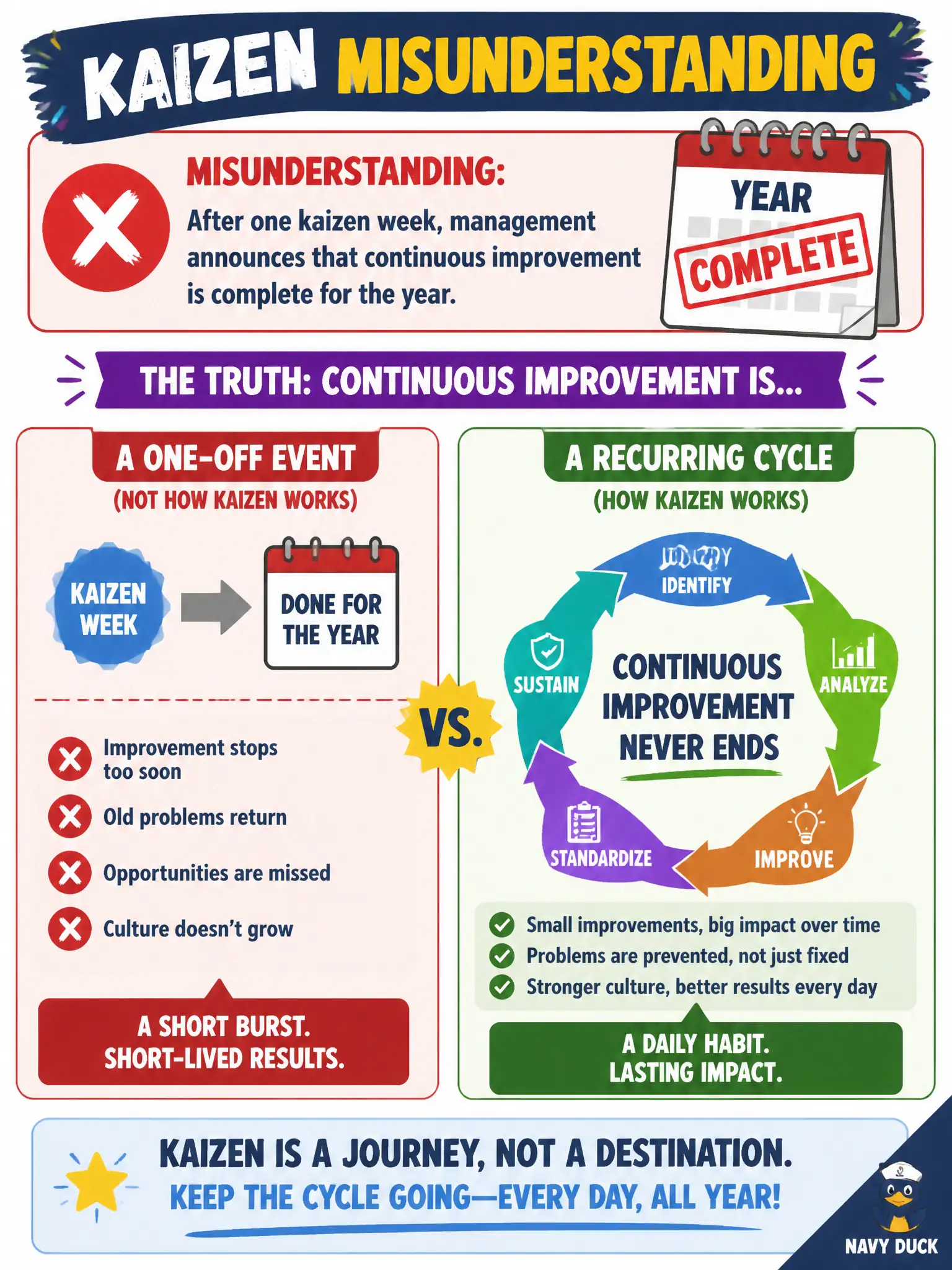
After one kaizen week, management announces that continuous improvement is complete for the year. What misunderstanding is this?
Select an answer to reveal the explanation.
Short Explanation
Continuous improvement is a treadmill, not a ribbon-cutting. One good kaizen week is a lap—not the finish line—so the cycle of find, fix, and check keeps rolling.
Full Explanation
Continuous improvement is an ongoing management cycle of identification, action, verification, and learning—not a one-off workshop that can be declared complete for the year after a single kaizen week. Management that announces CI is finished after one event misunderstands the recurring nature of the discipline. Civic programs need sustained cadence, not annual ceremonial bursts.
Treating kaizen weeks as permanently eliminating further hazard identification freezes learning after a marketing milestone. Claiming continuous improvement is finished once any single metric improves for seven days confuses a short win with a management system. Declaring completion after one event as required by most enterprise risk standards misstates those standards’ emphasis on ongoing processes.
Exam caveat: CI is cyclical and continuous. One workshop ≠ program completion.
Operational check: publish the next monitoring and improvement dates after any kaizen event; keep hazard identification and corrective-action cycles on the calendar year-round; report recurring metrics to leadership rather than a one-time completion banner. After any kaizen or blitz week, schedule the next two recurring improvement reviews on the calendar before closing the event. Leadership messaging should call it a cycle boost, not a finish line.