
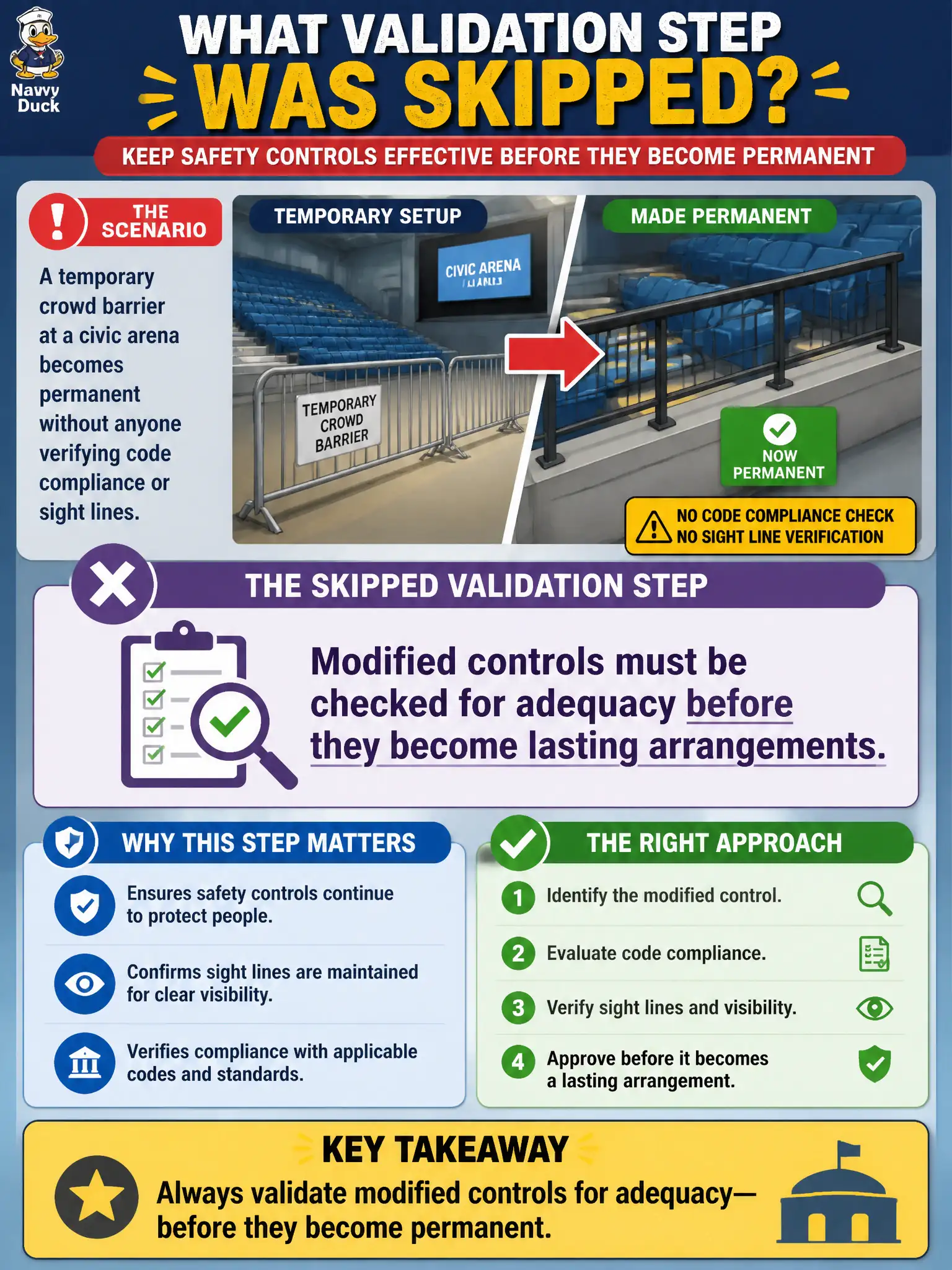
A temporary crowd barrier at a civic arena becomes permanent without anyone verifying code compliance or sight lines. What validation step was skipped?
Select an answer to reveal the explanation.
Short Explanation
“Temporary” that never leaves still needs a real design check. Duct-tape permanence is not compliance. Before the barrier stays forever, confirm it meets code and does not blind security or exits.
Full Explanation
Controls that evolve from temporary to permanent without formal review create hidden noncompliance and design gaps. A temporary crowd barrier at a civic arena that becomes permanent without verifying code compliance or sight lines skipped validation that modified controls must be checked for adequacy before they become lasting arrangements. Continuous improvement requires deliberate acceptance of permanent controls, not silent creep.
Assuming temporary barriers automatically meet code once they survive one event weekend confuses endurance with compliance. Claiming sight-line and code checks apply only to brand-new capital projects excludes reused or leftover temporary works. Treating permanence itself as proof of adequacy if no lawsuit has been filed yet uses absence of litigation as a poor safety metric.
Exam caveat: temporary-to-permanent transitions need review. Survival of one event is not a design approval.
Operational check: inventory temporary controls still in place; trigger adequacy and code/sight-line review before formalizing them; remediate or replace noncompliant barriers; record approval for any that remain as permanent municipal controls. Create a temporary-to-permanent control gate in facilities procedures requiring code and sight-line review before barriers or similar devices become lasting. Inventory legacy temporaries already in place.