
Executives call any alternate office with Wi-Fi a “hot site.” How should the risk manager correctly distinguish readiness levels?
Select an answer to reveal the explanation.
Short Explanation
Wi-Fi does not make a hot site any more than a light switch makes a hospital. Hot means systems are ready to run; warm is halfway there; cold is mostly empty space. Call the site what the prep actually is.
Full Explanation
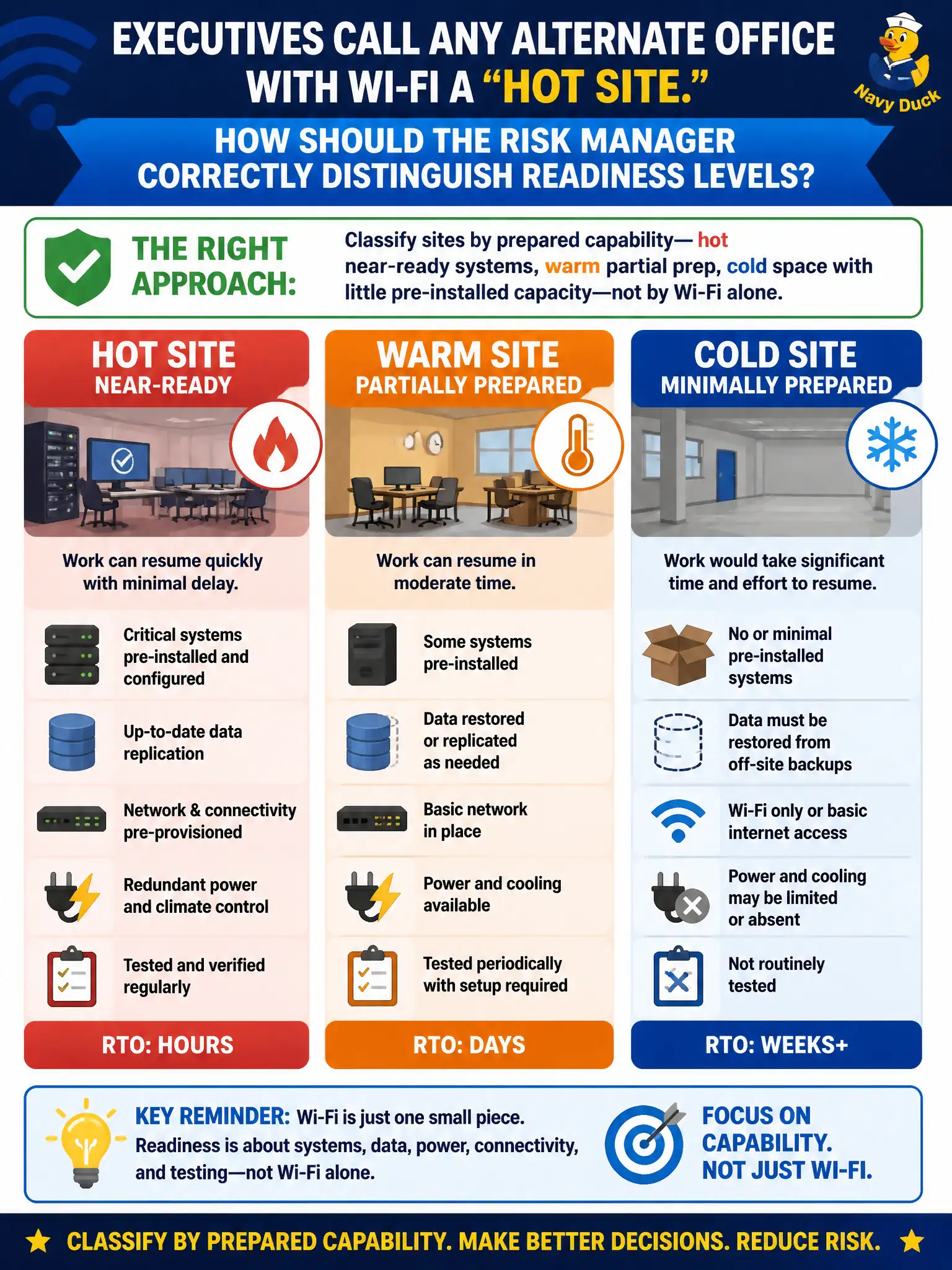
Site typology reflects how much infrastructure, data, and staffing are pre-positioned—not whether an alternate office has Wi-Fi. Executives calling any Wi-Fi office a “hot site” collapse hot, warm, and cold meanings into a convenience label. Risk managers should classify sites by prepared capability: hot near-ready systems, warm partial prep, cold space with little pre-installed capacity.
Declaring any room with wireless internet a hot site under standard definitions empties the taxonomy. Claiming hot/warm/cold labels are marketing only with no operational meaning discards useful readiness distinctions for planning and RTOs. Defining cold sites solely by whether executives have visited them once substitutes ceremony for capability assessment.
Exam caveat: Wi-Fi availability is not a hot-site definition. CRMC expects standard readiness classes tied to pre-positioned capacity.
Operational check: inventory each alternate location’s pre-installed systems, data access, network readiness, and staffing assumptions; assign hot/warm/cold labels accordingly; align RTOs and executive briefings to those classifications. Publish a one-page site-class glossary for executives using hot, warm, and cold definitions tied to pre-positioned capacity. Correct Wi-Fi-only labeling whenever it appears in budget or board language.