
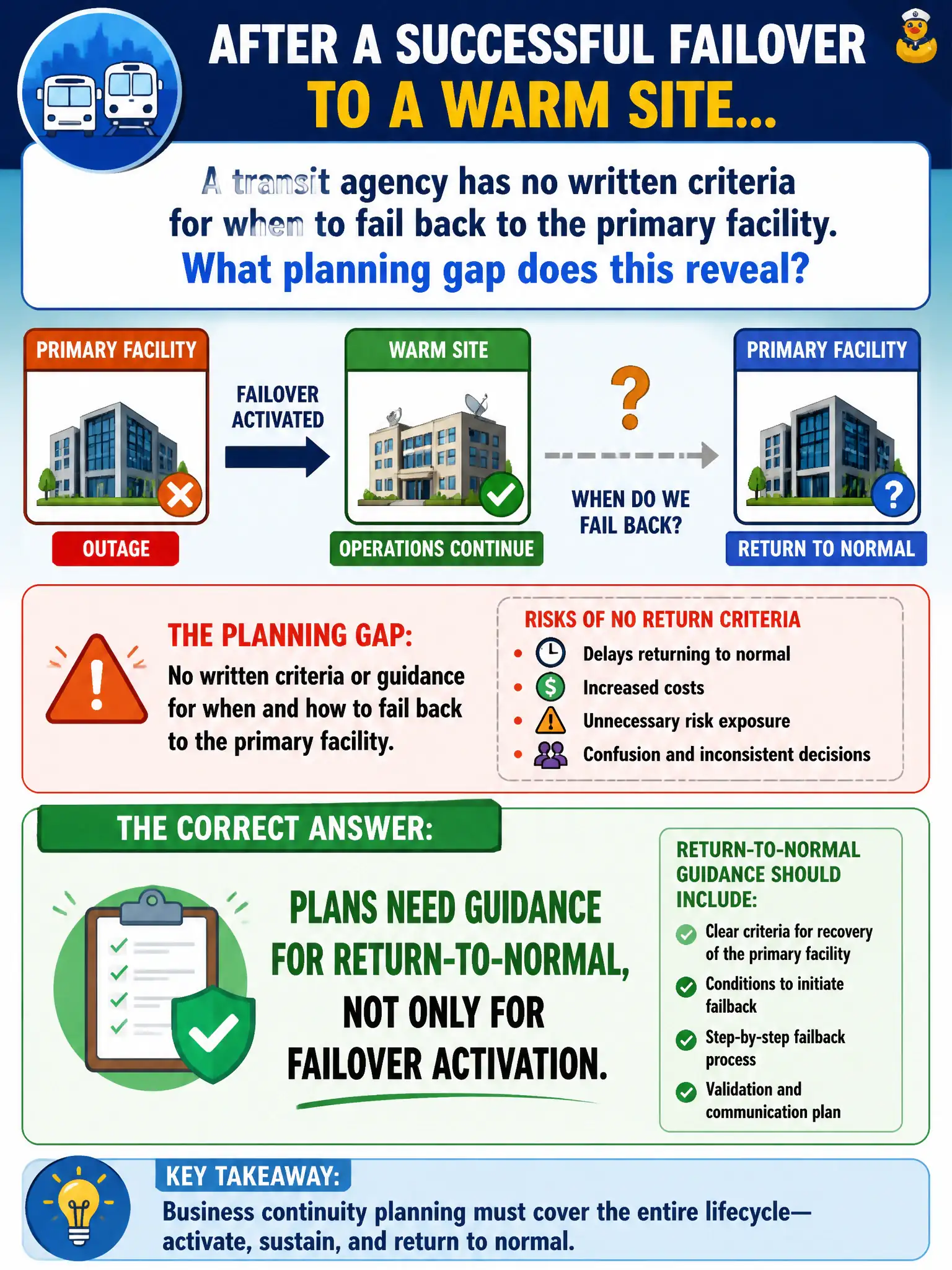
After a successful failover to a warm site, a transit agency has no written criteria for when to fail back to the primary facility. What planning gap does this reveal?
Select an answer to reveal the explanation.
Short Explanation
Failover gets you out of the fire; failback gets you home without creating a second mess. If nobody wrote the “when do we go back?” rules, teams argue while both sites stay half-live. Plan the return trip as carefully as the escape.
Full Explanation
Complete disaster recovery planning addresses both activation and restoration of normal operations. After successful failover to a warm site, a transit agency with no written failback criteria lacks guidance for return-to-normal. Plans need criteria for when and how to fail back to the primary facility—not only for failover activation—so municipal services are not stranded indefinitely at an interim posture.
Assuming failback is always automatic once power returns ignores validation, data sync, and safety checks that written criteria should drive. Believing warm-site contracts forbid return until the next budget year confuses commercial myths with operational planning. Waiting for insurers or claims adjusters to decide failback timing cedes operational control of citizen services to a financial process.
Exam caveat: failover and failback are both DR plan elements. CRMC items often test the neglected return-to-normal half.
Operational check: add failback criteria covering data integrity, facility readiness, staffing, and approval authority; exercise a failback decision tabletop after a failover drill; assign owners for each return-to-normal checkpoint. Write failback approval roles the same way activation roles are written, including data-sync and facility-clear criteria. Practice the return decision once per year even if failover is rare.