
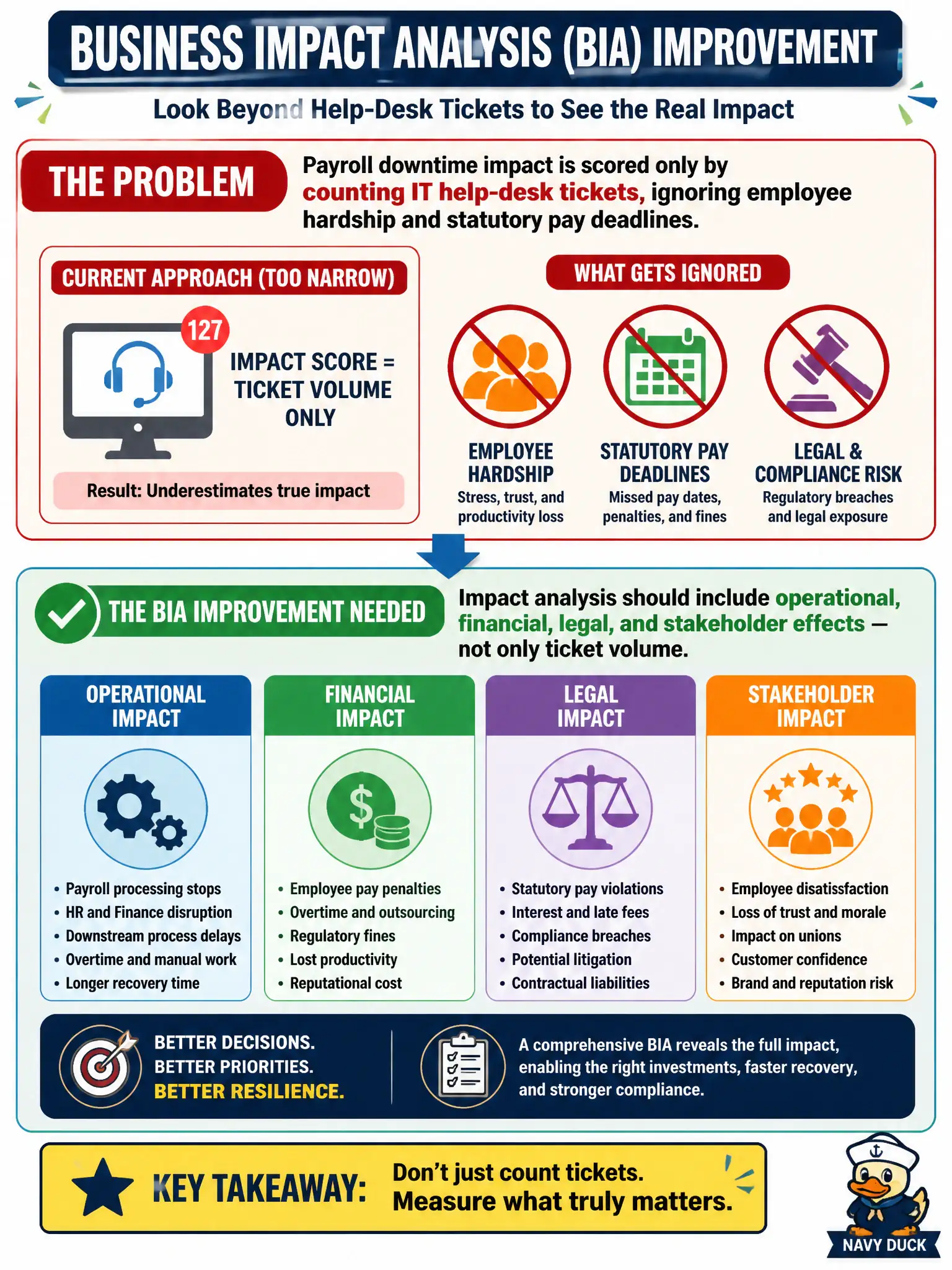
Payroll downtime impact is scored only by counting IT help-desk tickets, ignoring employee hardship and statutory pay deadlines. Which BIA improvement is needed?
Select an answer to reveal the explanation.
Short Explanation
Ticket counts tell you who's yelling at IT — not whether families miss rent or the city breaks wage law. BIA has to capture the real human, money, and legal hit, not just the noise in the queue.
Full Explanation
Impact analysis should include operational, financial, legal, and stakeholder effects—not only ticket volume—is needed when payroll downtime is scored only by counting IT help-desk tickets while ignoring employee hardship and statutory pay deadlines. Ticket counts measure support load, not full business impact. Civic payroll BIA must capture legal pay obligations, employee trust, and operational disruption.
Claiming help-desk ticket counts are the sole approved measure of payroll business impact fails by concept because tickets omit legal deadlines and human impact that define payroll criticality. Claiming legal pay deadlines are irrelevant once any IT metric dashboard is green fails because statutory obligations exist independent of IT green lights and drive recovery priority. Claiming stakeholder hardship is excluded from BIA to keep reports strictly technical fails because stakeholder and employee effects are legitimate BIA dimensions, not soft noise to delete.
Exam caveat: CRMC BIA impact dimensions are multi-factor. Single IT operational metrics are insufficient for functions with legal and human stakes like payroll.
Operational check: Rescore payroll impact using legal deadline exposure, employee hardship, financial controls, and operational dependencies; set RTO accordingly; validate with HR/payroll owners and finance—not help-desk volume alone.