
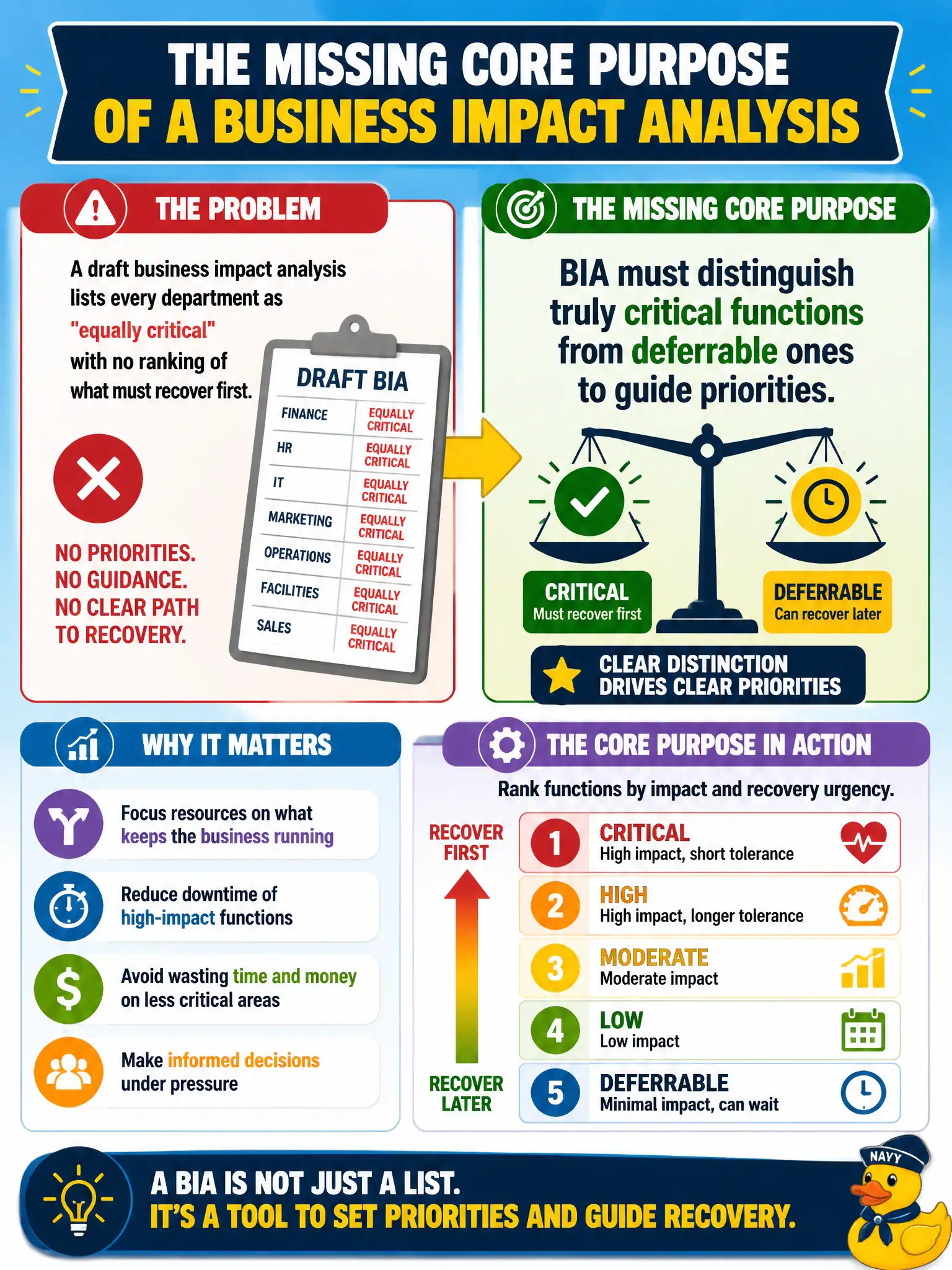
A draft business impact analysis lists every department as "equally critical" with no ranking of what must recover first. What core BIA purpose is missing?
Select an answer to reveal the explanation.
Short Explanation
If everything is "priority one," nothing is. A BIA's job is to sort what keeps the lights on from what can wait — equal labels for every shop don't help anyone recover in the right order.
Full Explanation
BIA must distinguish truly critical functions from deferrable ones to guide priorities is the core purpose missing when every department is listed as “equally critical” with no recovery ranking. Without differentiation, resource allocation during outages becomes political improvisation. Civic BIAs exist to sequence what keeps public safety, environmental control, and essential services running first.
Claiming BIA must list every department as critical so insurance premiums automatically drop fails by concept because equal criticality is analytically false and insurance pricing is not the BIA’s primary purpose. Claiming BIA replaces any disaster recovery planning once equality is declared fails because BIA informs DR/continuity planning—it does not replace it, and false equality misinforms. Claiming BIA requires identical recovery times for mailrooms and emergency operations fails because identical RTOs ignore dependency and impact differences the BIA should reveal.
Exam caveat: CRMC BIA fundamentals require prioritization and differentiation of functions. “Everything is critical” is an anti-pattern.
Operational check: Re-run the municipal BIA with ranked criticality, RTOs/RPOs, and dependency notes; validate with process owners; feed the ranked list into recovery playbooks and exercise injects.