
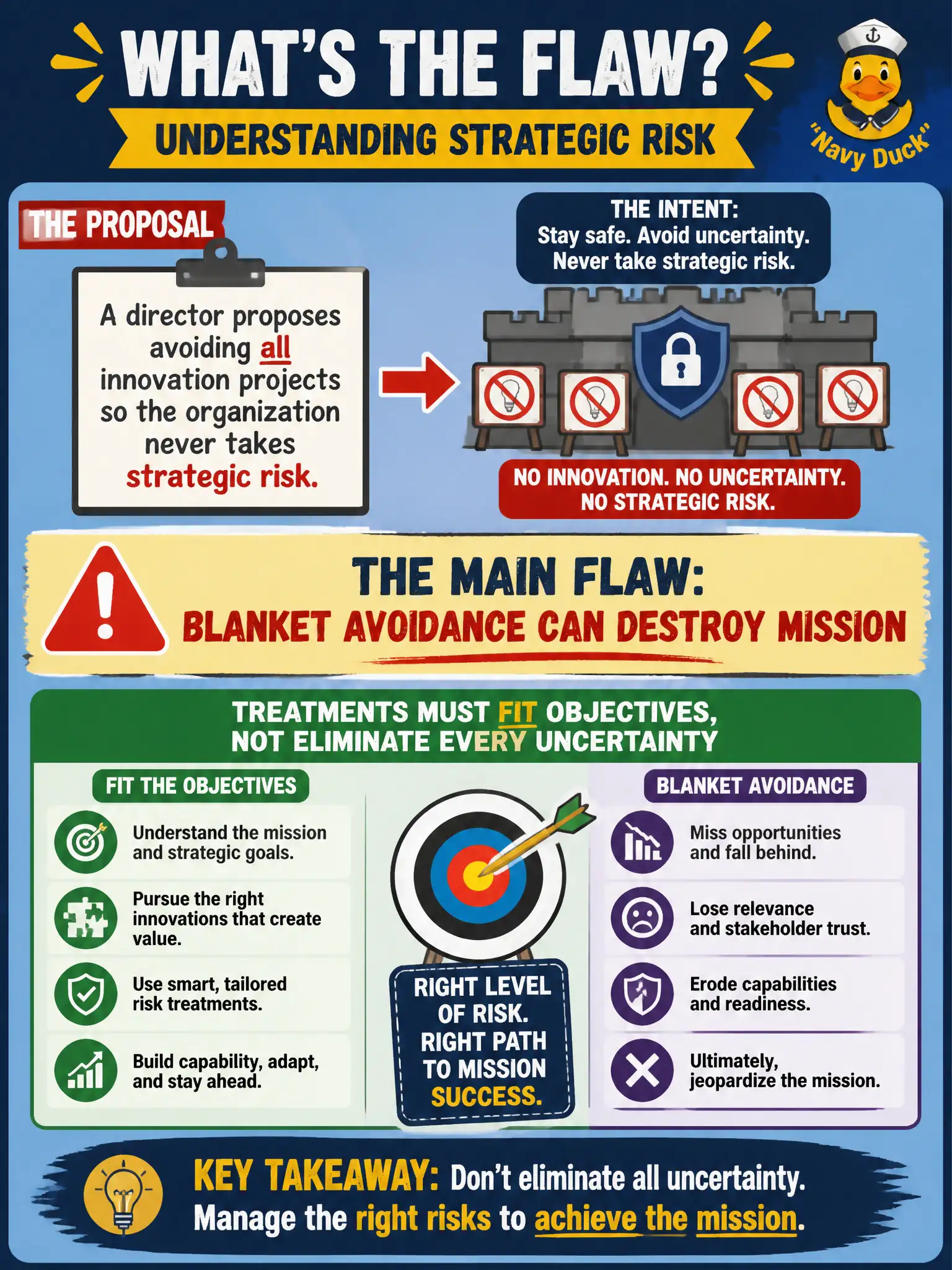
A director proposes avoiding all innovation projects so the organization never takes strategic risk. What is the main flaw in that strategy?
Select an answer to reveal the explanation.
Short Explanation
If your only play is "never try anything new," you avoid risk by also avoiding the mission. Good risk management picks the right tool — avoid the reckless stuff, manage the rest — so the organization can still deliver.
Full Explanation
Blanket avoidance can destroy mission; treatments must fit objectives, not eliminate every uncertainty is the flaw when a director proposes avoiding all innovation projects to escape strategic risk. Risk management enables objectives under uncertainty—it does not require organizational paralysis. Civic agencies still need proportionate screening, reduction, and acceptance of innovation risk aligned to public-service goals.
Claiming innovation risk can only be treated by transferring every idea to competitors fails by concept because sending all innovation elsewhere abandons mission advantage and is not the only treatment. Claiming acceptance of all innovation without screening is required by risk standards fails because standards expect evaluation and proportionate treatment, not uncritical acceptance. Claiming reduction is impossible for any project that uses new technology fails because pilots, staged rollouts, vendor due diligence, and controls routinely reduce innovation risk.
Exam caveat: CRMC treatment selection is objective-relative. Total avoidance of all strategic uncertainty is usually mission-destructive and not mandated.
Operational check: Replace blanket innovation bans with a portfolio screen: classify initiatives, apply proportionate controls, define residual acceptance where appetite allows, and avoid only proposals that remain intolerable after feasible treatment.