
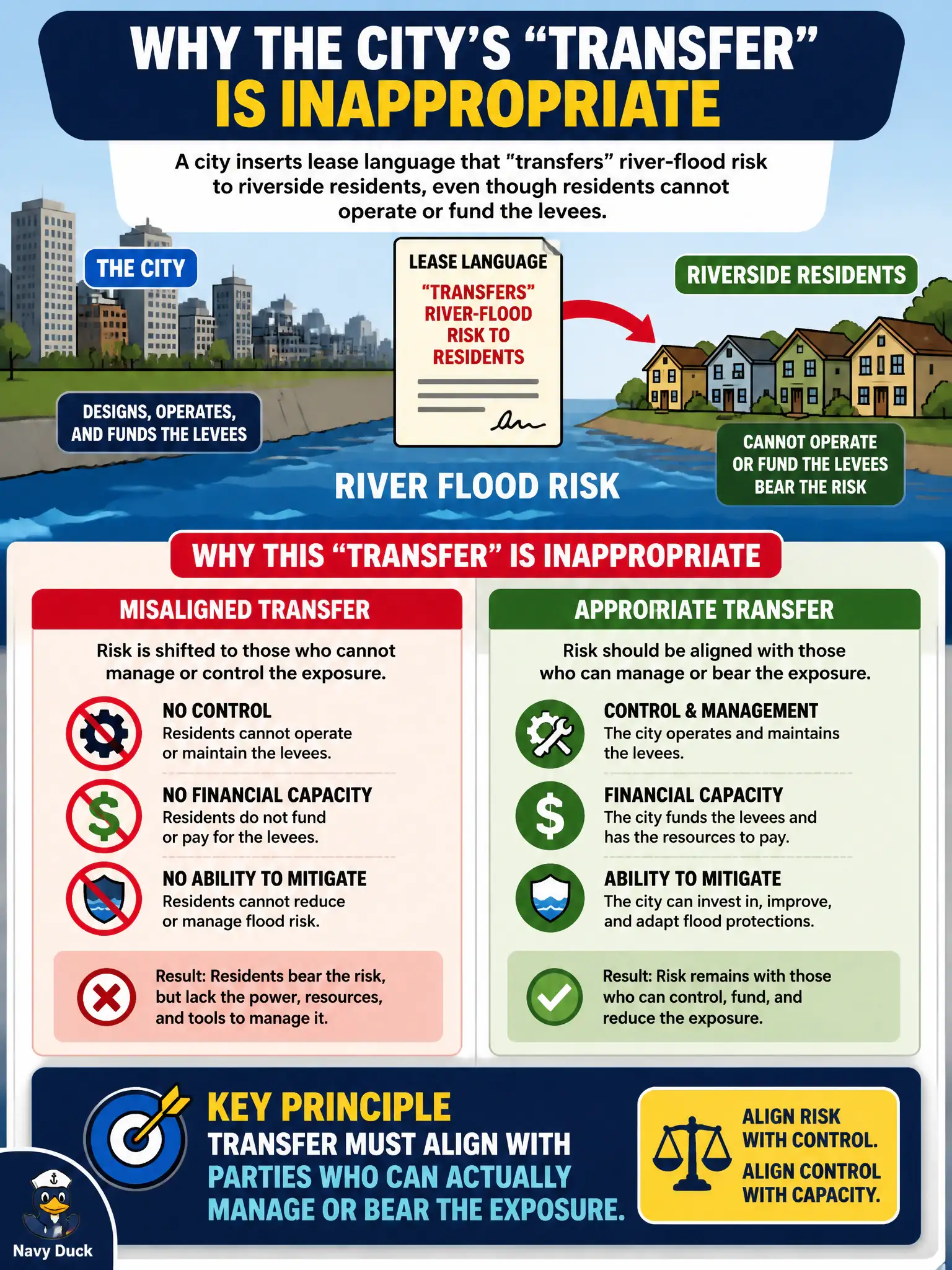
A city inserts lease language that "transfers" river-flood risk to riverside residents, even though residents cannot operate or fund the levees. Why is this transfer inappropriate?
Select an answer to reveal the explanation.
Short Explanation
You can't "transfer" the job of holding back a river to people who don't own the levees or the pumps. Transfer has to land on someone who can actually do something about the exposure — or truly finance it.
Full Explanation
Transfer must align with parties who can actually manage or bear the exposure is why inserting lease language that “transfers” river-flood risk to riverside residents is inappropriate when residents cannot operate or fund the levees. Effective transfer matches authority and capacity. Civic flood risk tied to public levees cannot be wished onto households through lease clauses alone.
Claiming flood risk can only be transferred through social-media announcements fails by concept because announcements are communication, not risk transfer mechanisms with legal and financial capacity. Claiming residents always control levee engineering once a lease clause exists fails because engineering control and funding remain with public agencies regardless of boilerplate. Claiming avoidance requires cities to sell all riverside parcels before any flood season fails because avoidance is one optional strategy (e.g., not building in a floodway); it is not a universal prerequisite and does not validate sham transfer to powerless residents.
Exam caveat: CRMC transfer quality hinges on counterparty ability to manage or bear the risk. Allocating flood responsibility to parties without levee control is ineffective transfer.
Operational check: Review municipal lease and disclosure language for flood; keep public-agency levee and emergency roles clear; use insurance, elevation, and land-use controls with capable parties rather than paper-shifting impossible duties onto residents.