
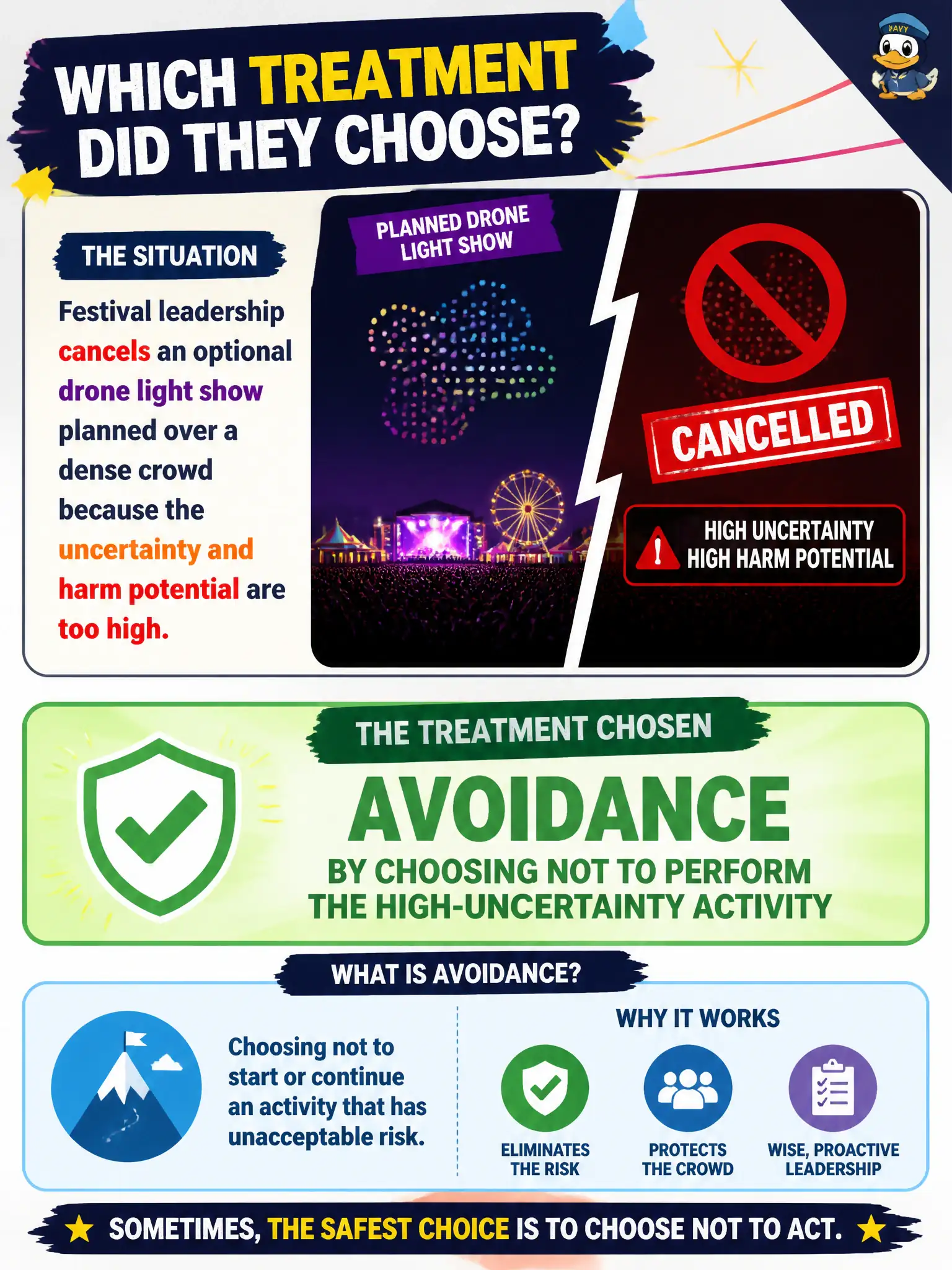
Festival leadership cancels an optional drone light show planned over a dense crowd because the uncertainty and harm potential are too high. Which treatment did they choose?
Select an answer to reveal the explanation.
Short Explanation
Avoidance is the simple move: if the stunt is optional and the downside is ugly, don't do the stunt. Canceling the drone show is choosing not to take that risk — not "managing" it with a shrug.
Full Explanation
Avoidance by choosing not to perform the high-uncertainty activity is what festival leadership did by canceling an optional drone light show over a dense crowd. Avoidance stops the activity when uncertainty and harm potential exceed appetite. Civic event risk management appropriately uses avoidance for optional spectacles that cannot be adequately controlled over crowds.
Reduction by flying the show with only a verbal safety briefing fails as the chosen treatment because they canceled rather than flew with a weak control; a verbal briefing alone would also be inadequate reduction for dense-crowd drone risk. Transfer by asking spectators to sign tickets that mention drones fails because ticket notices are weak transfer/assumption tools and do not match the decision to cancel. Acceptance by running the show unchanged and logging residual fails because the show was not run.
Exam caveat: CRMC avoidance is elective non-performance of an activity. Canceling a high-uncertainty optional show is textbook avoidance, distinct from reduce/transfer/accept paths.
Operational check: For optional festival features, run a go/no-go against crowd density and uncertainty; document avoidance decisions in the event risk plan so sponsors understand why the drone show will not fly.