
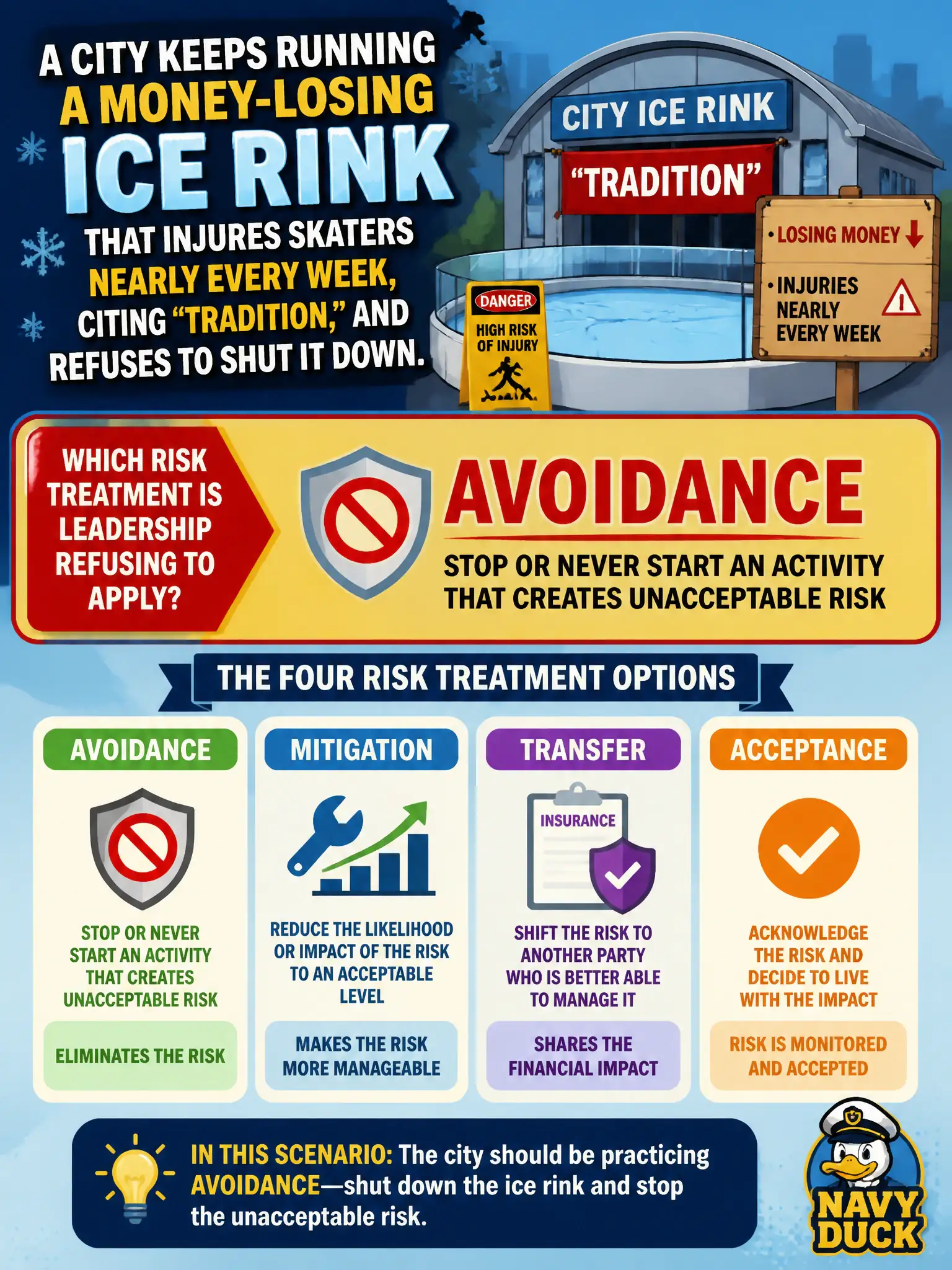
A city keeps running a money-losing ice rink that injures skaters nearly every week, citing "tradition," and refuses to shut it down. Which risk treatment is leadership refusing to apply?
Select an answer to reveal the explanation.
Short Explanation
Think of a restaurant that keeps serving a dish that makes people sick because "we've always had it on the menu." Avoidance means pulling that dish — stopping the activity that creates unacceptable risk. Tradition is not a risk treatment.
Full Explanation
Avoidance—stop or never start an activity that creates unacceptable risk—is the treatment leadership refuses when a money-losing ice rink injures skaters nearly every week yet stays open for “tradition.” Avoidance ends the activity; tradition is not a risk treatment. Civic leaders sometimes must close or cancel offerings whose residual harm stays outside appetite despite feasible lesser treatments.
Acceptance—documenting residual risk after controls are already adequate—fails here by concept because weekly injuries and refusal to shut down show neither adequate controls nor conscious residual acceptance within appetite; labeling tradition as acceptance misuses the term. Transfer—buying more liability insurance while keeping the rink unchanged—fails because insurance moves financial consequences; it does not stop ongoing skater harm and is not avoidance. Reduction—adding wrist guards while leaving operations identical—may help but is not the treatment leadership is refusing in the stem; the stem highlights refusal to stop the activity (avoidance), not refusal of a partial control.
Exam caveat: CRMC risk treatment distinguishes avoid / reduce / transfer / accept. Chronic intolerable harm with refusal to stop the activity is avoided-treatment refusal—not mere acceptance or transfer.
Operational check: Quantify injury rate and mission value of the municipal rink; if residual risk remains outside appetite after reasonable reduction, recommend formal avoidance (suspend/close) with board documentation rather than tradition-based continuance.