
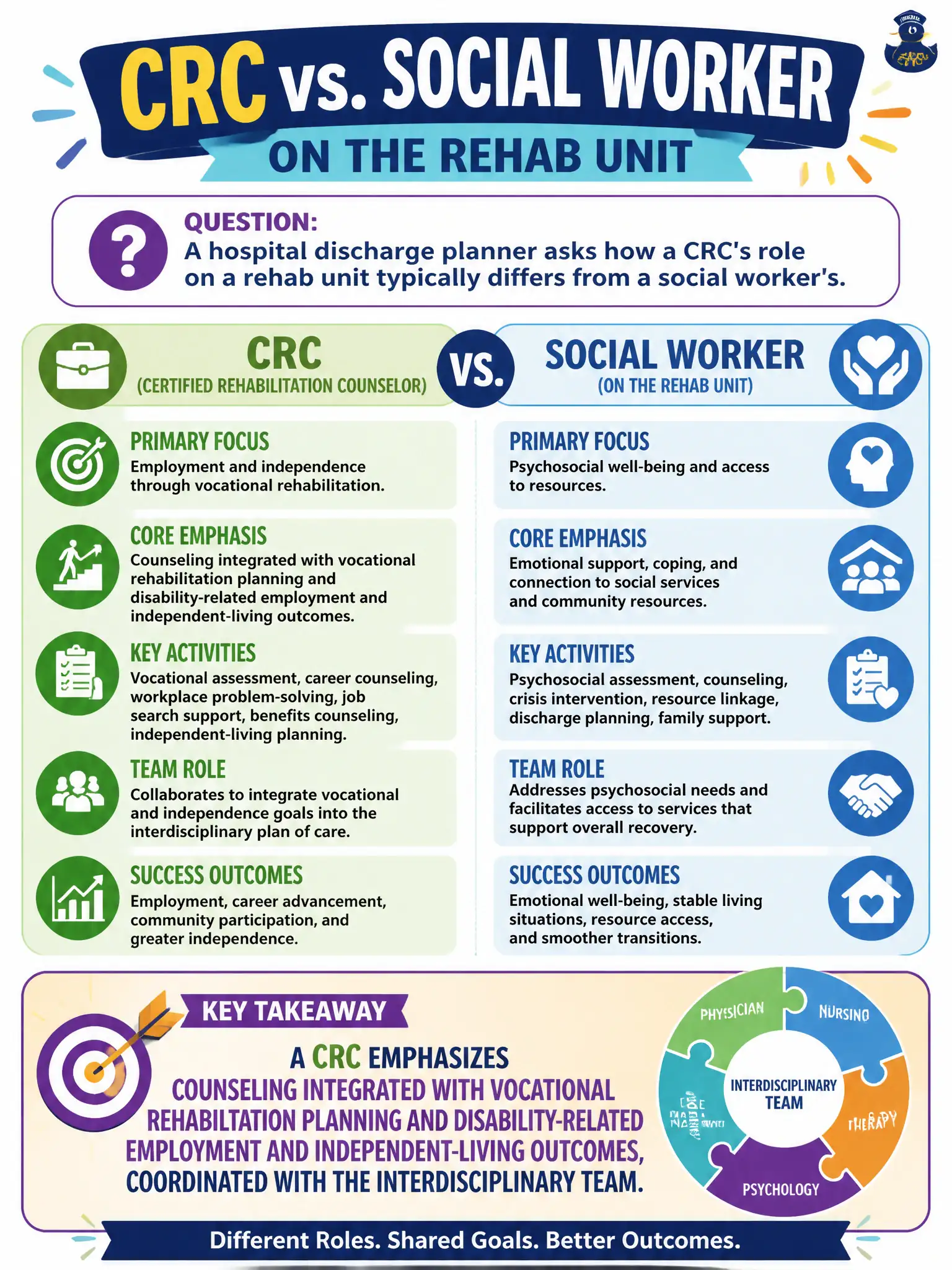
A hospital discharge planner asks how a CRC's role on a rehab unit typically differs from a social worker's. Which emphasis best reflects CRC professional identity?
Select an answer to reveal the explanation.
Short Explanation
On a rehab unit, the CRC's distinctive stripe is counseling plus vocational/rehab outcomes — working the employment and independent-living angle alongside the team, not swapping places with medicine or pure case paperwork.
Full Explanation
On a hospital rehab unit, CRC professional identity emphasizes counseling integrated with vocational rehabilitation planning and disability-related employment and independent-living outcomes, coordinated with the interdisciplinary team. That differs from social work’s typical emphasis areas even when roles collaborate closely. CRCs do not replace physicians for diagnosis and prescribing, nor are they limited to clerical scheduling.
Claiming the CRC replaces physicians for medical diagnosis and prescribing fails by concept because medical decision-making remains with licensed medical providers. Reducing the CRC to clerical scheduling fails because counseling and vocational planning are core to the credential’s identity. Declaring CRC and social work scopes identical so distinctions are never discussed fails because overlapping teams still require clear role negotiation for discharge and community planning.
Exam caveat: exact role boundaries vary by facility privilege lists—know local scope while holding the vocational-counseling center of CRC identity. Operational check: in team rounds, state the CRC contribution as counseling, vocational assessment, and community employment/IL planning; document coordination with SW, OT/PT, and medicine without overstepping medical scope.