
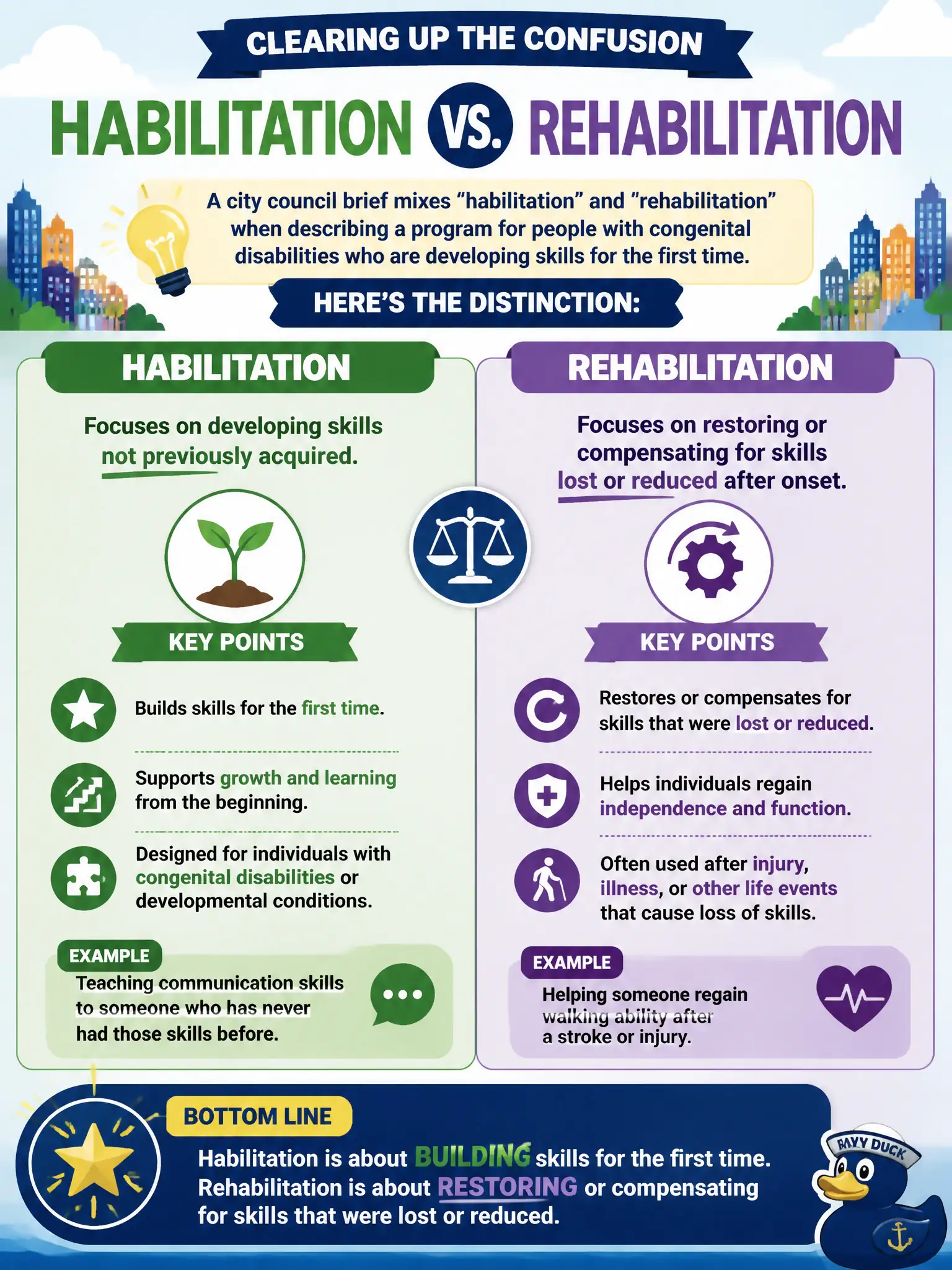
A city council brief mixes "habilitation" and "rehabilitation" when describing a program for people with congenital disabilities who are developing skills for the first time. Which distinction should the counselor provide?
Select an answer to reveal the explanation.
Short Explanation
Habilitation is building skills that were never there; rehabilitation is getting back — or working around — what was lost. Congenital first-skill work usually sits on the habilitation side of that line.
Full Explanation
City council briefs on programs for people with congenital disabilities should distinguish habilitation from rehabilitation. Habilitation focuses on developing skills not previously acquired; rehabilitation focuses on restoring or compensating for skills lost or reduced after onset. That distinction drives service design, funding narratives, and realistic goal writing in civic disability programs.
Calling the terms identical with no service-design difference fails by concept because first-time skill development and restoration/compensation imply different baselines and interventions. Assigning rehabilitation only to children and habilitation only to older adults fails because the distinction is about skill history and onset, not age brackets. Defining habilitation as medical cure and rehabilitation as denying community supports fails as a distortion of both concepts.
Exam caveat: some funding streams use “habilitation” in IDD or early-intervention contexts with specific regulatory meanings—match local definitions when writing grants. Operational check: label program components accurately in council materials, write goals that state whether skills are being newly developed or restored, and align staffing (developmental vs. restorative approaches) to that frame.