
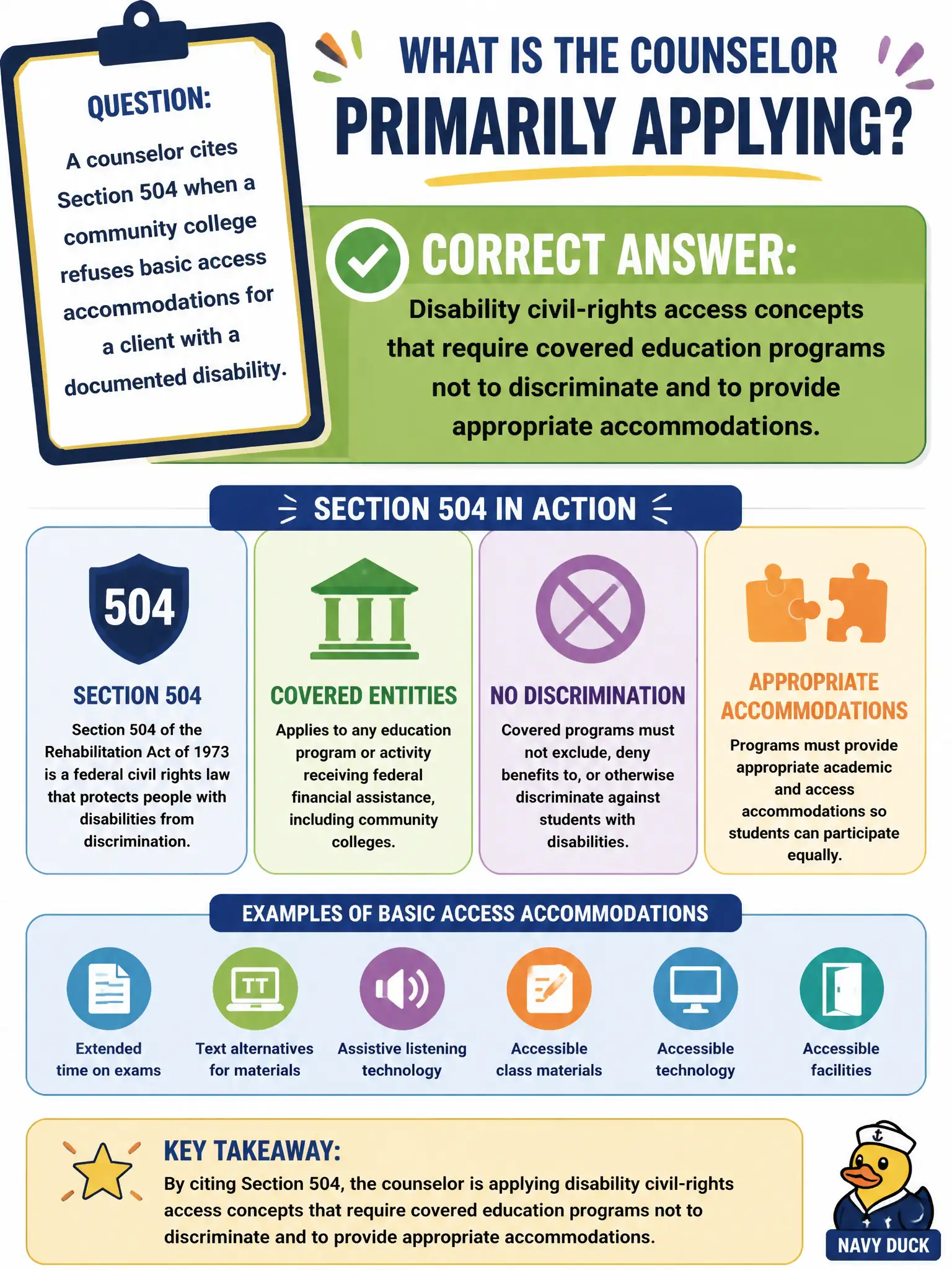
A counselor cites Section 504 when a community college refuses basic access accommodations for a client with a documented disability. What is the counselor primarily applying?
Select an answer to reveal the explanation.
Short Explanation
Section 504 is the access lever in many education settings — it is about nondiscrimination and needed accommodations, not rewriting every course for everyone.
Full Explanation
When a community college refuses basic access accommodations for a documented disability, citing Section 504 applies disability civil-rights access concepts: covered education programs must not discriminate and must provide appropriate accommodations. Section 504 is not a job-placement mandate into permanent staff roles, is not limited to employees, and does not require rewriting academic difficulty for all students.
Treating Section 504 as a requirement that the college hire the client into permanent staff fails by concept because nondiscrimination and access accommodations are distinct from an entitlement to employment at the institution. Claiming Section 504 never protects students in postsecondary settings fails because students in covered programs are within the civil-rights frame counselors commonly apply. Assuming an automatic mandate to rewrite curriculum difficulty for everyone fails because accommodations address equal access, not universal elimination of academic standards.
Exam caveat: coverage, documentation standards, and the boundary between accommodation and fundamental alteration are case-specific; counselors advocate access without promising grade modification as a right. Operational check: help the client request accommodations through disability services with documentation, document barriers, and escalate through the college’s grievance process when access is refused without interactive consideration.