
A school-to-work transition counselor must explain how IDEA transition planning differs from adult VR eligibility. Which distinction is most accurate?
Select an answer to reveal the explanation.
Short Explanation
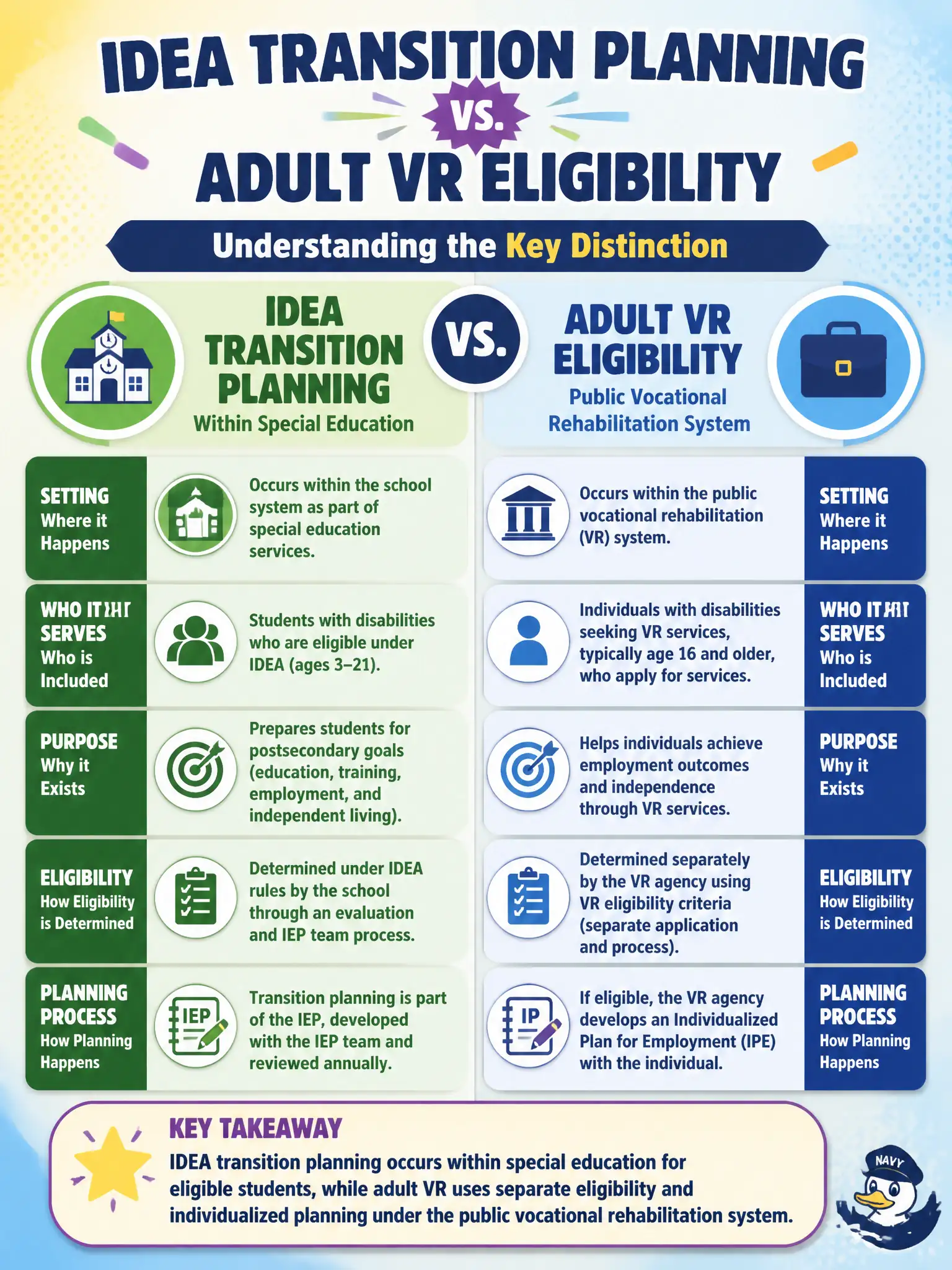
School transition under IDEA and adult VR are neighboring highways, not the same lane. One lives in special education; the other has its own adult eligibility and planning rules.
Full Explanation
School-to-work transition counseling in civic education and adult VR systems requires a clean distinction: IDEA transition planning occurs within special education for eligible students, while adult VR uses separate eligibility determination and individualized planning under the public vocational rehabilitation program. An IEP does not automatically create adult VR entitlement; systems coordinate but do not collapse into one eligibility rule.
Claiming identical eligibility so an IEP auto-creates adult VR entitlement fails by concept because adult VR applies its own eligibility criteria and order-of-selection realities. Saying adult VR replaces IDEA at age 14 and ends school transition immediately fails because IDEA transition planning continues in school while VR collaboration may begin—ages and processes are coordinated, not a hard swap that voids IDEA. Asserting only IDEA addresses employment and VR is limited to medical restoration fails because adult VR centers vocational goals, not merely medical services.
Exam caveat: age milestones (e.g., when transition planning must begin) and interagency agreements vary; do not invent a universal age where one law extinguishes the other. Operational check: map which document governs which setting (IEP vs. IPE), clarify referral timing to VR, and help families understand dual systems rather than promising automatic adult entitlement from school eligibility alone.