
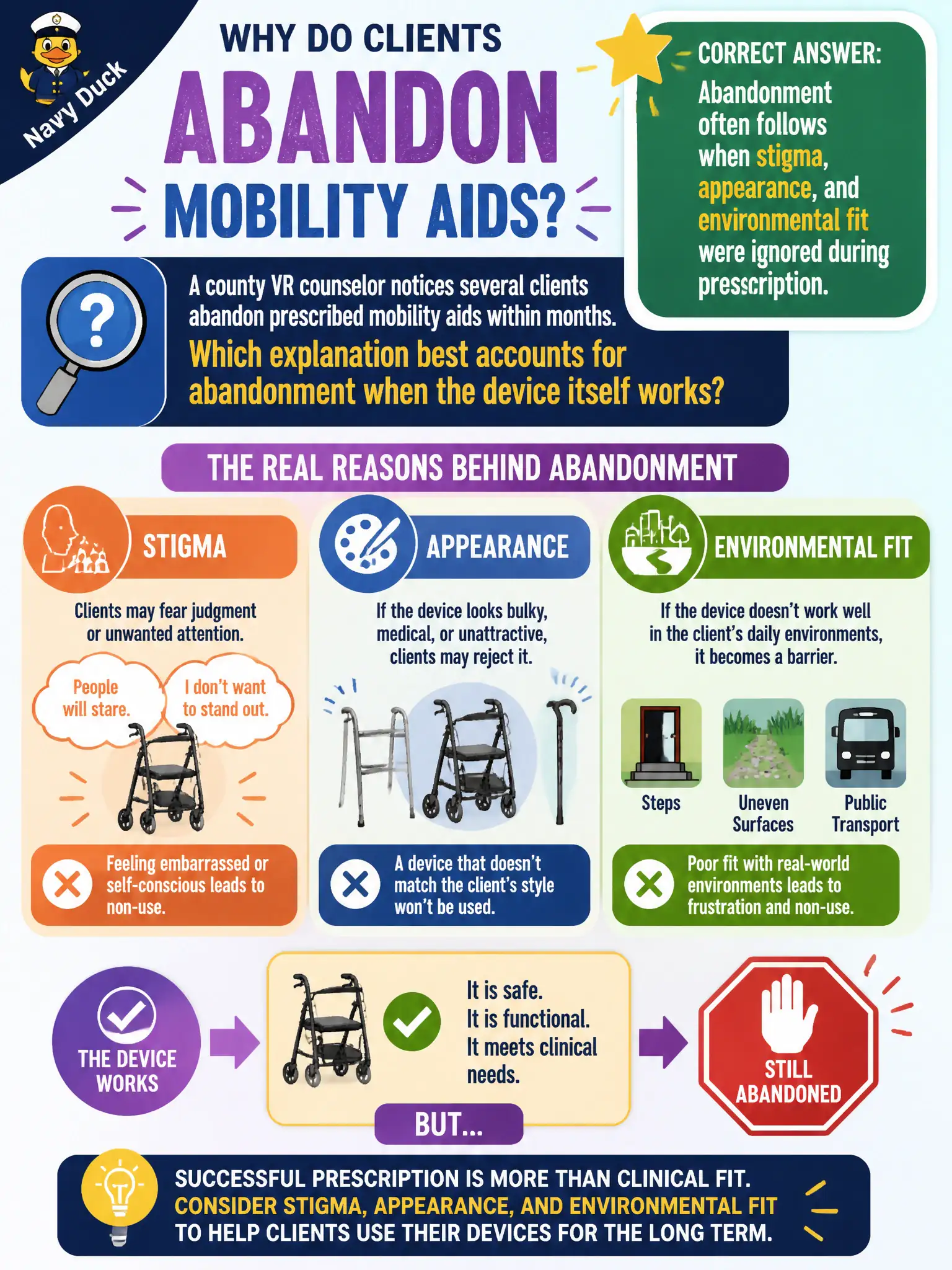
A county VR counselor notices several clients abandon prescribed mobility aids within months. Which explanation best accounts for abandonment when the device itself works?
Select an answer to reveal the explanation.
Short Explanation
Think of a perfectly good umbrella that never leaves the closet because it looks awkward and there is nowhere to hang it at work. The tool can work and still get ditched when stigma and the real environment were never part of the plan. Matching the device to how people feel and where they live beats handing over hardware alone.
Full Explanation
When prescribed mobility aids work mechanically yet clients abandon them within months, the usual drivers are psychosocial and environmental: stigma, appearance concerns, and poor fit with real community settings that were ignored during prescription. Device abandonment is rarely ‘inevitable’ or purely anti-technology principle; counseling and AT processes must address acceptance and environmental usability. County VR counselors who follow up on AT use catch these factors early.
Assuming abandonment mainly proves the prescription was medically incorrect and needs a stronger model medicalizes a psychosocial/environmental problem. Claiming clients abandon devices mainly because they refuse all AT on principle stereotypes without assessment. Declaring abandonment inevitable and unrelated to psychosocial or environmental factors excuses poor person-environment-device matching.
Exam caveat: working devices still get abandoned when stigma, appearance, and environmental fit were ignored—look beyond mechanics alone.
Operational check: interview abandoners about stigma, cosmetics, and where the device fails in real environments; involve AT specialists in contextual fitting; plan peer support and follow-up use checks after issuance.