
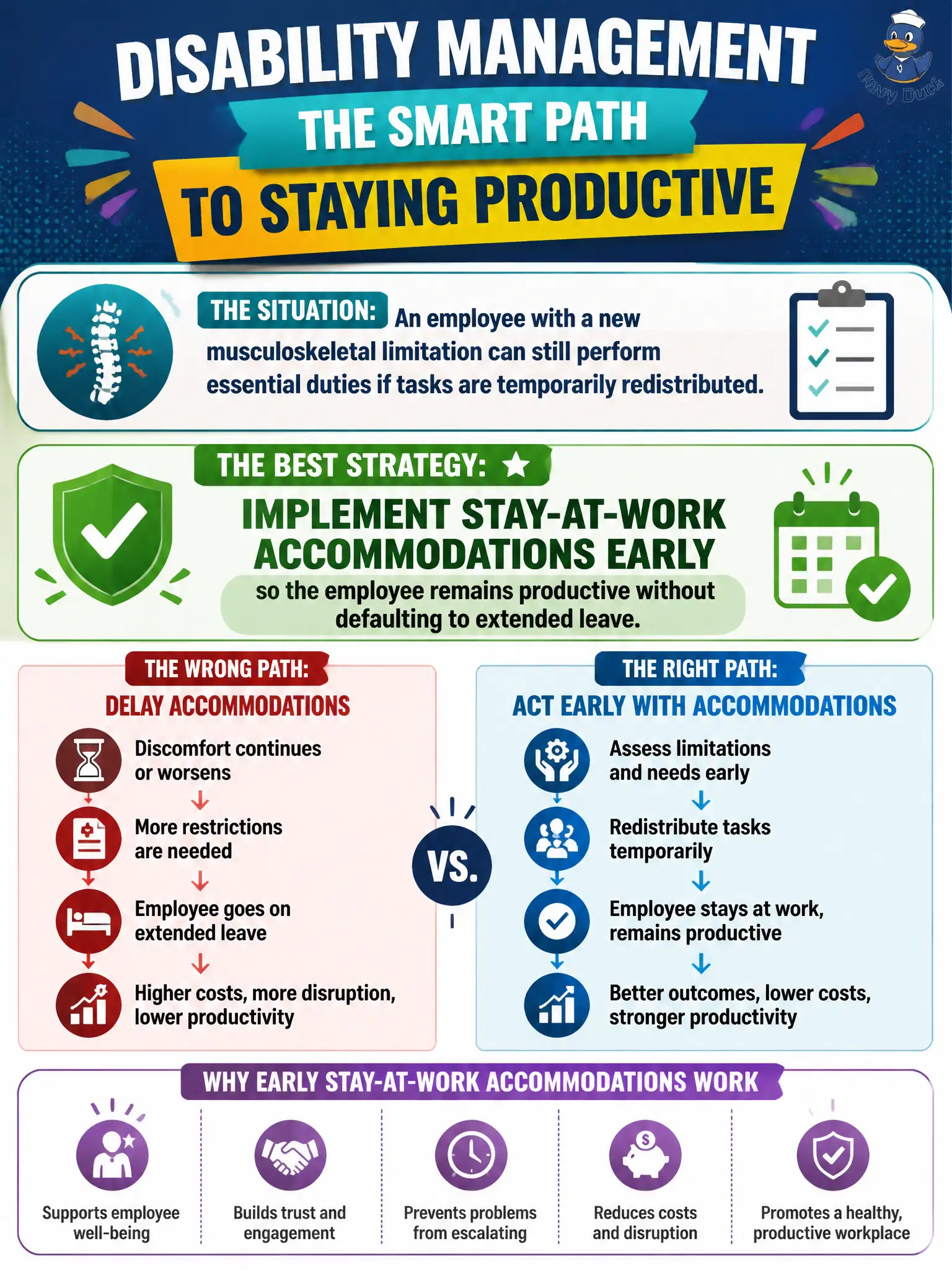
An employee with a new musculoskeletal limitation can still perform essential duties if tasks are temporarily redistributed. Which disability-management strategy best prevents unnecessary leave escalation?
Select an answer to reveal the explanation.
Short Explanation
Stay-at-work is like fixing a small leak before you call the flood crew. If a few task tweaks keep someone safe and productive, you often dodge a long leave spiral. Jumping straight to leave or waiting for a crash usually costs everyone more.
Full Explanation
Stay-at-work accommodations implemented early—such as temporary task redistribution so essential duties continue—best prevent unnecessary leave escalation when a municipal employee has a new musculoskeletal limitation. Keeping the worker productively connected reduces disability duration and supports employer continuity. Placing the employee on unpaid leave immediately to avoid any workplace accommodation discussion chooses absence over reasonable problem-solving. Waiting until performance fails completely before considering any job modification allows preventable deterioration and discipline risk. Requiring a permanent demotion as the only alternative to full leave ignores temporary accommodation and transitional duty options. Exam caveat: accommodations must fit essential functions and medical restrictions; stay-at-work is not a demand to ignore safety limits or ADA interactive-process requirements in civic employment. Operational check: convene an early stay-at-work discussion with employee and supervisor, document temporary task redistributions tied to restrictions, set a review date for progression, and avoid defaulting to extended leave when productive accommodated work remains feasible.