
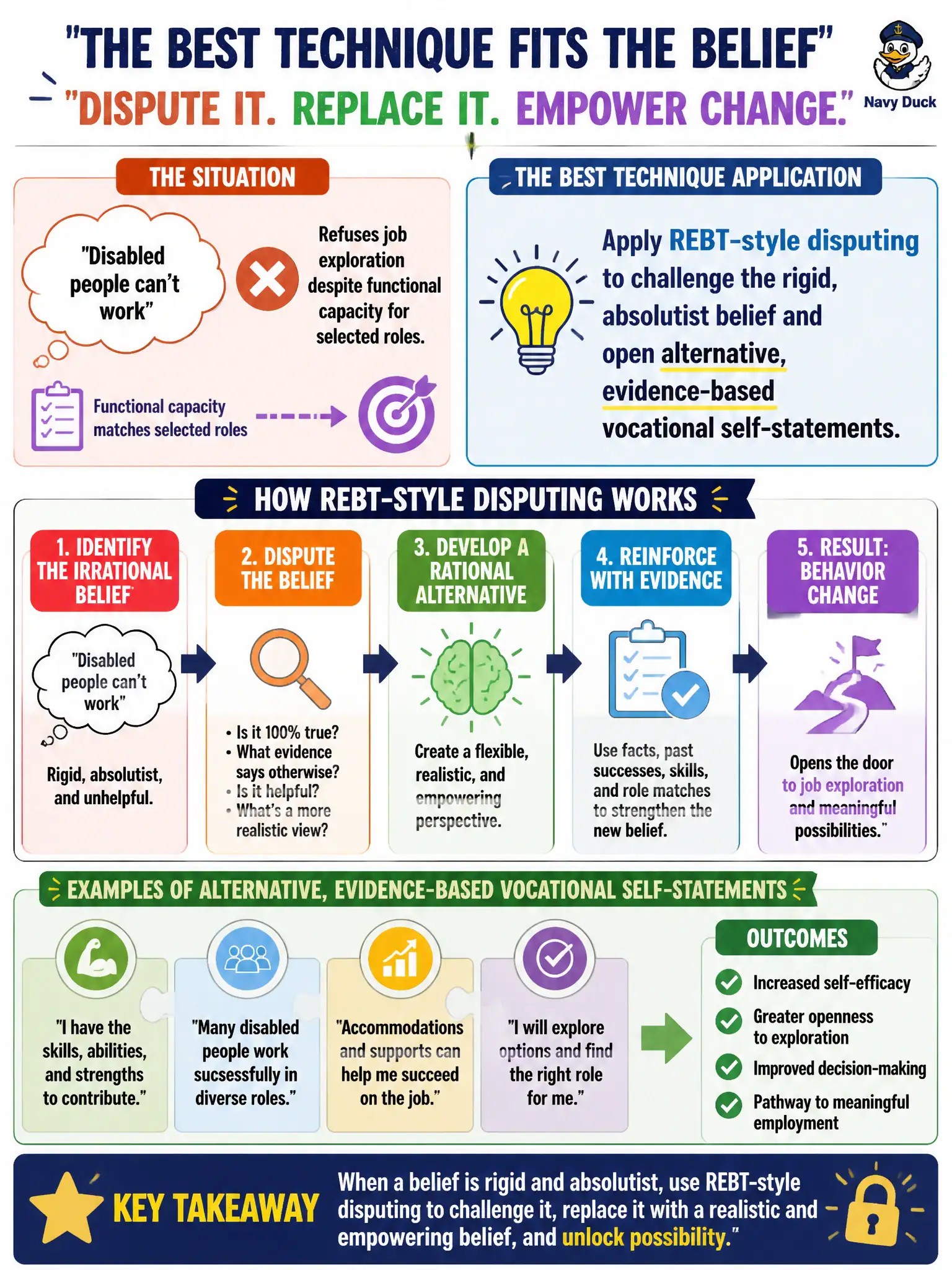
A client holds an absolute belief that “disabled people can’t work” and refuses job exploration despite functional capacity for selected roles. Which individual counseling technique application fits best?
Select an answer to reveal the explanation.
Short Explanation
Absolute beliefs are like locked doors with no windows—“disabled people can’t work” shuts the whole hallway. REBT-style disputing knocks on that rigid rule, checks the evidence, and builds truer vocational self-talk. Agreement without challenge leaves the lock in place.
Full Explanation
A client’s absolute belief that “disabled people can’t work,” despite functional capacity for selected roles, fits REBT-style disputing to challenge the rigid, absolutist belief and open alternative, evidence-based vocational self-statements. Civic counseling confronts internalized ableism as a cognitive barrier to informed vocational exploration.
Agreeing fully with the absolute belief to avoid cognitive challenge fails by concept as collusion with a vocationally disabling cognition. Using only medication education and never addressing beliefs fails because the barrier described is cognitive/attitudinal, not solely pharmacologic. Ending counseling because cognitive techniques are never used in rehab fails against common use of cognitive approaches in rehabilitation counseling.
Exam caveat: disputing is collaborative and respectful—challenge the belief’s absolutism, not the client’s worth—and pair cognitive work with real success experiences. Operational check: identify the absolute statement, dispute empirically and logically, generate flexible alternatives, assign behavioral experiments (informational interviews, tryouts), and track belief change alongside exploration activity.