
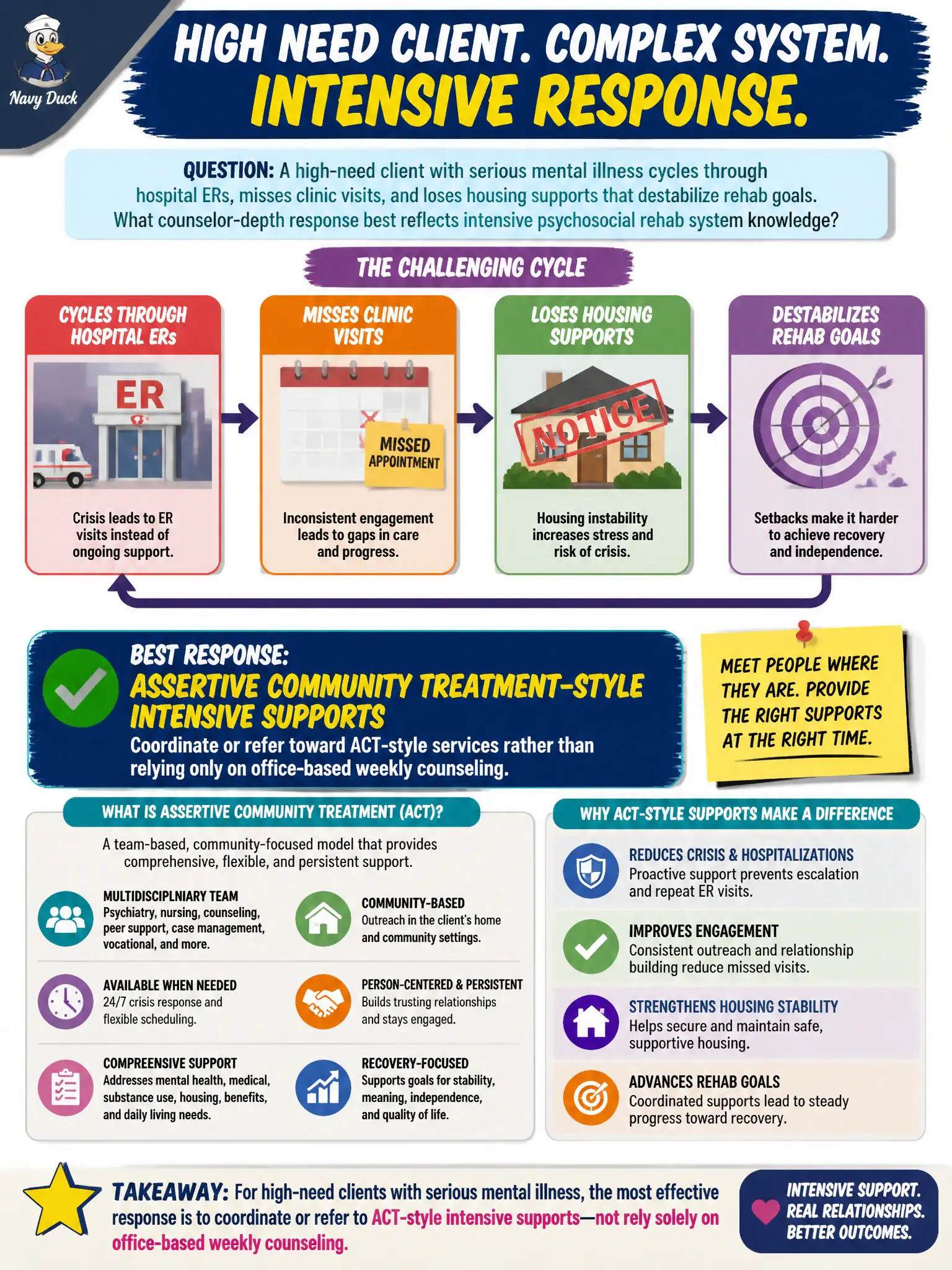
A high-need client with serious mental illness cycles through hospital ERs, misses clinic visits, and loses housing supports that destabilize rehab goals. What counselor-depth response best reflects intensive psychosocial rehab system knowledge?
Select an answer to reveal the explanation.
Short Explanation
When someone keeps bouncing through ERs and vanishing between visits, a once-a-week office chat is like a garden hose on a house fire. Intensive, outreach-heavy coordination—ACT-style supports—meets people where chaos lives, then rehab goals have a chance to stick.
Full Explanation
A high-need client cycling through ERs, missing clinic visits, and losing housing supports that destabilize rehab goals needs intensive psychosocial rehab system knowledge: consider coordinating or referring toward assertive community treatment–style intensive supports rather than relying only on office-based weekly counseling. Civic continuity of care for serious mental illness often requires outreach, multidisciplinary teams, and housing linkage.
Scheduling one annual office visit and waiting for spontaneous stabilization fails by concept as inadequate intensity for high utilizer patterns. Discharging from VR immediately because hospital use proves permanent inability to work fails by equating crisis utilization with lifelong unemployability. Replacing all clinical care with motivational posters and unsupervised peer-only chat fails as an unserious substitute for intensive treatment systems.
Exam caveat: ACT eligibility and availability vary locally; the concept is matching intensity to need, not naming one brand as the only option. Operational check: map crisis drivers (housing, meds, engagement), initiate referral to intensive community treatment or equivalent outreach, maintain VR goals at a paced level, and coordinate rather than duplicate crisis response.