
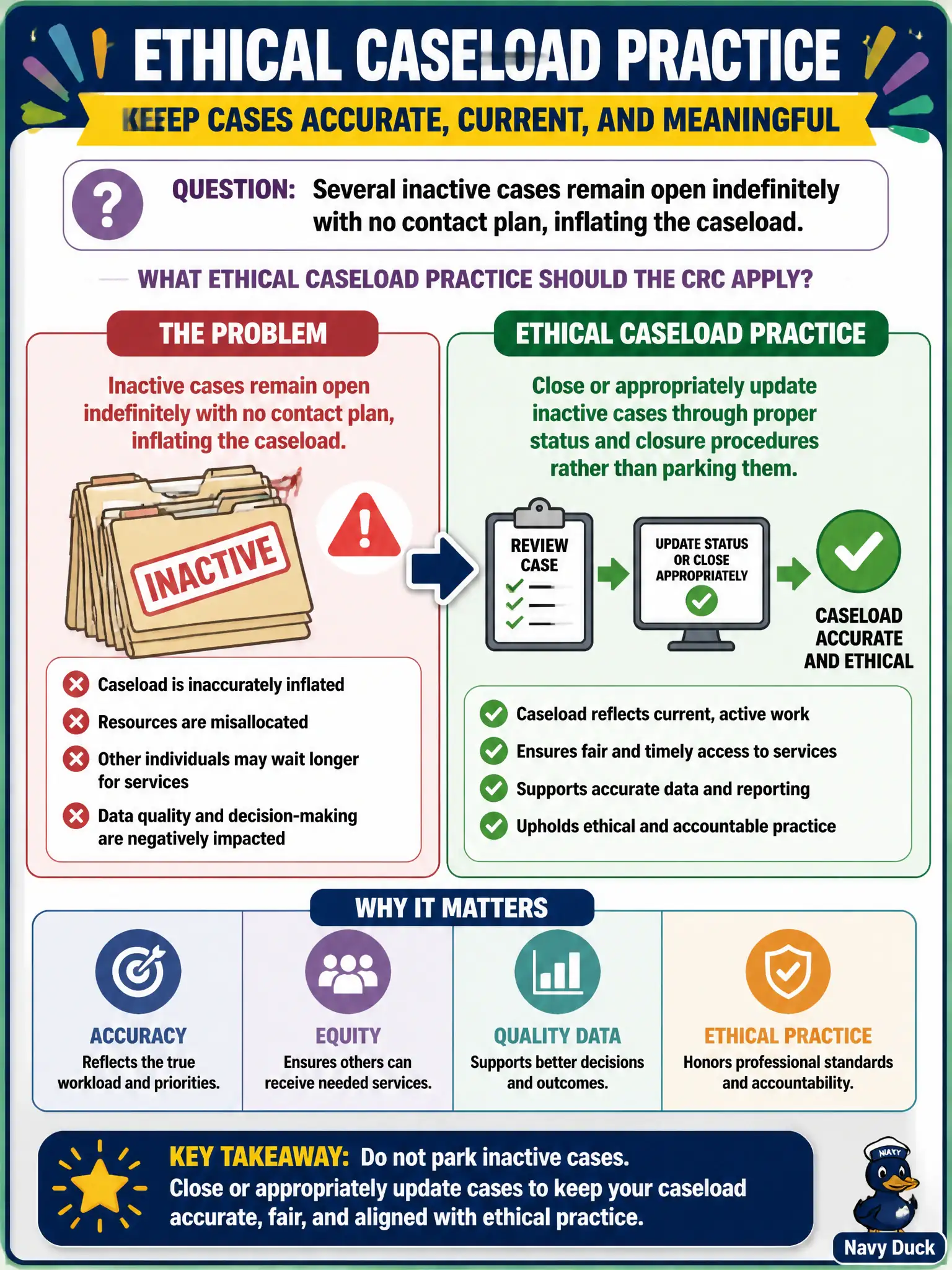
Several inactive cases remain open indefinitely with no contact plan, inflating the caseload. What ethical caseload practice should the CRC apply?
Select an answer to reveal the explanation.
Short Explanation
Parking dead cases forever is like leaving every light on in an empty building—it wastes capacity and hides the real workload. Close or update status the right way so the caseload stays honest.
Full Explanation
Ethical caseload practice in municipal agencies requires closing or appropriately updating inactive cases through proper status and closure procedures rather than parking them open indefinitely. Inactive cases with no contact plan inflate headcount, hide true workload, and can deprive other residents of counselor capacity. Honest status management keeps public rehabilitation caseloads accurate and actionable. Keeping inactive cases open forever to protect historical statistics prioritizes optics over ethical stewardship. Hiding inactive cases in personal folders outside the official system creates shadow records and audit risk. Transferring all inactive cases to interns without documentation or consent dumps responsibility without proper transition, supervision, or client agreement. Exam caveat: some cases may remain open with a documented monitoring plan; the target problem is indefinite inactivity without contact or status integrity. Operational check: generate a list of cases with no contact beyond the agency threshold, determine close versus update-with-plan for each, complete required closure or status paperwork, and verify the official civic caseload no longer counts abandoned files as active work.