
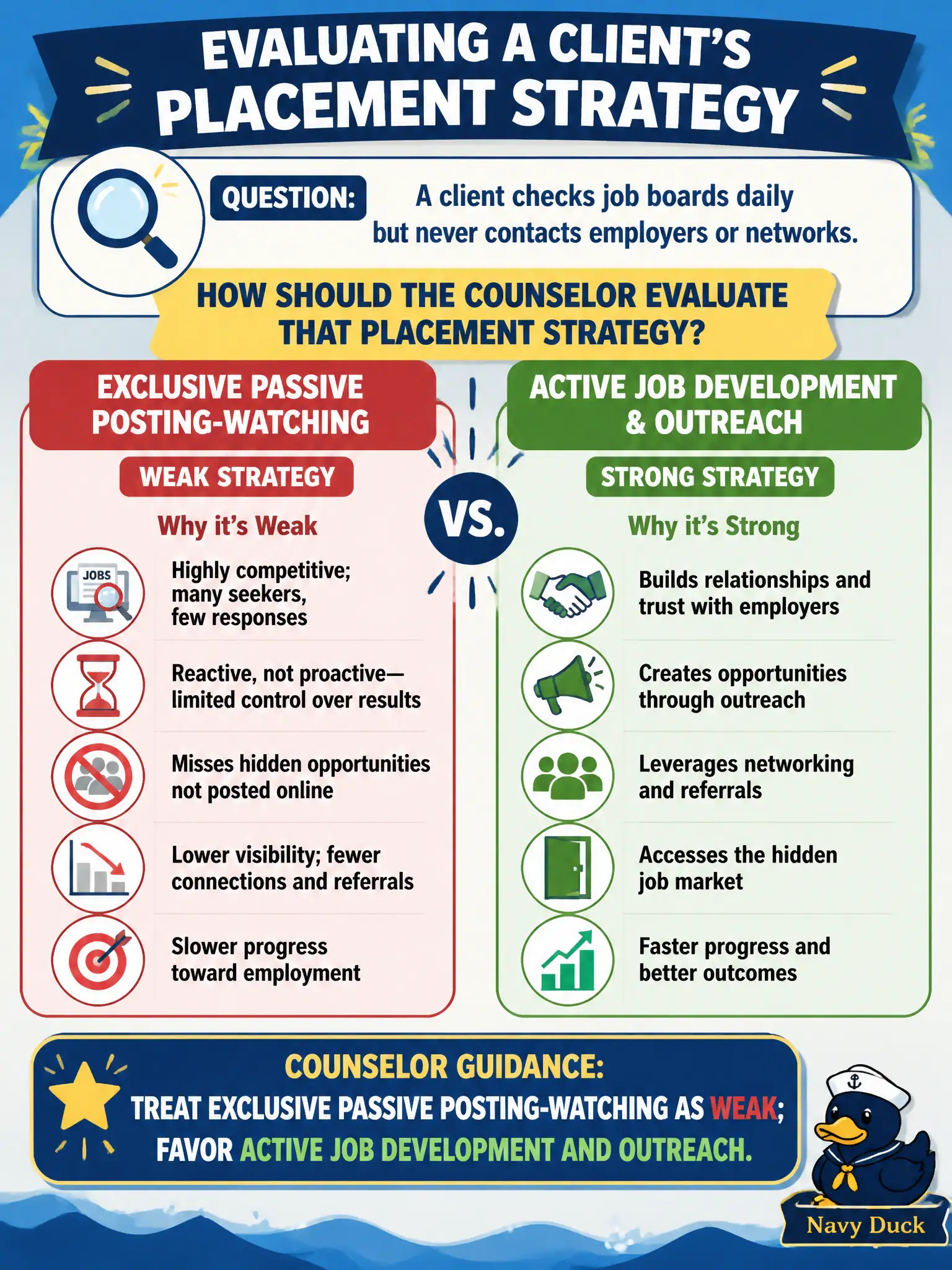
A client checks job boards daily but never contacts employers or networks. How should the counselor evaluate that placement strategy?
Select an answer to reveal the explanation.
Short Explanation
Refreshing a job board is like window-shopping with empty pockets — interesting, but nothing moves. Active outreach and job development open doors that never get posted. Watching alone is a weak placement diet.
Full Explanation
Exclusive passive watching of job boards is a weak placement strategy because openings that fit disability-related needs are often filled through active development, outreach, and relationship work. Counselors should favor active job development—contacting employers, clarifying staffing needs, and coaching outreach—while still using postings as one information source. Praising exclusive board-watching as the gold standard fails because it confuses information gathering with job development and leaves civic employers who never post accessible roles untouched. Requiring the client to stop reading postings entirely before any applications fails because postings remain useful market signals; the problem is exclusivity, not literacy about openings. Replacing all client-driven search with sealed records and no employer conversation fails because silence about skills and supports prevents matching and retention planning. Exam caveat: some clients need graded activation—board monitoring can be a starting habit—but the counseling goal is movement into outreach and applications with supports. Operational check: if a weekly log shows only board views and zero employer contacts or submitted applications, redesign the plan with concrete outreach targets and practice scripts before the next case review.