
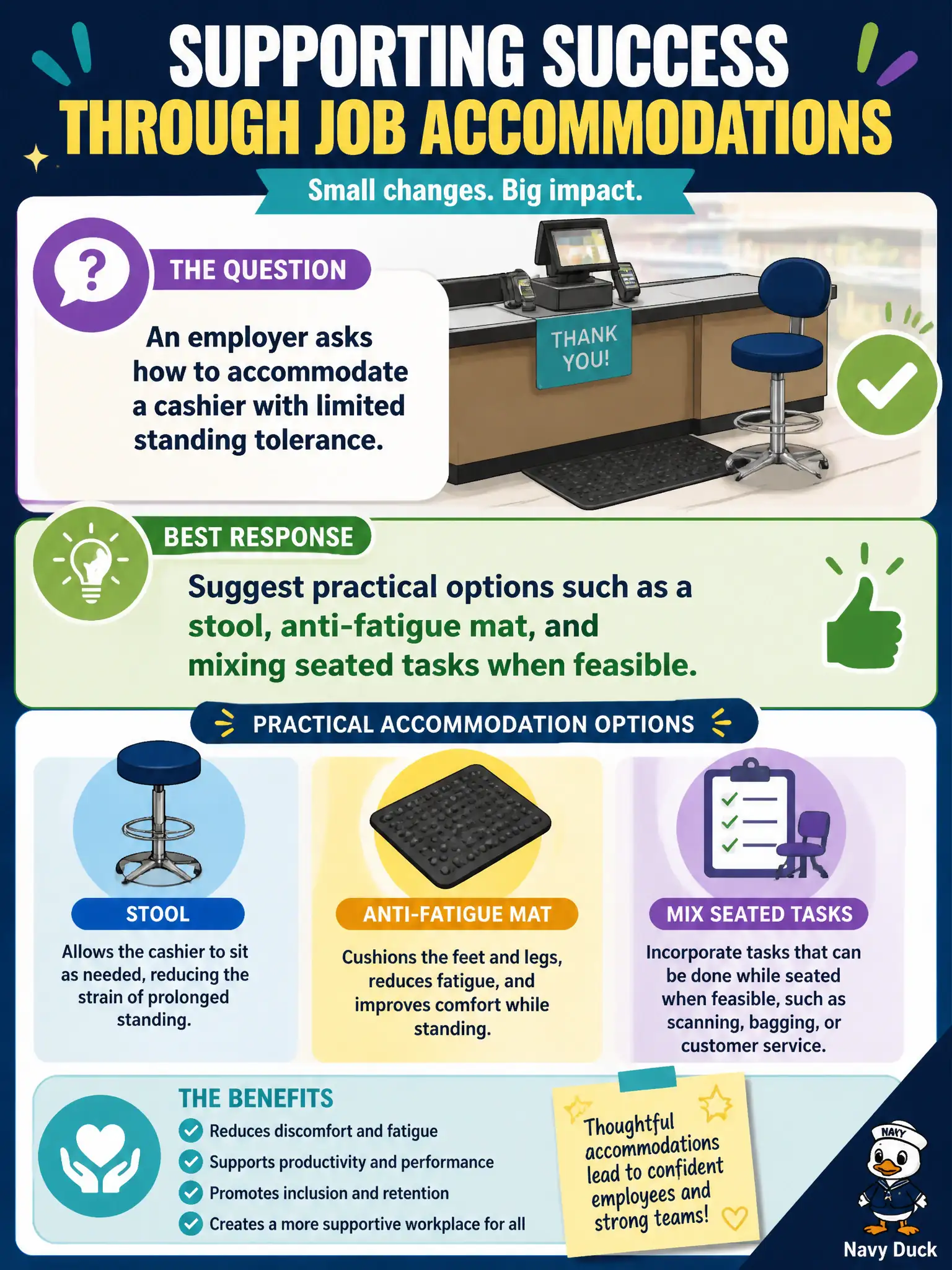
An employer asks how to accommodate a cashier with limited standing tolerance. Which counselor response best assists with job accommodations?
Select an answer to reveal the explanation.
Short Explanation
Cashiers don’t always need to be statues—a stool, a mat, and a smarter task mix can keep the register ringing. Employers often just need concrete ideas, not a lecture. You’re the translator between body limits and doable fixes.
Full Explanation
When an employer asks how to accommodate a cashier with limited standing tolerance, the counselor assists with practical options such as a stool, anti-fatigue mat, and mixing seated tasks when feasible—supports that preserve essential cashier functions while reducing pain and fatigue. That consultation style models the interactive process in business language supervisors can use. Telling the employer no cashier role can ever be modified fails because many retail essential functions—transactions, customer interaction, till accuracy—can be met with positional and task-mix changes. Recommending immediate termination to avoid accommodation discussion fails ethically as a consultation stance and abandons problem-solving that often costs less than replacement hiring. Insisting the only solution is a full career change with no workplace changes fails because job accommodation is frequently less disruptive than separation and a new placement cycle. Exam caveat: counselors provide rehabilitation consultation, not formal legal rulings on undue hardship; complex disputes may need HR counsel or external accommodation resources such as JAN-style guidance. Operational check: list essential cashier tasks, propose two to three low-cost positional or schedule-mix accommodations, and ask the employer which options they will trial with a dated review.