
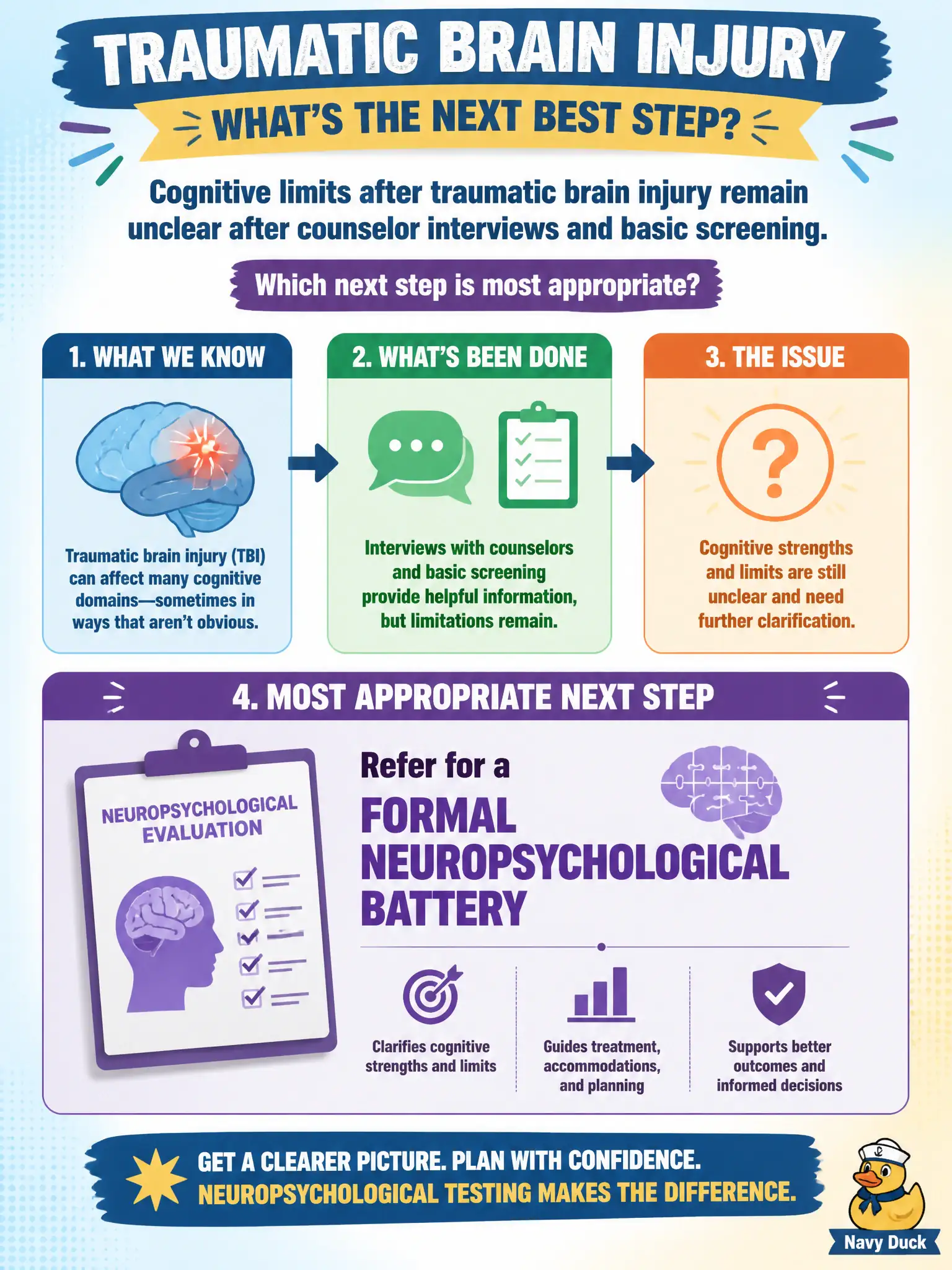
Cognitive limits after traumatic brain injury remain unclear after counselor interviews and basic screening. Which next step is most appropriate?
Select an answer to reveal the explanation.
Short Explanation
When the fog will not clear with a flashlight, you call in better instruments. Unclear TBI cognition is a classic cue to refer for formal neuropsychological testing. Guessing from chatty sessions alone can miss real vocational risks.
Full Explanation
When cognitive limits after TBI remain unclear after interviews and basic screening, referral for a formal neuropsychological battery is the appropriate next step to clarify strengths and limits. Conversation skill in session is not a full cognitive exam, and online brain games are not definitive measures. Public VR systems rely on neuropsychology when planning stakes require clearer cognitive mapping.
Concluding cognition is intact because the client converses well underestimates hidden attention, memory, or executive deficits. Assigning competitive employment immediately to ‘test cognition on the job’ without assessment risks failure and safety issues. Using only a five-minute online brain game as the definitive measure lacks clinical adequacy.
Neuropsychological clarification prevents both under-challenge and unsafe over-placement after TBI in competitive community jobs.
Exam caveat: unclear post-TBI cognition after screening → formal neuropsychological referral, not assumptions or toy measures.
Operational check: refer for neuropsychological evaluation; provide functional questions to the examiner; pause high-stakes placement until results inform accommodations and targets.