
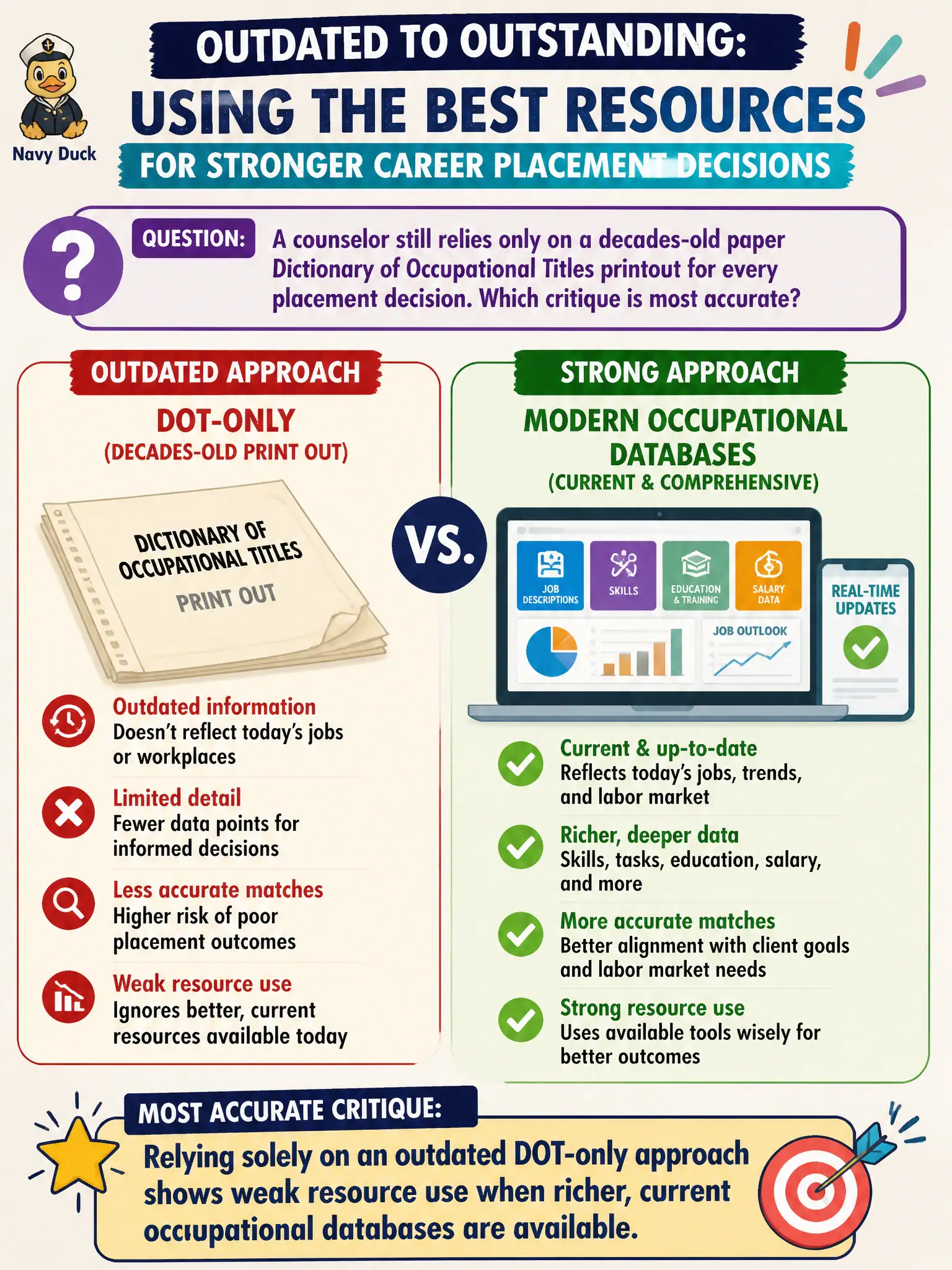
A counselor still relies only on a decades-old paper Dictionary of Occupational Titles printout for every placement decision. Which critique is most accurate?
Select an answer to reveal the explanation.
Short Explanation
Using only a dusty old phone book when everyone else has a live directory is asking for wrong numbers. Occupational data age out — titles, tools, and demand shift. Updating to current databases is part of using assessment resources well, not optional trivia.
Full Explanation
Relying solely on a decades-old paper Dictionary of Occupational Titles printout for every placement decision shows weak resource use when richer, current occupational databases are available. Occupational information ages; modern rehab practice integrates updated sources while understanding DOT history. Public VR quality improvement includes retiring outdated-only workflows.
Insisting paper DOT volumes remain the only acceptable source ignores contemporary databases and labor-market change. Claiming any non-DOT database violates ethics invents a prohibition that does not exist. Asserting occupational information never changes so the oldest edition always suffices is factually false.
Current occupational databases capture task and technology change the old paper DOT cannot; dual literacy (DOT history plus modern sources) is expected professional competence.
Exam caveat: outdated DOT-only practice is criticized; counselors should use current occupational information resources.
Operational check: supplement or replace sole paper-DOT reliance with current occupational databases; verify titles, demands, and outlook against up-to-date sources before finalizing placements. Re-verify length and fidelity of the written plan at the next supervisory case review so civic accountability stays visible.