
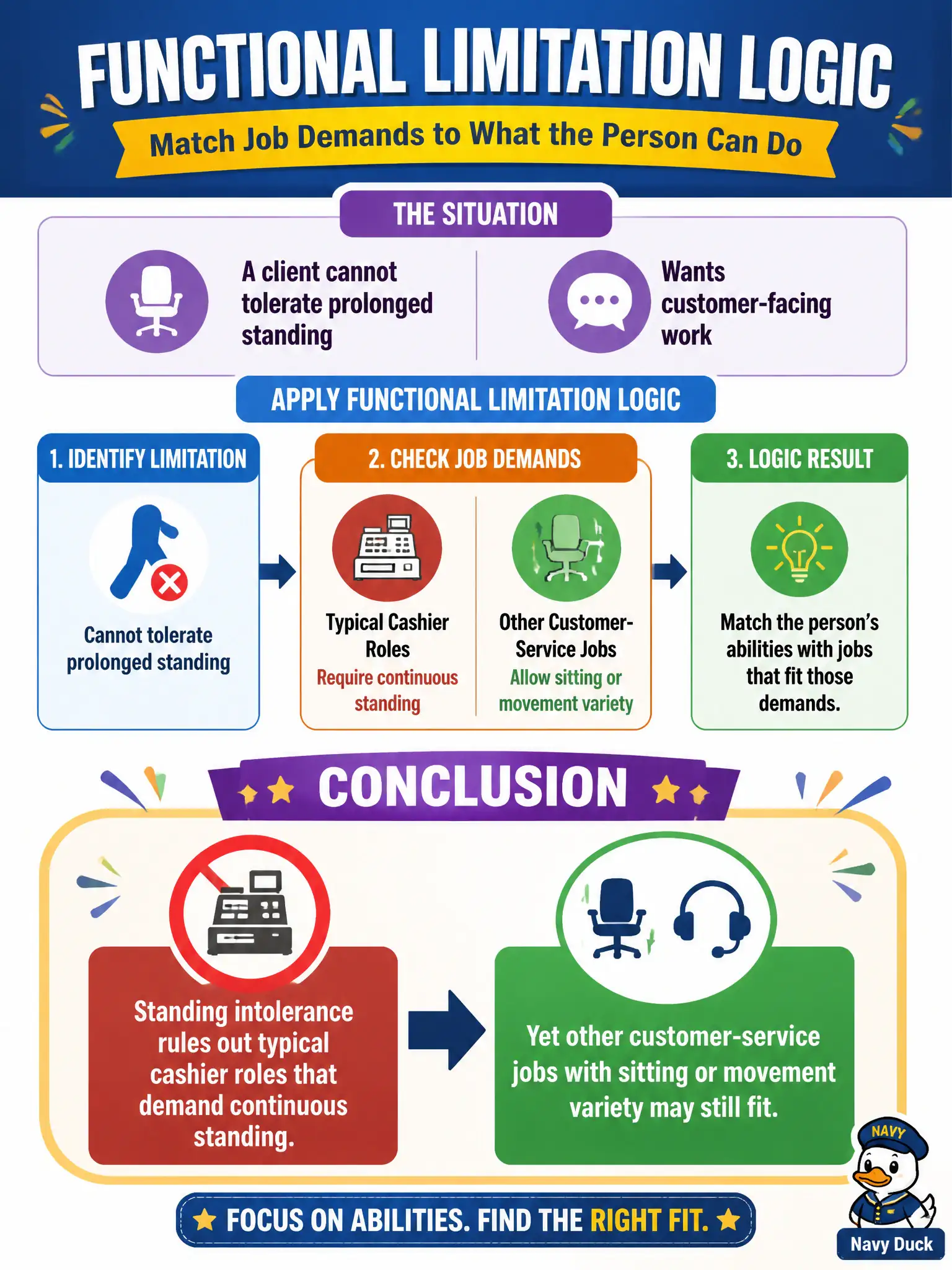
A client cannot tolerate prolonged standing but wants customer-facing work. Which conclusion follows from functional limitation logic?
Select an answer to reveal the explanation.
Short Explanation
Standing all day at a register is like holding a plank for eight hours — some customer jobs ask for that, others do not. You can still help people without planting your feet in one spot. Match the residual capacity to the real demands of each role, not to a whole industry label.
Full Explanation
Standing intolerance rules out typical cashier roles that demand continuous standing, yet other customer-service jobs with sitting or movement variety may still fit. Functional limitation logic is job-demand specific, not a blanket ban on an entire interest area. Community placement counseling preserves feasible customer-facing options while excluding mismatched standing-heavy cashier work.
Ruling out any customer-service job once standing intolerance is documented overgeneralizes from one job’s demands to a whole field. Keeping cashier work because the client likes people ignores essential standing demands. Claiming standing intolerance only matters for warehouse jobs, not retail or service, invents a false industry carve-out.
Sit-stand customer-service roles in libraries, call-assisted retail, or municipal counters may fit when continuous cashier standing does not.
Exam caveat: map limitations to specific essential demands; exclude mismatched titles without excluding entire vocational fields unnecessarily.
Operational check: analyze cashier standing demands versus alternate customer-service roles with sit/stand options; tour worksites; match only roles whose essential functions fit tolerance.