
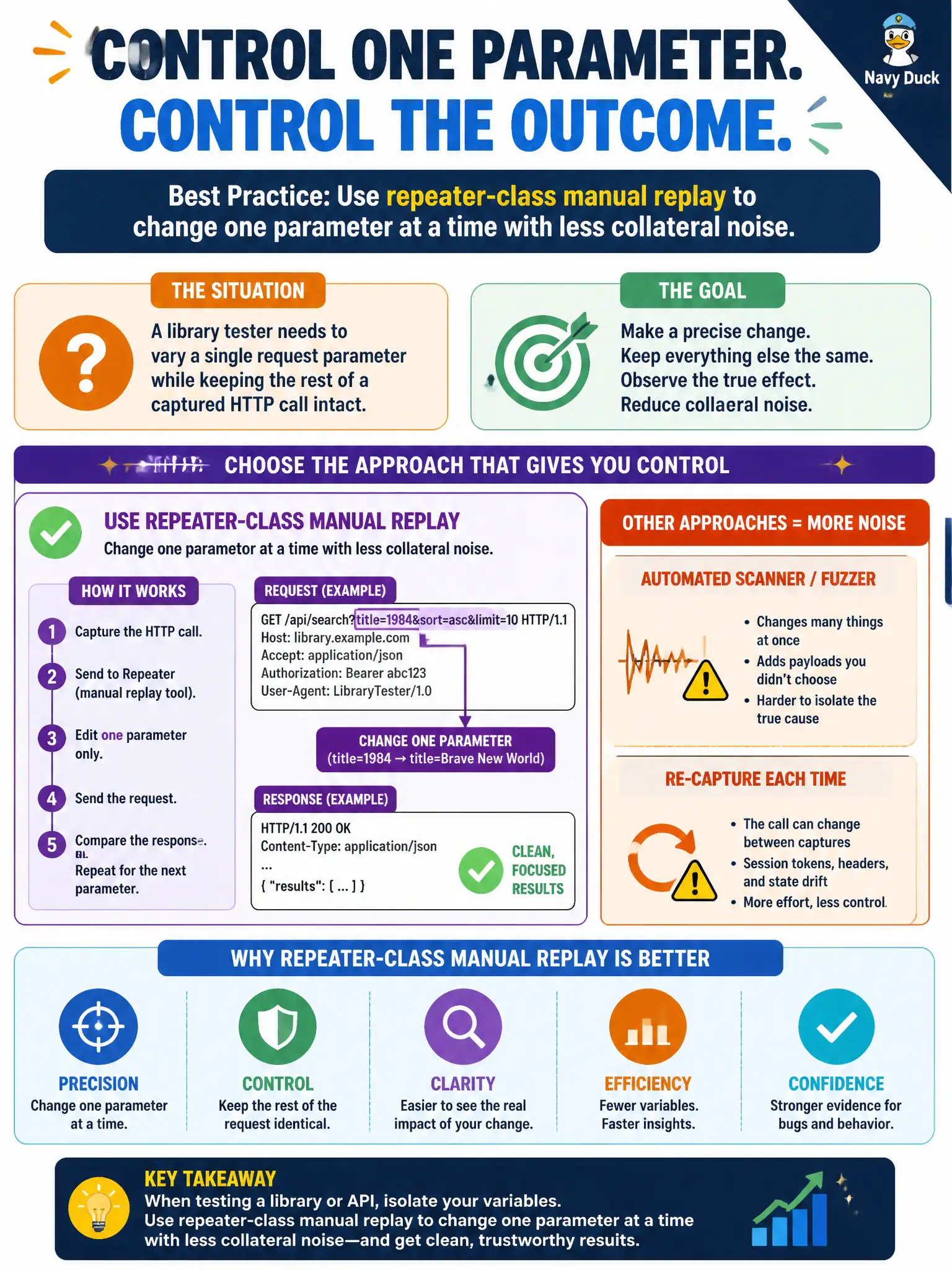
A library tester needs to vary a single request parameter while keeping the rest of a captured HTTP call intact. Which approach best matches controlled testing judgment?
Select an answer to reveal the explanation.
Short Explanation
Repeater-style replay is the scalpel: change one dial, watch what happens, keep the rest of the request steady. It beats spraying the whole internet or slamming the app pool just to feel productive. Precision beats noisy floods when you are proving a single behavior.
Full Explanation
Repeater-class manual replay lets a library tester vary a single request parameter while keeping the rest of a captured HTTP call intact, producing controlled evidence with less collateral noise than unbounded automation. That judgment matches professional web testing: isolate the variable, observe the response, and avoid unnecessary impact on patron-facing systems.
Unbounded internet-wide crawling of every DNS hostname violates scope. Pasting production session cookies to a public paste site leaks credentials. Flooding until the app pool recycles is availability abuse, not careful parameter testing.
Exam caveat: prefer manual or tightly scoped mutation when validating a hypothesis; reserve noisy tools for approved windows with throttles. CPTS web questions often test control and precision over maximum firepower.
Operational check: capture one authenticated civic request, replay with one-parameter changes, log response codes/bodies needed for evidence, and escalate to broader tooling only under RoE rate limits. Prefer evidence packs built from a handful of precise repeater proofs over megabytes of noisy scans when briefing library stakeholders. One clean before/after pair often persuades library sponsors better than exhaustive scanner noise.