
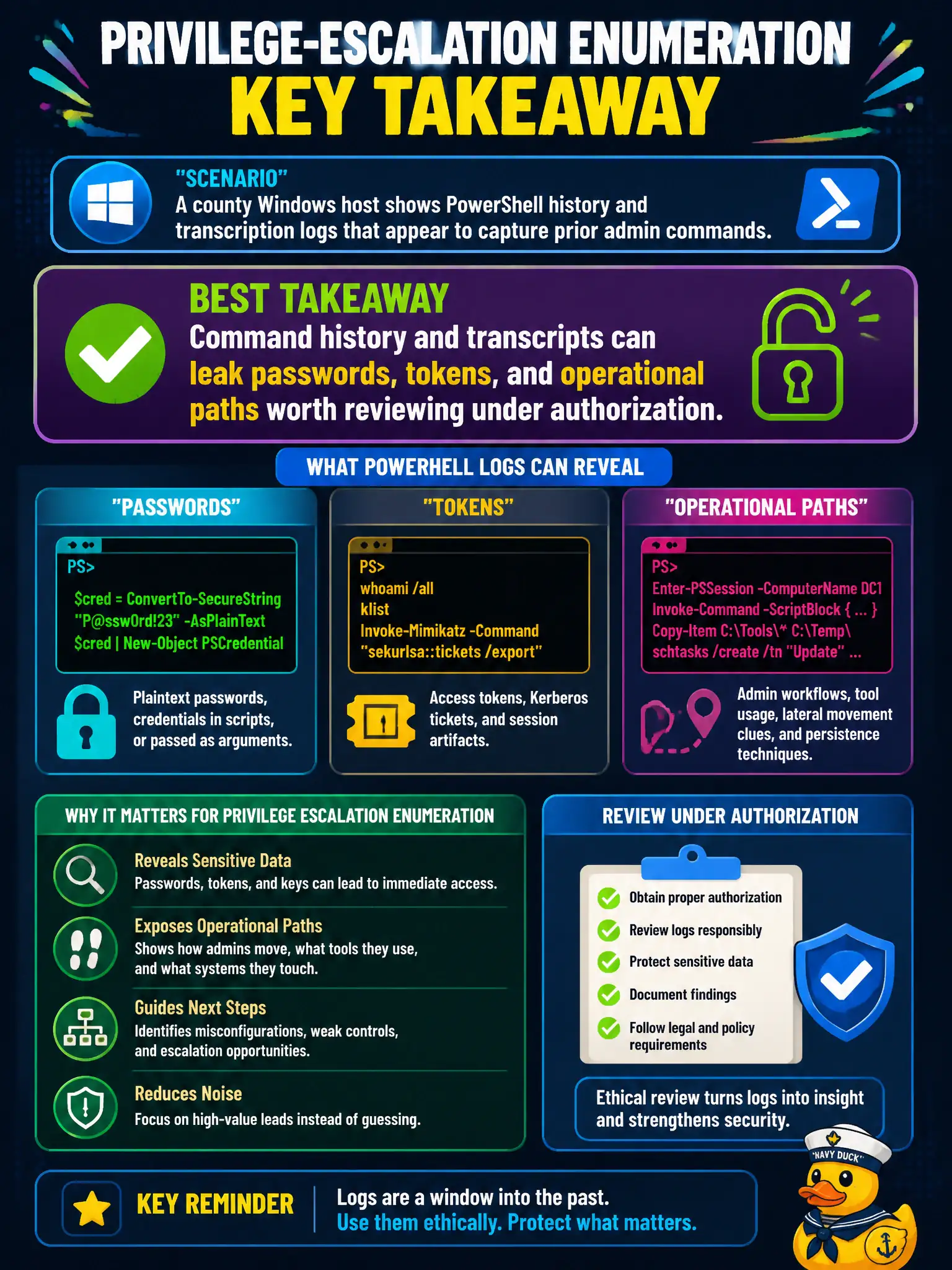
A county Windows host shows PowerShell history and transcription logs that appear to capture prior admin commands. What is the best privilege-escalation enumeration takeaway?
Select an answer to reveal the explanation.
Short Explanation
Admins sometimes type secrets the same way people leave sticky notes on monitors. History and transcripts are those sticky notes in digital form—great for understanding what ran and sometimes what was typed.
Full Explanation
PowerShell history and transcription logs on a county Windows host that capture prior admin commands are high-value privilege-escalation enumeration sources: they can leak passwords, tokens, URLs, and operational paths under authorized local review.
History files are not decoys to ignore. Credentials appear outside Event Viewer System logs—including transcripts. History is relevant before Domain Admin exists; it often helps obtain higher privileges.
Exam caveat: respect privacy and RoE when handling admin command logs; store secrets securely and rotate exposed material.
Operational check: review ConsoleHost_history and transcription locations permitted by scope, extract credential-class evidence carefully, and recommend secure logging practices that still support operations without leaving reusable secrets on disk. In municipal operations, record the rationale in the engagement notes so future assessors know which control was chosen and which failure modes the rejected options would create for city services. Re-validate after the next maintenance window that the same finding class still applies under the estate's current patch and configuration baseline. In municipal operations, record the rationale in the engagement notes so future assessors know which control was chosen and which failure modes the rejected options would create for city services.