
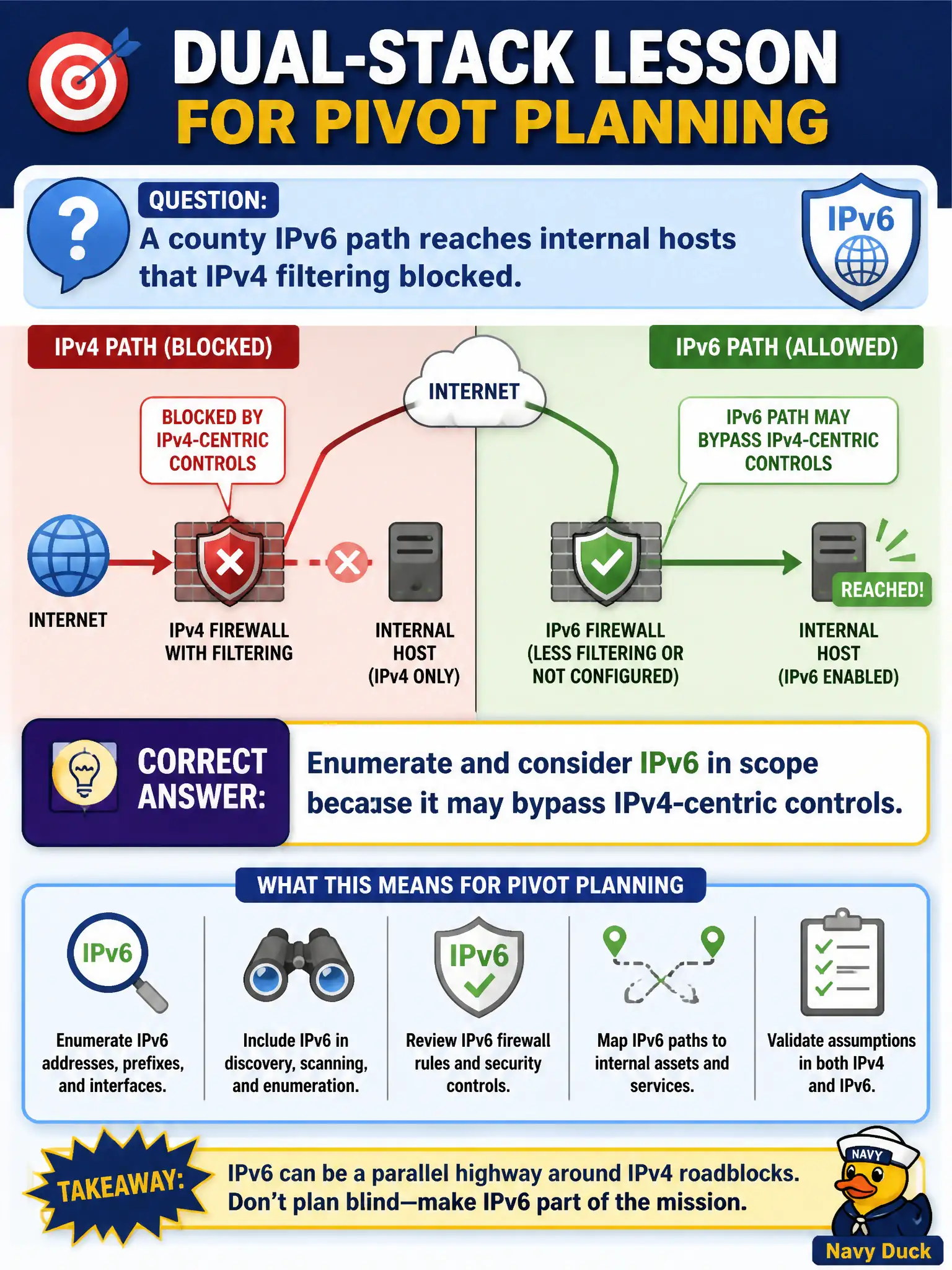
A county IPv6 path reaches internal hosts that IPv4 filtering blocked. What dual-stack lesson belongs in pivot planning?
Select an answer to reveal the explanation.
Short Explanation
IPv4 filters can look like a brick wall while IPv6 is a side gate nobody remembered to lock. Dual-stack environments deserve a glance down both paths when they are in scope. Ignoring IPv6 is how quiet routes stay quiet—for the wrong team.
Full Explanation
If a county IPv6 path reaches internal hosts that IPv4 filtering blocked, pivot planning must enumerate and consider IPv6 in scope because it may bypass IPv4-centric controls. Ignoring IPv6 whenever IPv4 ACLs look strict is a classic dual-stack blind spot. Claiming only IPv4 routes matter for lateral movement documentation under-reports how civic networks are actually reached. Disabling IPv6 globally without approval is an unauthorized change that can break services. Exam caveat: dual-stack awareness is part of professional internal testing. Operational check: include IPv6 discovery in the county enumeration plan, verify discovered IPv6 ranges against RoE, test through approved methods, and recommend aligned filtering for both families. In municipal operations, record the rationale in the engagement notes so future testers and city defenders understand which approach was chosen and which failure modes the rejected options would create for civic services. Re-validate the same judgment after the next change window so the control still holds under the city’s current tooling, identity posture, and RoE amendments. Keep secret material and session artifacts in the approved vaulted workflow rather than chat paste or unprotected tickets used by mixed municipal teams.