
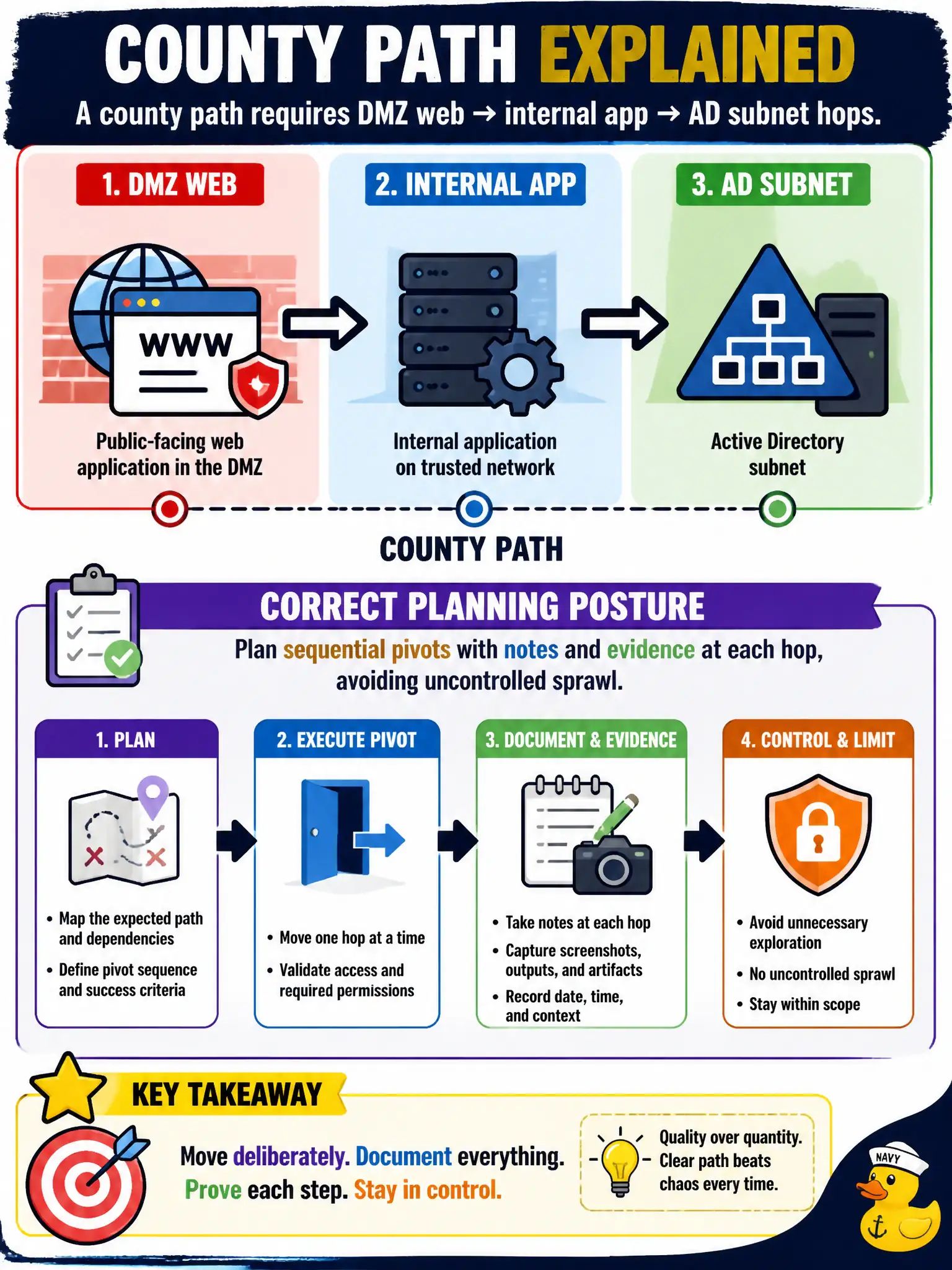
A county path requires DMZ web → internal app → AD subnet hops. What planning posture should the tester take?
Select an answer to reveal the explanation.
Short Explanation
Multi-hop pivoting is a staged road trip, not a demolition derby. You plan each leg, jot what you did, and keep proof—otherwise you get lost and cannot explain the route later. Controlled sequencing beats uncontrolled sprawl every time.
Full Explanation
For a county path that requires DMZ web → internal app → AD subnet hops, the tester should plan sequential pivots with notes and evidence at each hop, avoiding uncontrolled sprawl. Jumping all three tiers in one undocumented burst sacrifices accountability and makes RoE mistakes likely. Skipping evidence until the final AD host is owned leaves the city without a reconstructable path narrative. Treating every discovered host worldwide as automatically chained in scope ignores CIDR and partner boundaries. Exam caveat: multi-hop success is measured by controlled progression and evidence, not speed alone. Operational check: checklist each hop’s authorization, capture proof of reachability and relevant findings before advancing, and pause if the next tier is unclear in the county RoE. In municipal operations, record the rationale in the engagement notes so future testers and city defenders understand which approach was chosen and which failure modes the rejected options would create for civic services. Re-validate the same judgment after the next change window so the control still holds under the city’s current tooling, identity posture, and RoE amendments. Keep secret material and session artifacts in the approved vaulted workflow rather than chat paste or unprotected tickets used by mixed municipal teams.