
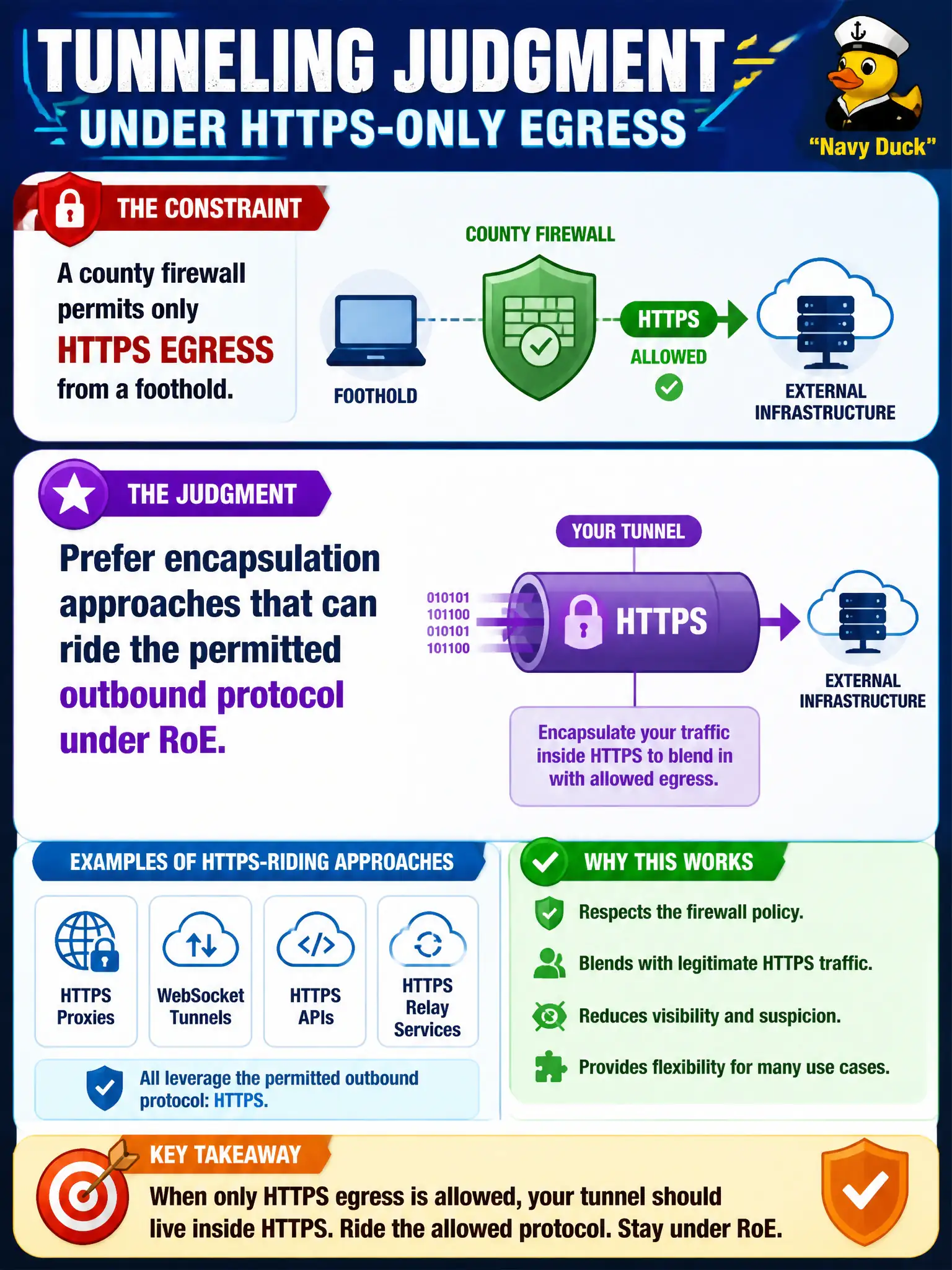
A county firewall permits only HTTPS egress from a foothold. Which tunneling judgment fits that constraint without writing a configuration recipe?
Select an answer to reveal the explanation.
Short Explanation
If the only open door out of the building is the HTTPS door, you do not kick down the loading dock—you plan a path that fits the door that exists. Matching your tunnel idea to allowed egress is just reading the room. RoE still decides whether that path is fair game.
Full Explanation
If a county firewall permits only HTTPS egress from a foothold, the fitting tunneling judgment is to prefer encapsulation approaches that can ride the permitted outbound protocol under RoE—without writing a full configuration recipe. Ignoring egress policy and opening arbitrary outbound ports fights the control plane the county deployed and may trip blocks or incident response. Assuming ICMP tunnels are always allowed wherever HTTPS is allowed invents protocol privileges the firewall never granted. Demanding the SOC disable egress filtering for the entire engagement is a convenience ask that weakens municipal defense during the test. Exam caveat: work within egress allow-lists; do not treat lab-favorite covert channels as automatically authorized. Operational check: verify allowed egress with non-destructive checks, select an RoE-approved encapsulation that matches HTTPS-capable paths if permitted, and record the channel so defenders can distinguish test traffic from real threats. In municipal operations, record the rationale in the engagement notes so future testers and city defenders understand which approach was chosen and which failure modes the rejected options would create for civic services.