
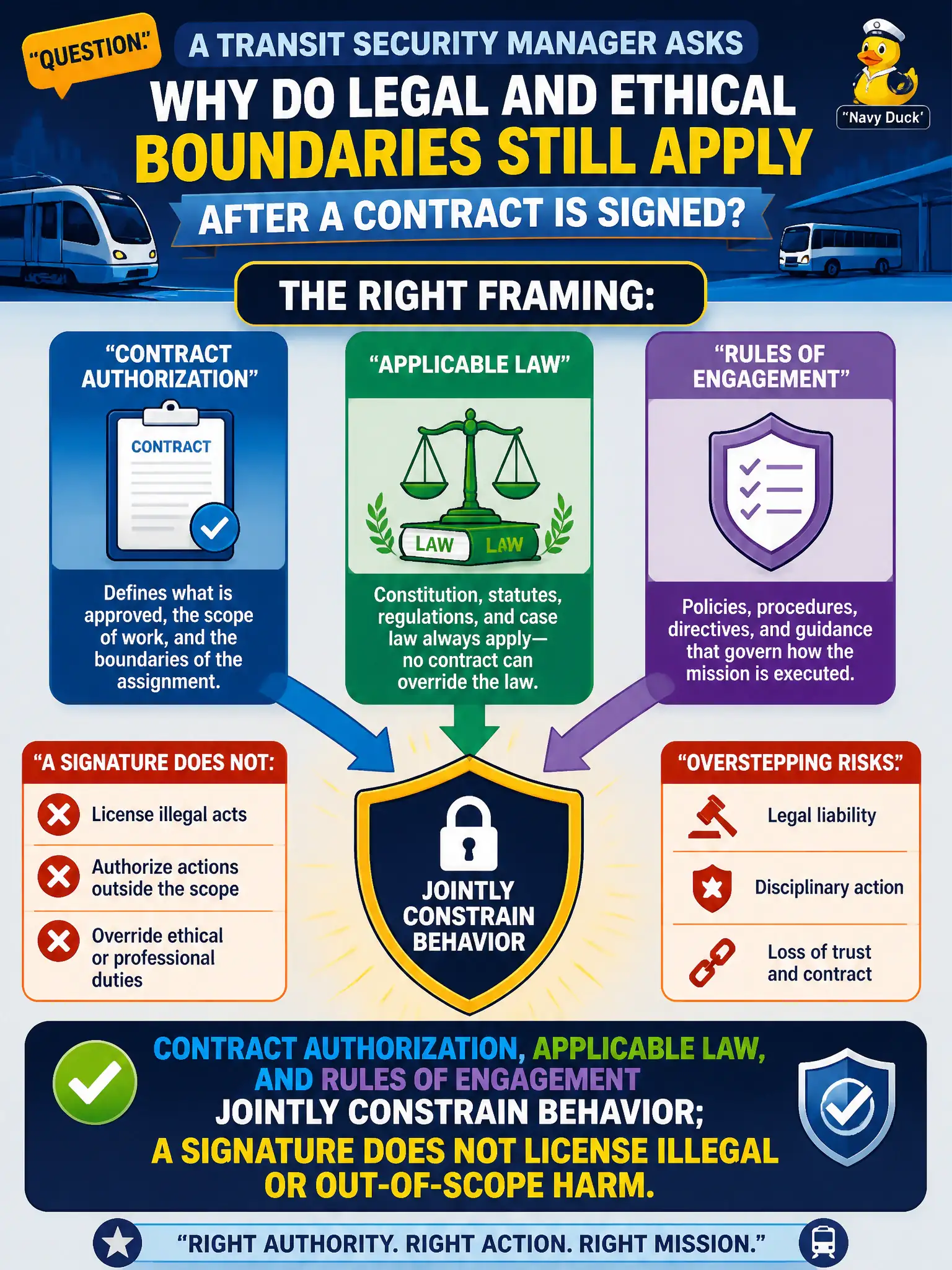
A transit security manager asks why legal and ethical boundaries still apply after a contract is signed. What is the right framing?
Select an answer to reveal the explanation.
Short Explanation
A contract is a green light inside a marked lane — not a blank check to floor it through town. Law and RoE still bind what you do. Authorization never meant 'anything goes.'
Full Explanation
Legal and ethical boundaries still apply after a transit security manager's contract is signed because contract authorization, applicable law, and rules of engagement jointly constrain behavior. A signature does not license illegal or out-of-scope harm. Contracts do not override criminal law for convenient techniques. Ethics do not expire at kickoff when scanning begins. RoE remains mandatory even after a purchase order number exists. Exam caveat: if a technique is legal in the abstract but forbidden by RoE—such as intentional DoS—the RoE still wins for that engagement. Operational check: when considering a new technique mid-test, cross-check law, LoE scope, and RoE prohibitions; if any gate fails, document the idea as residual risk or seek a written change, and do not proceed against transit systems. Document the rationale in the municipal engagement notes so later civic responders know which boundary was honored and which failure modes the rejected options would create for public services. Document the rationale in the municipal engagement notes so later civic responders know which boundary was honored and which failure modes the rejected options would create for public services.