
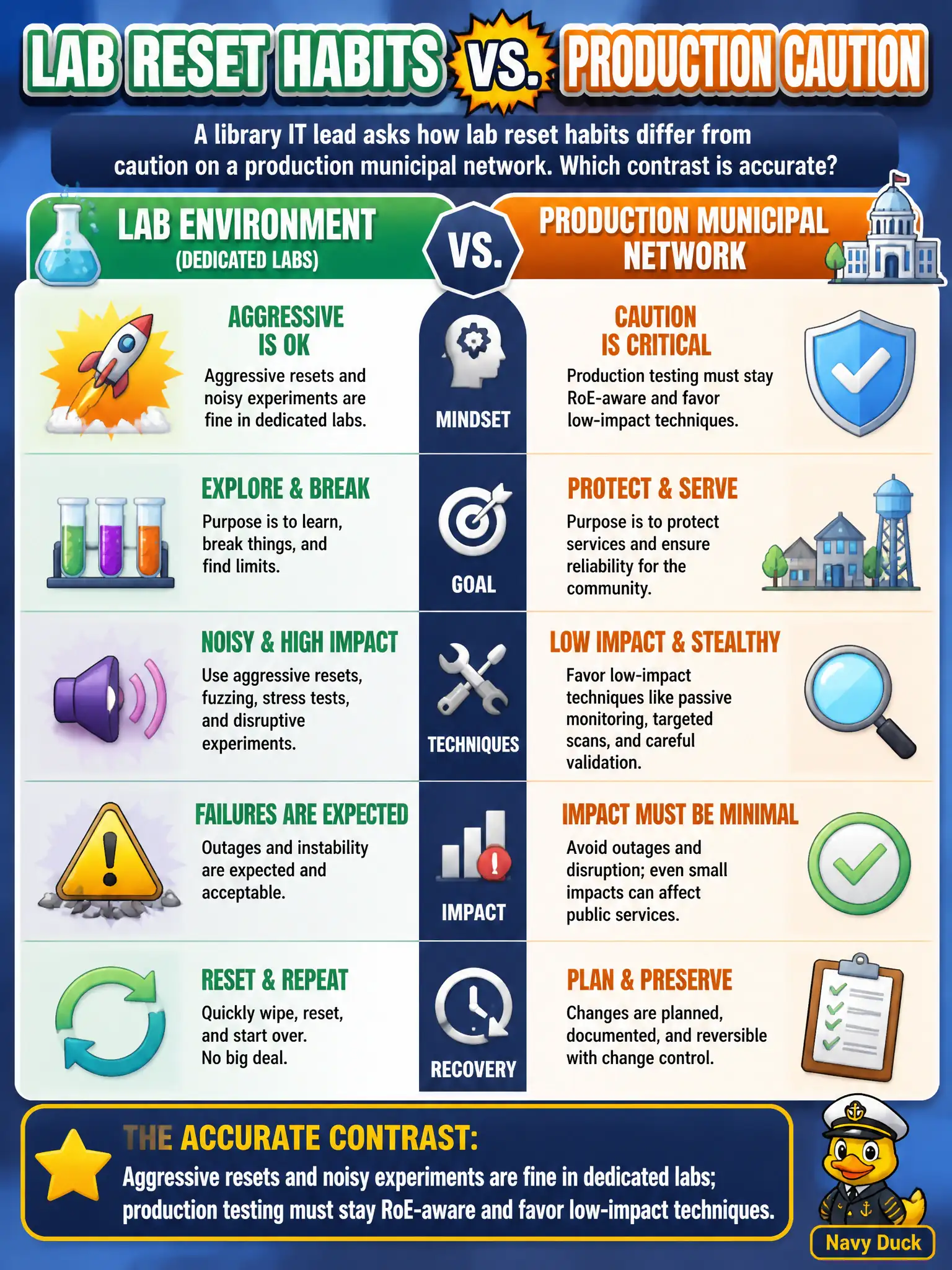
A library IT lead asks how lab reset habits differ from caution on a production municipal network. Which contrast is accurate?
Select an answer to reveal the explanation.
Short Explanation
Labs are crash-test dummies; city networks are the real car with passengers. Break and reset freely in the lab. On production, keep it controlled, low-impact, and inside the RoE.
Full Explanation
Lab reset habits differ sharply from caution on a production municipal network. Aggressive resets, noisy experiments, and destructive trials belong in dedicated labs where wipe-and-restore is expected. Production testing must stay RoE-aware and favor low-impact techniques that protect citizen-facing services. Treating production like disposable lab VMs—including casual wipes—can interrupt courts, clinics, or transit operations. Lab hygiene does not forbid destructive testing on isolated training hosts; that is often the point of a lab. RoE constraints apply on production engagements, not only in labs. Exam caveat: even in labs, document risky techniques so bad habits do not transfer unchanged into civic work. Operational check: before any potentially disruptive test on city systems, confirm RoE allowances, choose the least impactful validation method, and ensure rollback or stop-call procedures are ready with the municipal contact. Document the rationale in the municipal engagement notes so later civic responders know which boundary was honored and which failure modes the rejected options would create for public services. Document the rationale in the municipal engagement notes so later civic responders know which boundary was honored and which failure modes the rejected options would create for public services.