
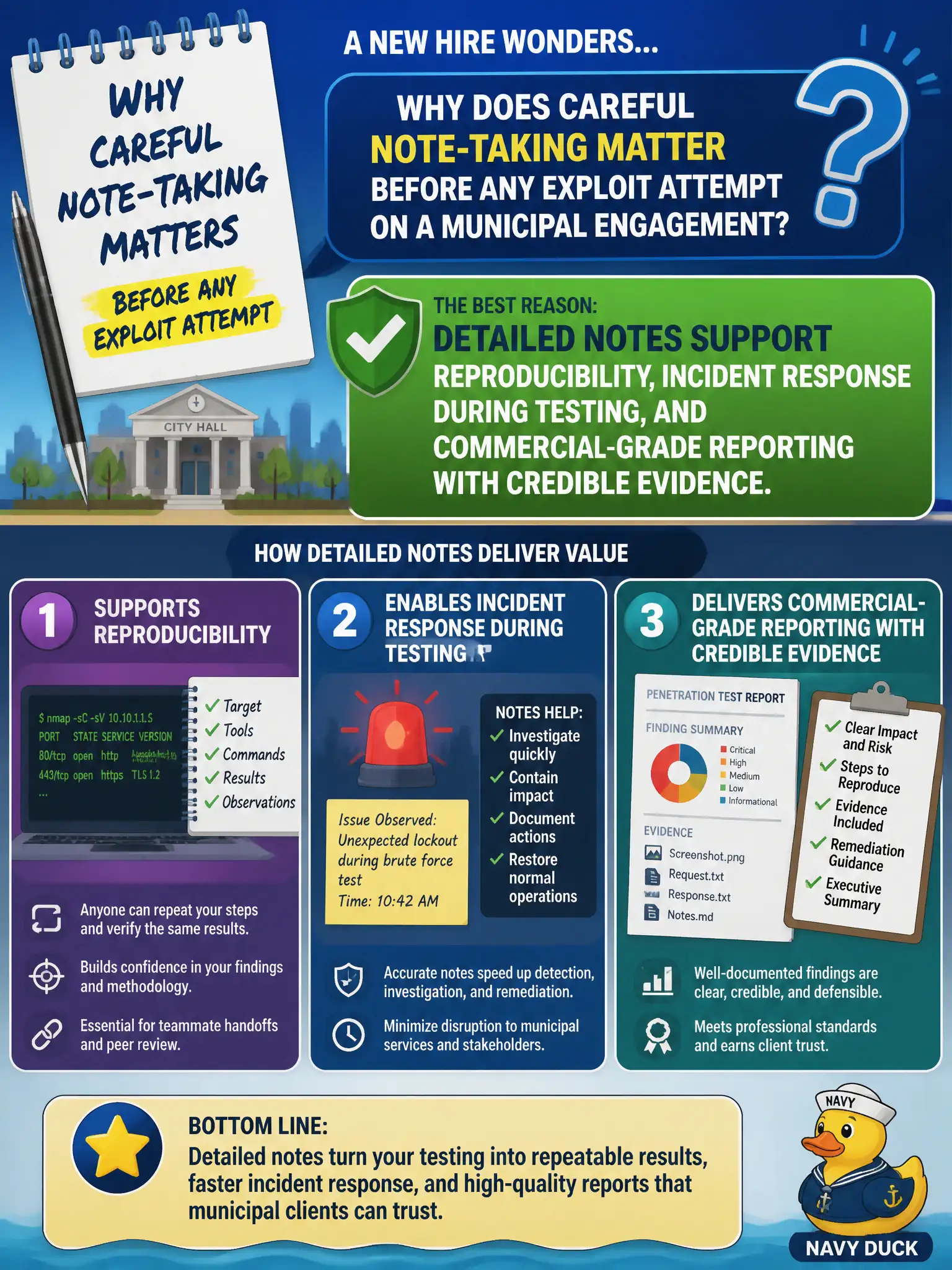
A new hire wonders why careful note-taking matters before any exploit attempt on a municipal engagement. What is the best reason?
Select an answer to reveal the explanation.
Short Explanation
Notes are the flight recorder for the engagement. When something breaks — or when the report is due — you need the who, what, when, and how without guessing. Screenshots alone rarely tell the whole story.
Full Explanation
Careful note-taking before exploit attempts on a municipal engagement supports reproducibility, incident response during testing, and commercial-grade reporting with credible evidence. Timestamps, commands, affected hosts, and observed responses let another tester or the city's SOC reconstruct what happened if an alert fires mid-test. Treating notes as optional decoration once screenshots exist understates how narrative context and exact sequences prove impact. Claiming notes slow time-boxed work ignores that incomplete evidence wastes more time in retesting and disputes. Notes never replace signed authorization or rules of engagement. Exam caveat: sensitive civic data captured in notes still follows data-handling rules in the RoE—minimize retention of resident PII. Operational check: maintain a running log with host, action, result, and evidence pointer before each exploit attempt; sync critical entries to the shared findings tracker the municipality can review at daily check-ins. Document the rationale in the municipal engagement notes so later civic responders know which boundary was honored and which failure modes the rejected options would create for public services. Document the rationale in the municipal engagement notes so later civic responders know which boundary was honored and which failure modes the rejected options would create for public services.