
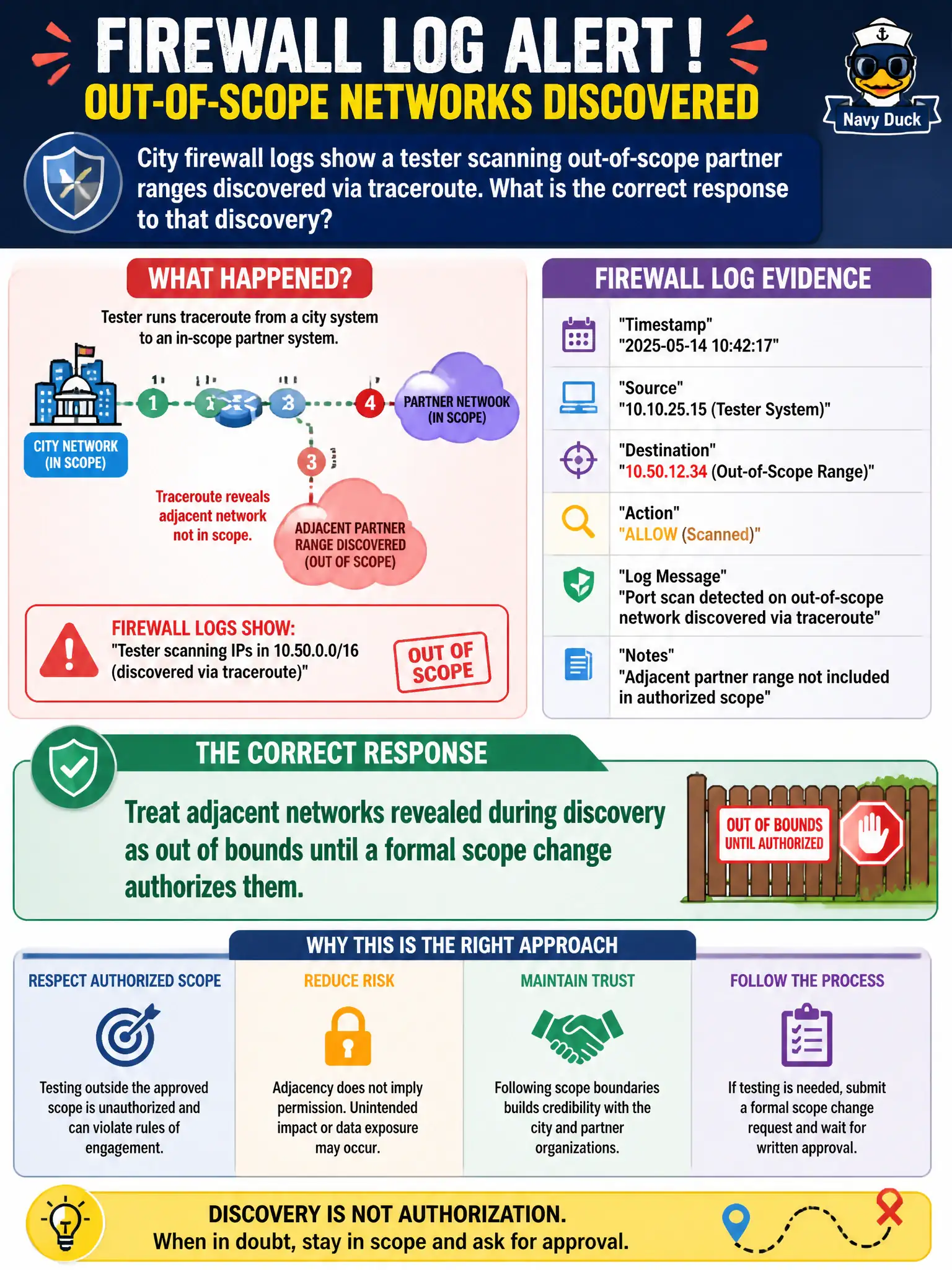
City firewall logs show a tester scanning out-of-scope partner ranges discovered via traceroute. What is the correct response to that discovery?
Select an answer to reveal the explanation.
Short Explanation
Seeing a new street on the map is not the same as getting keys to those houses. Traceroute may reveal neighbors, but neighbors stay off-limits until the client signs a scope change. Curiosity is not authorization.
Full Explanation
If city firewall logs show scanning of out-of-scope partner ranges discovered via traceroute, the correct response is to treat those adjacent networks as out of bounds until a formal scope change authorizes them. Traceroute reachability is not implied permission. Deleting traceroute evidence to hide the discovery from the client is unethical. Converting partner ranges into phishing targets without updating the letter of engagement compounds the authorization failure. Exam caveat: note the discovery as residual attack-surface intelligence for the city without continuing intrusive testing. Operational check: stop probes immediately, notify the municipal contact, record the partner ranges as observed-but-untested, and resume only against authorized city ranges unless a signed change order expands scope. Document the rationale in the municipal engagement notes so later civic responders know which boundary was honored and which failure modes the rejected options would create for public services. Document the rationale in the municipal engagement notes so later civic responders know which boundary was honored and which failure modes the rejected options would create for public services. Document the rationale in the municipal engagement notes so later civic responders know which boundary was honored and which failure modes the rejected options would create for public services.