
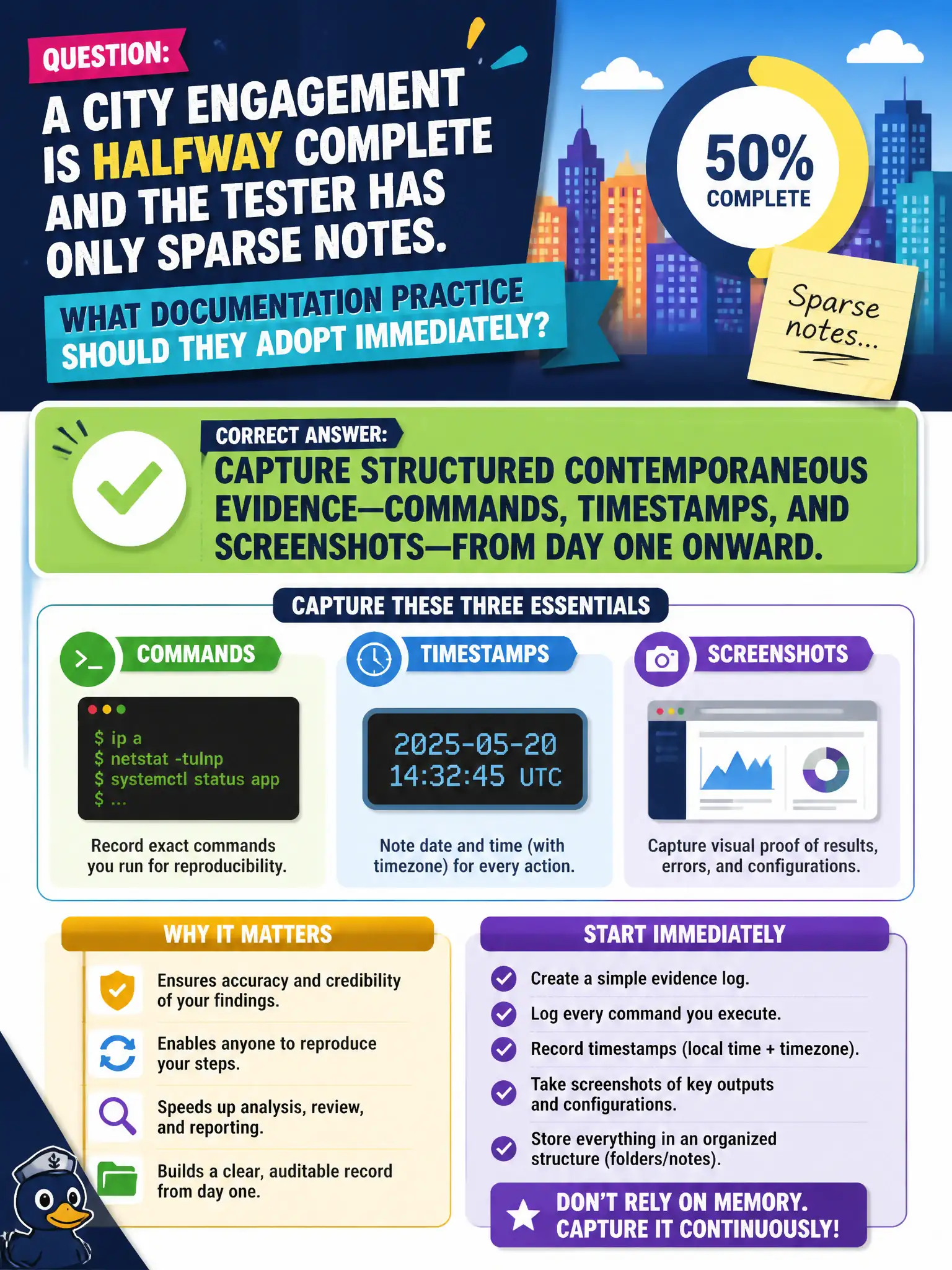
A city engagement is halfway complete and the tester has only sparse notes. What documentation practice should they adopt immediately?
Select an answer to reveal the explanation.
Short Explanation
Trying to rebuild a week of testing from memory is like rewriting a recipe after dinner without notes—you will miss steps. Good commercial work keeps timestamps, commands, and screenshots as you go.
Full Explanation
Halfway through a city engagement with only sparse notes, the tester must immediately adopt structured contemporaneous evidence practices: commands, timestamps, screenshots, and outcome notes from day one onward. Civic reports fail when reconstruction relies on memory at the deadline.
Waiting until the final day to rebuild everything from memory produces errors and missing proof. Deleting screenshots to shrink the report harms defensibility. Storing credentials only in personal chat apps creates leakage and retention failures.
Exam caveat: evidence hygiene includes secure storage, minimization of secrets in tickets, and clear mapping from notes to finding IDs.
Operational check: stand up a dated evidence folder structure now, backfill today's work while fresh, and enforce a daily checklist for municipal findings before continuing new testing. In municipal operations, record the rationale in the engagement notes so future assessors know which control was chosen and which failure modes the rejected options would create for city services. Re-validate after the next maintenance window that the same finding class still applies under the estate's current patch and configuration baseline.