
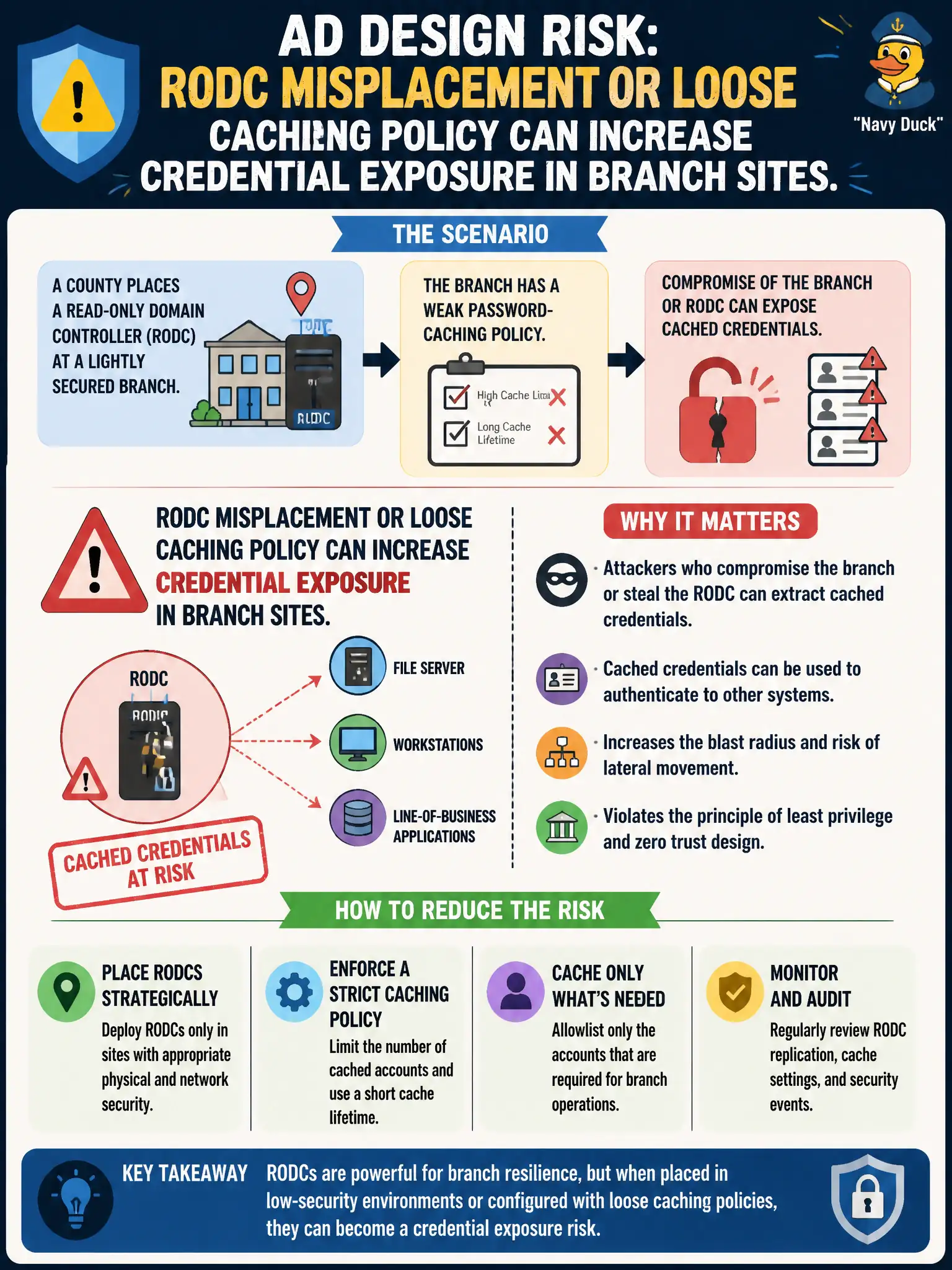
A county places a read-only domain controller at a lightly secured branch with a weak password-caching policy. What AD design risk is most relevant?
Select an answer to reveal the explanation.
Short Explanation
An RODC is a locked display case — useful, but only if you do not stash the master keys inside a glass storefront. Bad placement or over-caching puts secrets where physical and network controls are weaker. Design the branch case carefully.
Full Explanation
Read-only domain controllers reduce some writable-DC risks at branches, but placement and password-caching policy still matter. A county RODC in a lightly secured branch with weak caching can increase credential exposure: cached secrets may be obtainable if the RODC is stolen or locally compromised, undermining the branch security model meant to protect municipal users at remote sites.
RODCs do not eliminate all credential risk by definition—caching and physical/administrative controls remain decisive. RODCs should not cache every privileged secret to “make offline work”; privileged caching should be tightly controlled. Branch RODCs do not automatically become writable schema masters; that claim misunderstands RODC and FSMO roles.
Exam caveat: RODC security depends on site placement, delegated admins, and PRP/caching policy—not the “read-only” label alone. CPTS AD design questions reward reviewing who and what is allowed to cache.
Operational check: review the branch RODC’s password replication policy, confirm privileged accounts are denied caching, assess physical and local admin controls at the site, and document residual exposure for the county AD architecture review. For county residents relying on branch authentication, documenting PRP exceptions and physical RODC protections is as important as the RODC deployment itself.