
A water utility still allows legacy LM or NTLMv1 preference in parts of the environment. What risk awareness should the tester communicate?
Select an answer to reveal the explanation.
Short Explanation
Old auth dialects are like cheap locks that skilled thieves already know how to pick. If LM or NTLMv1 is still in the mix, credential theft themes get easier. Push for modern authentication settings.
Full Explanation
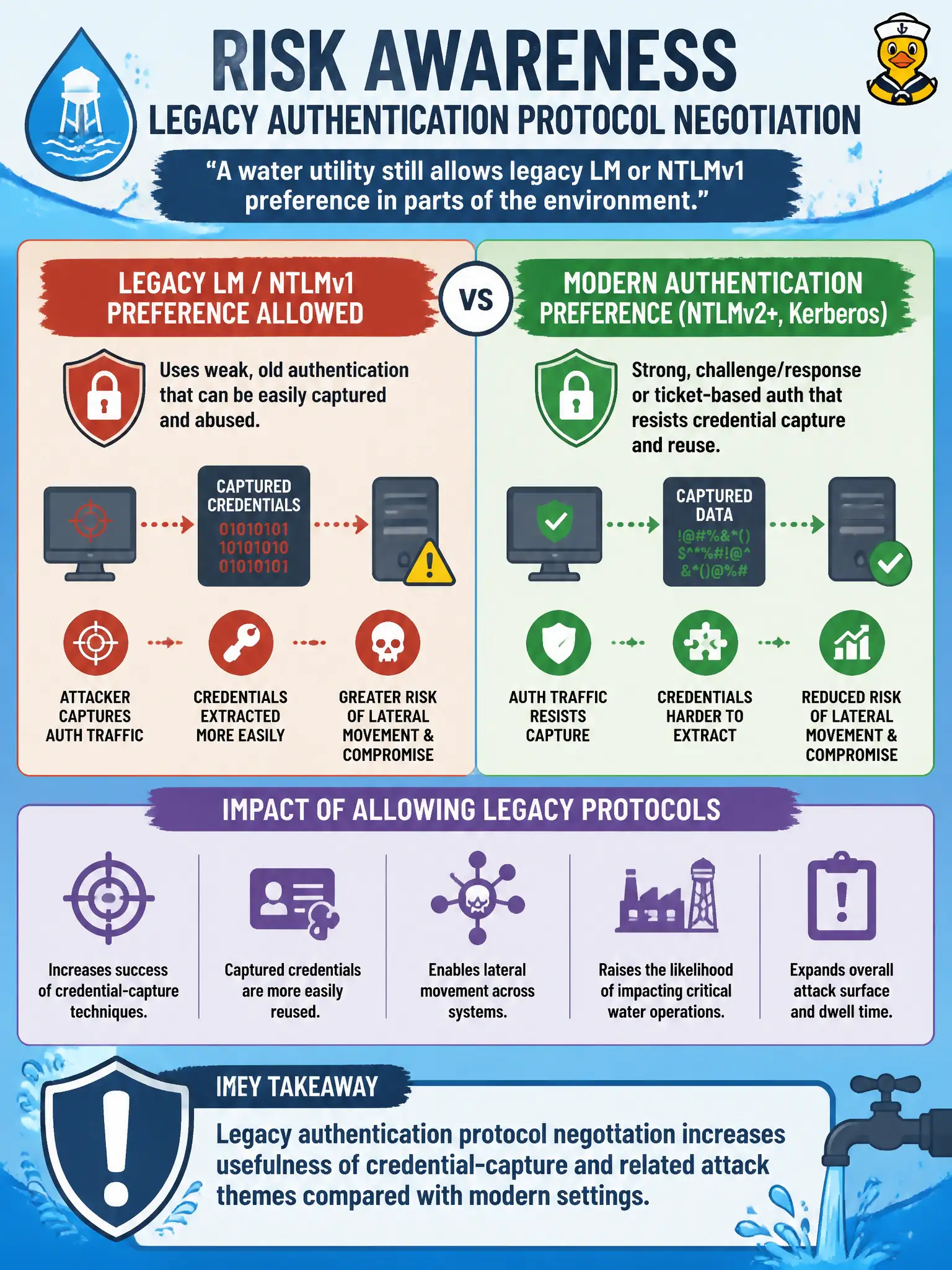
If a water utility still allows legacy LM or NTLMv1 preference in parts of the environment, the tester should communicate that legacy authentication protocol negotiation increases usefulness of credential-capture and related attack themes compared with modern settings. These preferences are not wallpaper deployment trivia. They do not prove Kerberos cannot be used anywhere in the forest. Allowing NTLMv1 also does not automatically enable mandatory SMB signing domain-wide. Exam caveat: protocol negotiation hardening is a preventive control theme worth reporting even without a live relay demonstration. Operational check: gather effective NTLM/LM compatibility settings under authorization, recommend modern levels that disable LM/NTLMv1, pair with signing and channel binding where applicable, and pilot changes on non-critical utility OU segments first. In municipal operations, record the rationale in the engagement notes so future testers and city defenders understand which approach was chosen and which failure modes the rejected options would create for civic services. Re-validate the same judgment after the next change window so the control still holds under the city’s current tooling, identity posture, and RoE amendments.